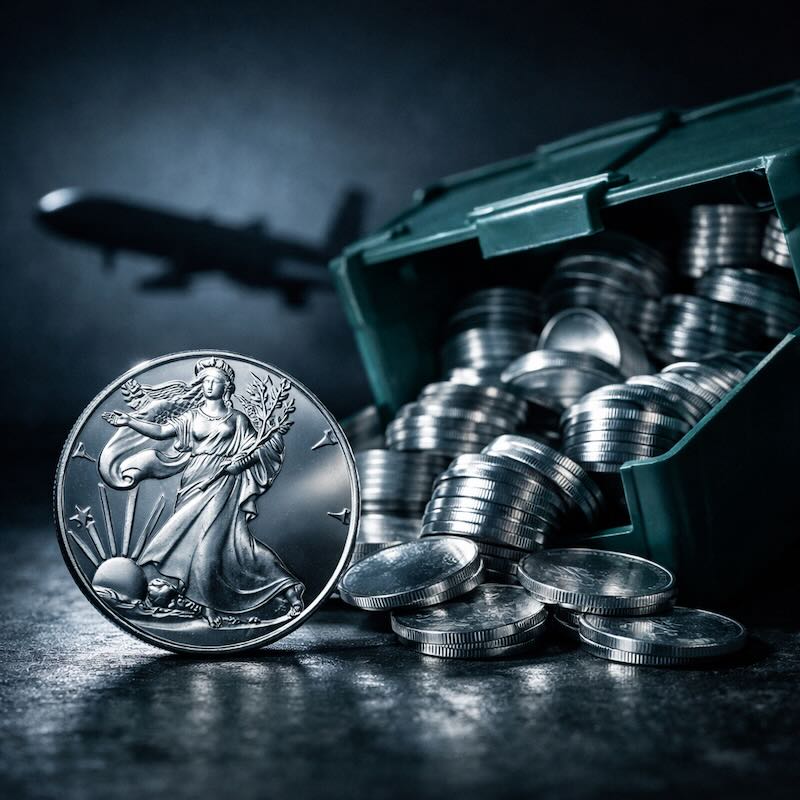
Usually after a major military event involving U.S. cruise missiles, a familiar claim resurfaces in precious metals forums, newsletters, and social media threads: each Tomahawk missile contains 500 ounces of silver.
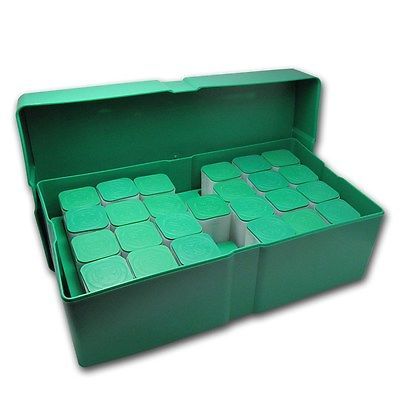
For anyone who stacks American Silver Eagles, that number should trigger immediate recognition. Five hundred troy ounces is exactly how much silver fits in a single monster box — 500 coins, each containing one troy ounce of .999 fine silver, stacked into 25 green tubes of 20.
If the myth were true, every Tomahawk launch would consume the equivalent of a full ASE monster box. That’s a vivid image and a compelling bullish argument for silver prices. Fire a volley of 200 missiles, and the military has just burned through 200 monster boxes, or 100,000 troy ounces.
There’s just one problem: the 500-ounce figure is almost certainly wrong — by a factor of roughly 25 to 33 times.
Credible analyst estimates place the actual silver content of a Tomahawk at 15 to 20 troy ounces per missile. That’s not a monster box. It’s not even a full tube of Silver Eagles — it’s less than one.
For silver investors trying to understand what military demand actually means for their holdings, the distinction matters. This article examines where the monster-box-sized myth came from, what credible estimates actually say, and what the real silver content of a cruise missile means for the silver market.
Where Did the “500 Ounces” Claim Come From?
The 500-ounce figure appears to trace back to online precious metals forums as early as 2012, circulating without a verifiable original source. The claim picked up steam in investment communities that have a vested interest in bullish silver narratives — and once a compelling round number enters those circles, it tends to repeat and compound without scrutiny.
The figure gained renewed attention during periods of active U.S. military engagement in the Middle East and elsewhere, where large cruise missile deployments gave the claim fresh relevance. Some notable names in the silver community have referenced versions of it in videos and newsletters, amplifying its reach further.
The core problem is that the actual materials specifications for the BGM-109 Tomahawk are classified. No public document from Raytheon, the U.S. Navy, or the Department of Defense confirms any specific silver content. What circulates online is not sourced data — it’s an unverified number that repeated long enough to become accepted wisdom.
The 500-Ounce Monster Box Coincidence
Why did “500 ounces” stick? Partly because 500 is a round number that sounds authoritative. But for silver stackers, there’s an additional layer of psychological plausibility: 500 troy ounces is the exact fill weight of an American Silver Eagle monster box — the standard unit in which serious stackers think about substantial silver holdings.
The myth number didn’t arrive at 500 accidentally. And its coincidence with a familiar stacking benchmark made it feel more real to the community that repeated it most.
A Monster Box of American Silver Eagles Per Missile?
If the 500-oz Tomahawk claim were accurate, every missile launched would consume the silver equivalent of one monster box. The physical plausibility question: the entire Tomahawk weighs 2,900 to 4,000 pounds depending on the launch and payload configuration. A monster box of Silver Eagles contains 500 coins weighing 1 oz each, totaling roughly 34 pounds of coins. The claim would have up to 1.2% of the missile’s weight composed entirely of silver.
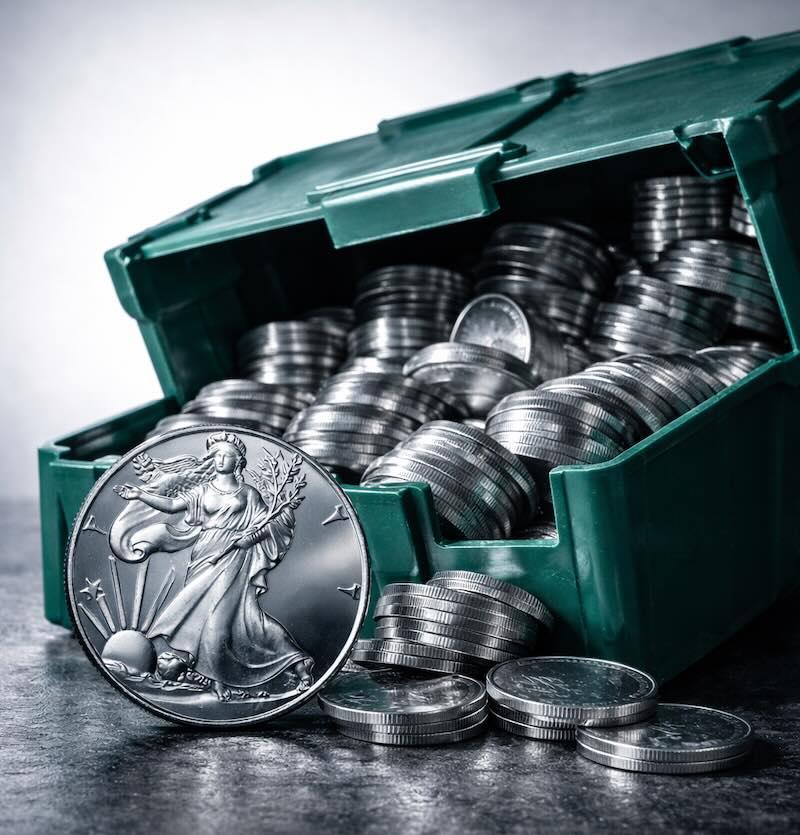
ASEs come packaged in a standard hierarchy that any silver stacker recognizes:
- 1 coin = 1 troy oz of silver
- 1 tube = 20 coins = 20 troy oz
- 1 monster box = 25 tubes = 500 coins = 500 troy oz
At current silver spot prices around $83.58/oz, a full monster box represents approximately $41789 in silver content.
| Physical Implausibility Check A 500-oz silver monster box (500 ASEs) weighs approximately 34 lbs. Five 100-oz silver bars would weigh the same. A BGM-109 Tomahawk missile weighs 2,900 lbs total. The 500-oz claim would mean 1.2% of the missile’s total weight is silver alone — comparable to a full monster box crammed into a precision guidance system that must maintain aerodynamic balance and hit targets with GPS-level accuracy. For anyone who has held a monster box, the physical implausibility of this is immediately apparent. |
How much silver is in a Tomahawk Missile really?
While official specifications remain classified, analysts who have examined the question using publicly available data on silver’s industrial applications in aerospace and defense electronics have arrived at significantly lower figures.
Research from Binance and analysis from Longbridge both place the likely silver content of a Tomahawk in the range of 15 to 20 troy ounces per missile.
These estimates are grounded in how silver is actually used in advanced weapons systems:
- Electrical contacts and switches — Silver is the preferred material for high-reliability contacts due to its conductivity and resistance to arc erosion
- Wiring and connectors — Silver-plated copper wiring is common in aerospace applications where weight and conductivity are both critical
- Solder and brazing alloys — Silver-based solders are used throughout circuit boards and structural joints in electronics
- Radar and guidance electronics — Silver is used in RF components, capacitors, and multilayer ceramic components within the missile’s guidance system
None of these applications require anywhere near 500 ounces. A modern cruise missile is a sophisticated electronic system, but its silver content is comparable to other complex aerospace electronics packages.
Putting It in Silver Coin and Bar Terms
To make these numbers tangible, here’s how each estimate maps to the physical silver products silver investors already own or are familiar with:
| Claim | Silver Content | ASE Monster Boxes (500 oz) | Tubes of Silver Eagles (20 oz) | 10 oz Silver Bars | 100 oz Silver Bars |
| The myth | 500 troy oz | 1 full monster box | 25 tubes | 50 bars | 5 bars |
| Credible estimates | 15–20 troy oz | 0.03–0.04 monster boxes | < 1 tube | 1.5–2 bars | 0.15–0.20 bars |
| Low-end community estimates | 10–15 troy oz | ~0.02–0.03 monster boxes | < 1 tube | 1–1.5 bars | 0.10–0.15 bars |
In plain terms: if credible estimates are right, the silver in a single Tomahawk missile is roughly equivalent to less than one green tube of Silver Eagles — somewhere between 15 and 20 of those familiar 1-oz coins. Not a monster box. Not even close to a monster box.
The 500-ounce version of the story would require each missile to contain a full monster box worth of silver. For anyone who has picked one up at their local coin dealer — a substantial, dense, heavy package — the idea that its equivalent is packed into a precision weapons system strains credibility on its face.
- 1 American Silver Eagle = 1 troy oz | 1 tube of ASEs = 20 troy oz | 1 ASE monster box = 500 troy oz (~34 lbs)
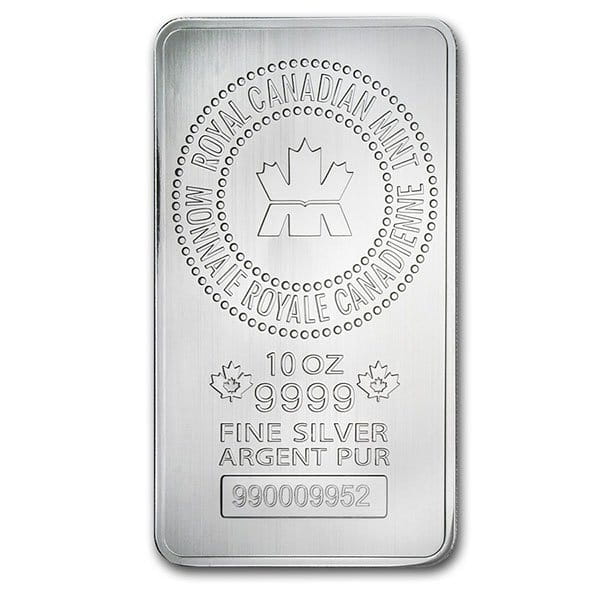
- 1 standard 10 oz silver bar: palm-sized, ~0.69 lbs — the reality in a Tomahawk (15-20 oz) equals about 1.5 to 2 of these
- 1 standard 100 oz silver bar: ~6.86 lbs, roughly 5.5″ × 3.5″ × 1.4″ — five of these would match the 500-oz myth
| Silver Benchmarks at a Glance – 1 American Silver Eagle = 1 troy oz | 1 tube of ASEs = 20 troy oz | 1 ASE monster box = 500 troy oz (~34 lbs) – 1 standard 10 oz silver bar: palm-sized, ~0.69 lbs — the reality in a Tomahawk (15-20 oz) equals about 1.5 to 2 of these – 1 standard 100 oz silver bar: ~6.86 lbs, roughly 5.5″ × 3.5″ × 1.4″ — five of these would match the 500-oz myth Reality check: 15–20 oz is a fraction of one tube of Silver Eagles, and less than two 10-oz bars. |
Why the Distinction Matters for Silver Investors
The reason this myth persists is that it supports a bullish narrative: military conflicts consume silver at scale, tightening supply and pushing prices up. If each Tomahawk contained 500 ounces — one monster box — a deployment of 2,000 missiles would consume 4,000 monster boxes, or 2,000,000 troy ounces. That’s a number large enough to feel like it could move markets.
Here’s what the math actually looks like:
| Supply Impact Comparison: 2,000 Missiles Fired At 500 oz per missile (the myth): 2,000 missiles × 500 oz = 1,000,000 troy oz | = 2,000 monster boxes of Silver Eagles Share of annual global silver supply (~1 billion oz): ~0.1% At 15–20 oz per missile (credible estimates): 2,000 missiles × 17.5 oz (midpoint) = 35,000 troy oz | = 70 monster boxes of Silver Eagles Share of annual global silver supply: ~0.003% Even the mythologized 500-oz figure represents only a tenth of a percent of annual silver supply — a rounding error. The realistic figure essentially doesn’t register. |
Even 2,000 monster boxes of Silver Eagles — the mythologized version — represents a trivial fraction of annual global silver supply. The realistic figure (roughly 70 monster boxes across 2,000 missiles) is essentially invisible against a market that produces billions of ounces per year.
This doesn’t mean military demand has no effect on silver prices. Defense electronics, across all platforms and systems, represent a meaningful and growing slice of industrial silver demand. But the Tomahawk missile specifically — even in large deployments — is unlikely to move the needle on silver prices in any measurable way.
The Broader Lesson: Unverified Data in Precious Metals Communities
The Tomahawk silver myth is a useful case study in how misinformation spreads in investment communities. A few characteristics made it particularly sticky:
It’s specific. “500 ounces” sounds like insider knowledge. Vague claims are less persuasive than precise-sounding ones — and 500 happens to be a number silver stackers immediately associate with a monster box.
It’s bullish. In communities oriented around silver’s investment case, claims that support higher prices receive less scrutiny than claims that undermine them.
The source is classified. Because no one can point to an official document that says “15 ounces,” it’s hard to definitively disprove the claim — which creates space for the myth to survive.
It gets repeated by credible voices. When respected figures in the precious metals community repeat a claim, their credibility partially substitutes for the missing primary source.
None of this means silver doesn’t belong in a portfolio, or that military demand isn’t worth tracking. It means investors benefit from applying the same skepticism to bullish claims that they would to bearish ones — and from being wary when a compelling number happens to correspond exactly to a familiar benchmark.
Frequently Asked Questions
How much silver is in a Tomahawk missile?
Official specifications are classified, but credible analyst estimates place the figure at approximately 15–20 troy ounces per missile — significantly less than the 500-ounce figure commonly circulated in precious metals circles. That’s less than one tube of American Silver Eagles (20 oz per tube), not a full monster box (500 oz).
Does the 500-ounce claim equal one ASE monster box?
Yes — and that’s probably not a coincidence. An American Silver Eagle monster box contains exactly 500 coins at 1 troy oz each, equaling 500 troy oz total. The myth figure maps precisely to one of the most recognizable units in the silver stacking community, which may partly explain why it’s stuck around. The reality is roughly 15–20 oz, less than one tube of Silver Eagles.
Does military use of Tomahawk missiles affect silver prices?
Based on realistic silver content estimates, even large deployments of Tomahawk missiles consume a negligible fraction of global silver supply — roughly 0.003% of annual production per 2,000 missiles fired. This is unlikely to have a meaningful effect on silver spot prices.
Where did the 500-ounce claim come from?
The figure appears to have originated in online forums around 2011, without a verifiable primary source. It has been repeated in investment communities ever since, particularly during periods of active U.S. military engagement.
What is silver used for in cruise missiles?
Silver is used in electrical contacts, silver-plated wiring, brazing alloys, solder, and various RF and electronic components throughout the guidance and control systems of advanced weapons.
How much does 15–20 oz of silver look like?
Fifteen to twenty ounces of silver is roughly equivalent to 15–20 individual American Silver Eagle coins — less than a full tube (tubes hold 20 ASEs). In bar form, it’s approximately 1.5 to 2 standard 10 oz silver bars — the kind you might buy in a single trip to a coin shop.
Bottom Line
The 500-ounce silver figure is almost certainly a myth that has circulated in precious metals communities for over a decade without a credible source.
Analyst estimates grounded in aerospace electronics applications suggest the real figure is closer to 15–20 troy ounces per missile, less than one tube of Silver Eagles, or roughly one and a half standard 10-ounce silver bars.
That distinction matters for investors. A military action that sounds like a silver supply shock turns out to be a non-event for markets when realistic figures are applied. Global silver supply measures in the billions of ounces annually; tens of thousands of ounces consumed in missile electronics is noise.
Silver has a compelling investment case built on real, verifiable demand drivers: solar panel manufacturing, EV batteries, medical applications, and ongoing industrial use. Those fundamentals deserve investor attention. Missile myths — however perfectly they map onto a monster box — don’t.
All silver content figures for the Tomahawk BGM-109 are estimates based on publicly available information about silver’s use in aerospace electronics. Official specifications are classified by the U.S. Department of Defense. American Silver Eagle coin specifications are public (U.S. Mint). This article is for informational purposes only and does not constitute investment advice. Silver spot prices referenced are illustrative; check our live silver price tracker for current pricing.
Sources and further reading: Binance Research silver demand analysis; Longbridge precious metals reports; U.S. Geological Survey silver industrial demand data; Silver Institute World Silver Survey; U.S. Mint ASE product specifications.