Definition, history, conversions, and why the troy ounce still dominates precious metals
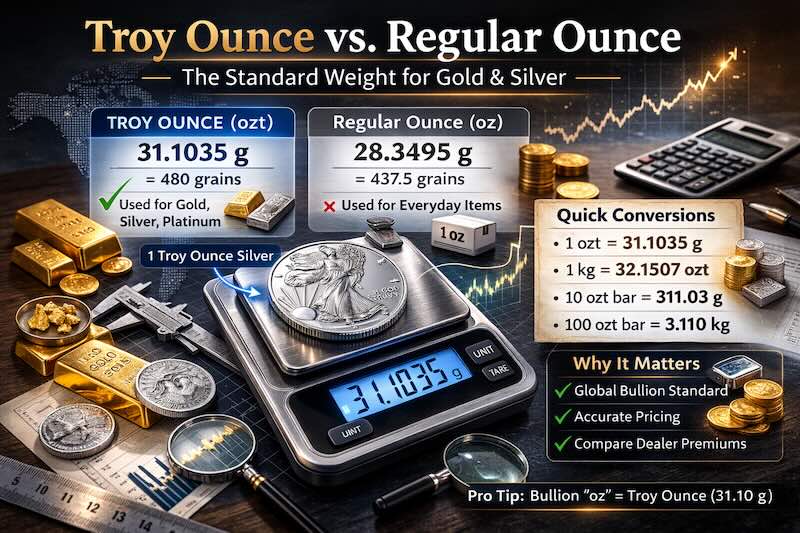
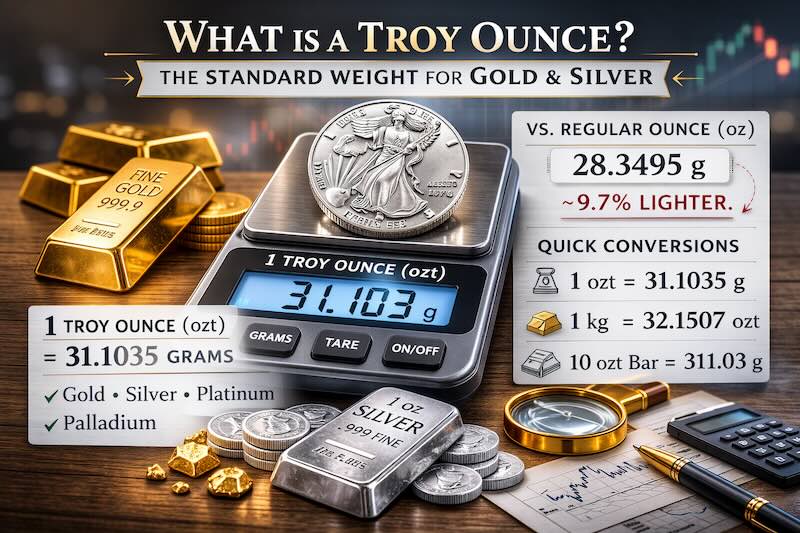
The troy ounce is the standard unit of weight for gold, silver, platinum, and palladium. While most everyday items in the U.S. use the avoirdupois (“regular”) ounce, bullion uses troy weight. One troy ounce (ozt) is exactly 31.1034768 grams, about 9.7% heavier than a regular ounce (28.349523125 g). If you buy a “1 oz” silver bar or coin, it almost always refers to 1 troy ounce, unless explicitly stated otherwise.
How the Troy Ounce is Used Today
Precious metals are traded worldwide using a common yardstick. Refiners, mints, dealers, and exchanges (e.g., London Good Delivery) all quote bullion in troy ounces. That consistency:
- Keeps global price discovery clean.
- Aligns retail bars/coins with wholesale bars (kilos are also standard, but convert to troy ounces).
- Reduces confusion between collectors, stackers, and institutions.
For investors comparing premiums and melt values, knowing the unit is non-negotiable is crucial. A misread ounce can skew value calculations by nearly 10%.
A Precise Definition
- 1 troy ounce = 480 grains
- 1 grain = 64.79891 milligrams (exact)
- Therefore, 1 troy ounce = 31.1034768 grams (exact)
- 1 troy pound = 12 troy ounces (~373.242 g). Unlike the regular (avoirdupois) pound of 16 ounces, the troy pound is not used in commerce today.
A Brief History of the Troy Ounce
Origins in medieval France (Troyes & the Champagne fairs)
Most historians trace the system to Troyes, a market city in the Champagne region of medieval France, home to bustling international trade fairs (12th–13th centuries). Merchants needed a trusted, portable, precious-metal standard. The Troy weight, likely influenced by earlier Roman/continental measures, took root as trading widened across Europe.
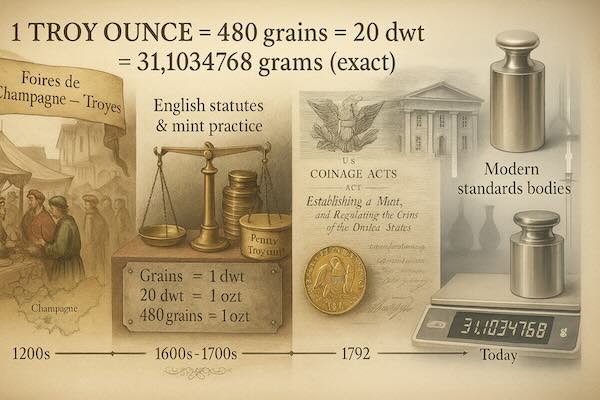
- Troyes fairs (Champagne) fostered international merchant norms.
- English statutes & mint practice fixed grains, pennyweights, and troy ounces for coinage.
- US Coinage Acts tied coin specifications to grains/troy measures; national standards later anchored grains in SI (grams).
- Modern standards bodies (e.g., national metrology institutes) maintain exact conversions—hence why 31.1034768 g is exact, not approximate.
Adoption in England & the English mints
By the late Middle Ages, English merchants and royal mints had adopted the troy weight for coinage and precious metals. Over time, Parliamentary statutes and mint practice standardized the grain, pennyweight (24 grains), and troy ounce (20 dwt = 480 grains).
American coinage and formalization
In the United States, the Coinage Act of 1792 established the U.S. Mint and formalized weight standards traceable to grains and troy ounces for gold and silver coins. As the metric system matured, national standards bodies tied the grain to the kilogram, locking the 31.1034768 g conversion.
Why this matters: the Troy ounce is not an approximation—it’s a precisely defined SI-traceable unit through the grain/gram relationship, which is why it remains the legal/technical basis for bullion weights.
How Its Use Spread and Why It’s Still the Bullion Default
- European trade facilitated the unit’s circulation through merchant guilds and mints.
- British Empire influence seeded the standard across colonies and global finance.
- Modern commodities infrastructure—refiners, LBMA Good Delivery bars, COMEX contracts, and sovereign mints—cemented troy ounces for bullion.
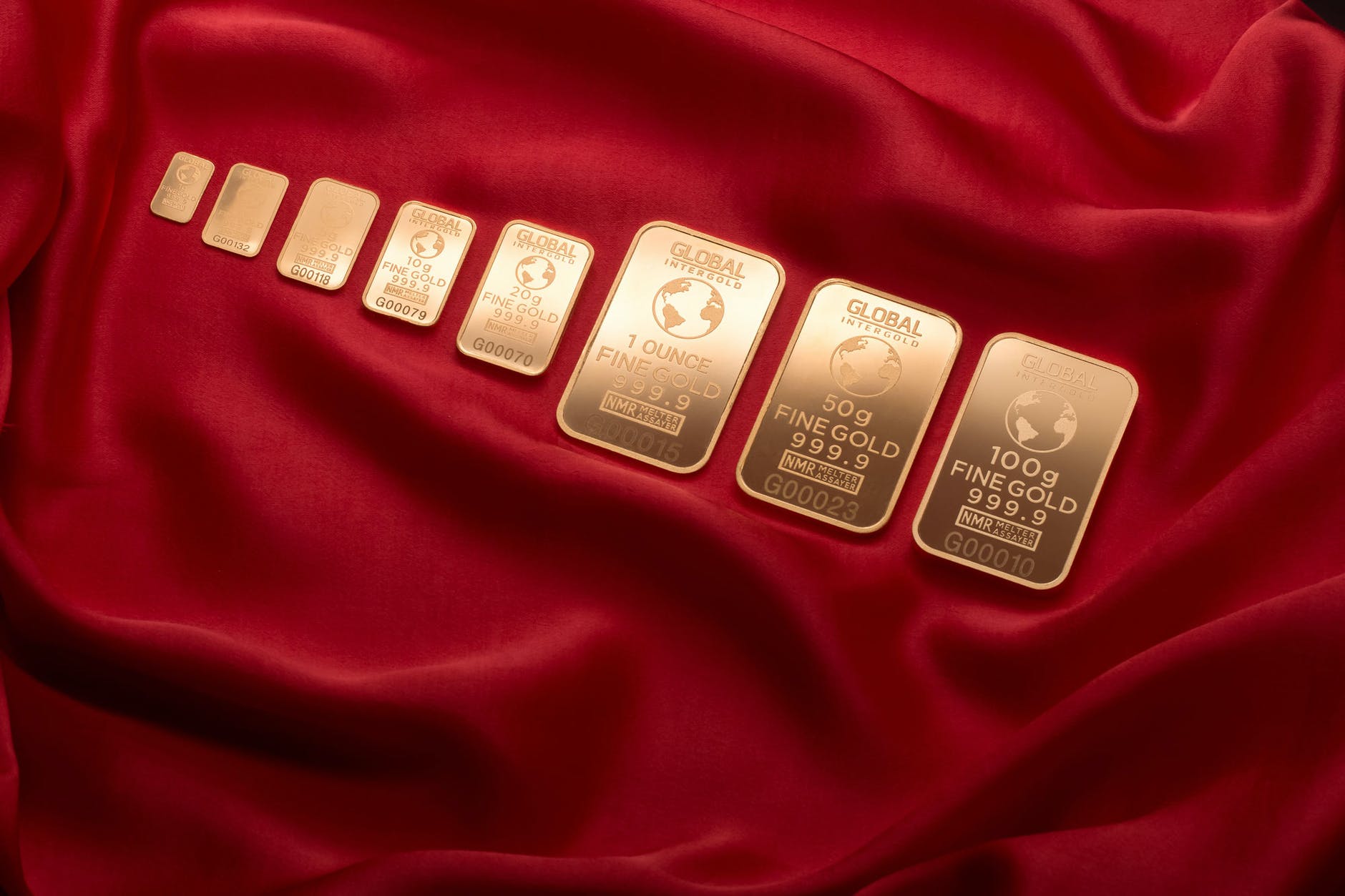
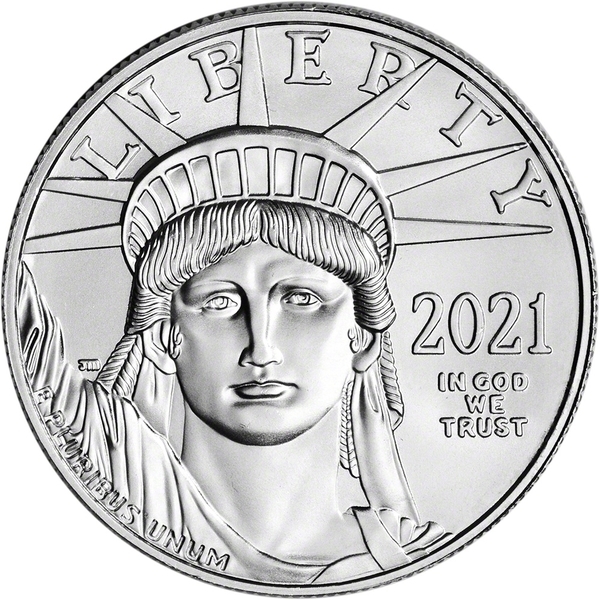
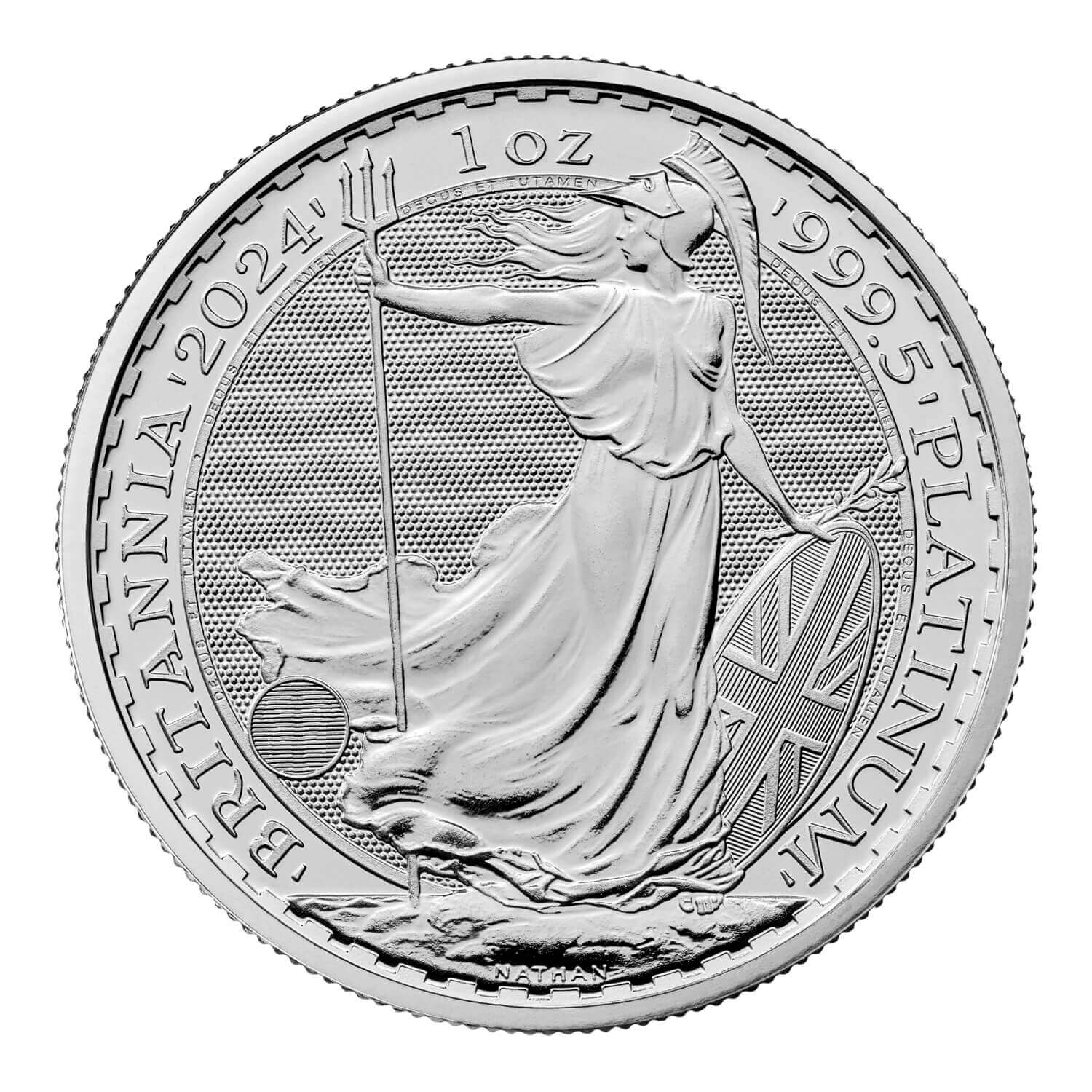
- Today, retail investors purchasing American Gold Eagles, Gold Buffalos, Maple Leafs, Britannias, Krugerrands (with gold content), or silver bars/rounds are implicitly transacting in troy ounces.
Troy Ounce vs Regular Ounce (Avoirdupois)
| Unit | Exact grams | Common uses |
|---|---|---|
| Troy ounce (ozt) | 31.1034768 g | Bullion (gold, silver, platinum), precious metals trade |
| Avoirdupois ounce (oz avdp) | 28.349523125 g | Groceries, shipping, body weight, most non-precious metals |
| Difference | ≈ +9.7% heavier | Using the wrong ounce under/over-states bullion weight |
Also known as: the avoirdupois ounce is often called the “regular,” “standard,” or “common” ounce online. If a bullion listing ever quotes “oz” without context, assume troy—but verify when in doubt.
Modern Alternatives & Related Units
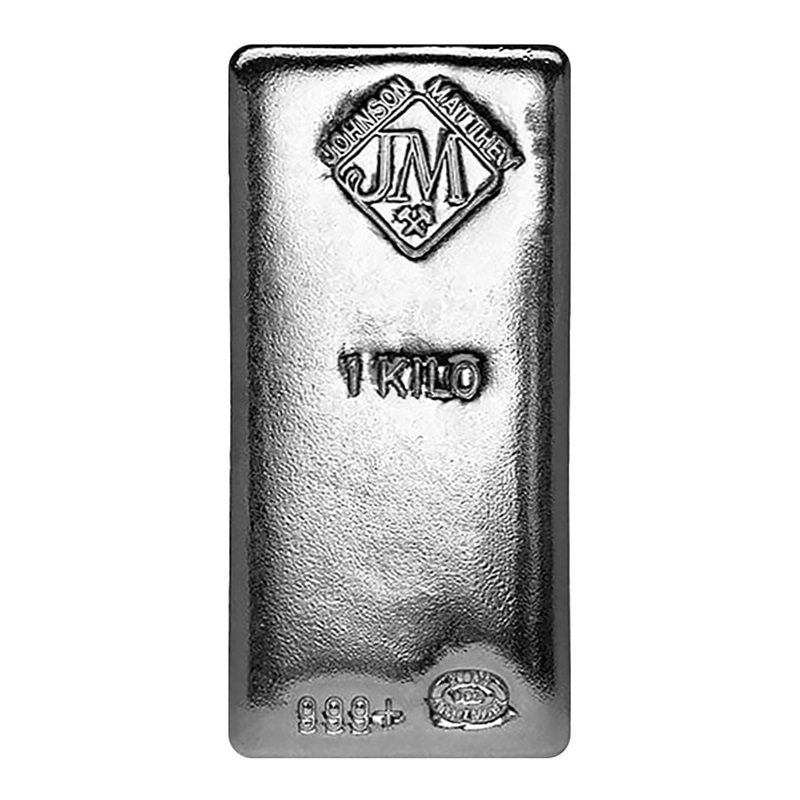
- Grams/Kilograms: increasingly used by mints/refiners. 1 kg = 32.1507466 troy oz.
- Pennyweight (dwt): jewelry/assay unit. 1 ozt = 20 dwt; 1 dwt = 1.55517384 g.
- Grains: small unit for assay/precision. 1 oz = 480 grains.
- Regional systems: Tola (South Asia) ≈ 11.6638038 g; 10 tola bar ≈ 116.638 g (~3.75 ozt)
- Tael (varies by region; Hong Kong tael ≈ 37.799 g ≈ 1.215 ozt)
- Baht (Thailand) ≈ 15.244 g (~0.490 ozt)
- Legacy/technical: Apothecaries’ ounce (aligned to troy in grains), assay ton (analytical chemistry), Tower pound (obsolete English coinage system).
Quick Conversions
- 1 troy oz = 31.1034768 g
- 1 regular (avdp) oz = 28.349523125 g
- 1 kg = 32.1507466 troy oz
- 10 oz bar = 311.034768 g
- 100 oz bar = 3.11034768 kg
Pro tip: Large silver bars (e.g., 100 ozt) typically carry the lowest % premium above spot; kilo bars are popular outside North America and are easy to convert using the 32.1507 factor.
Where the Troy Ounce Shows Up Today
- Coins & rounds (silver):
- Typical retail premiums in calm markets: ~5–12%+ over spot for common 1 ozt coins/rounds. Sovereigns (ASE, Maple, Britannia) often sell for a higher price than generic rounds/bars.
- Bars (silver):
- 1 ozt bars ~4–10%, 10 ozt ~3–7%, 100 ozt often 2–5% (market dependent).
- Gold bars (1 ozt):
- ~1–3% over spot for mainstream brands in quiet markets; coins (Eagles/Maples/Buffalos) often higher.
- ETFs (physically-backed):
- Expense ratios typically 0.20–0.50%/yr; no retail “premium,” but fund costs apply.
- Blockchain/digital silver (physically backed with redemption):
- Spreads/fees vary; please check storage fees, redemption minimums, and shipping details.
Compare dealer premiums in real time: FindBullionPrices.com aggregates prices across trusted U.S. dealers so you can spot the lowest premium fast.
Common Mistakes to Avoid
- Assuming “ounce” refers to the standard ounce. In bullion, “oz” = troy almost always.
- Using 28.35 g/oz to calculate the melt on a coin/bar. Use 31.1035 g.
- Ignoring purity. .999 fine silver rounds are different from 90% coins—calculate fineness (e.g., a 90% silver coin has 0.9 × gross weight in fine silver).
- Confusing net weight with gross weight. Capsules, assay cards, and capsules add grams—ignore them when figuring fine weight.
FAQ
How many grams are in a troy ounce?
Exactly 31.1034768 grams.
How many troy ounces are in a kilobar?
32.1507466 Troy ounces.
Why does precious metal use troy weight?
Due to centuries-old trade and minting practices, which were later formalized and tied to SI units. It keeps global bullion markets standardized.
Reminder: Precious metals can rise or fall. This is educational content, not financial advice. Consider your time horizon, liquidity needs, storage plan, and taxes.