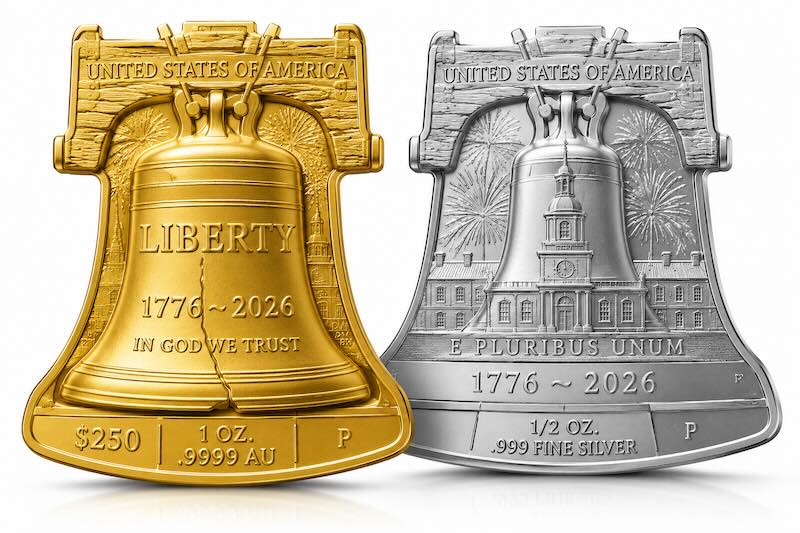
The US Mint just released the most polarizing coins of the entire Semiquincentennial program: three Liberty Bell-shaped pieces in gold and silver, priced at levels that have collectors and investors sharply divided. A one-ounce gold coin for $19,600. A half-ounce gold coin for $10,050. A half-ounce silver medal for $750. Each limited to 2,026 units.
The two gold pieces are the first non-round coins struck by the US Mint in over a century, and the silver medal is the Mint’s first recent non-round medal. The last time the Mint produced a non-circular coin was the 1915 Panama-Pacific $50 octagonal gold piece, and only 645 of those were ever sold. Whether the Liberty Bell pieces follow that trajectory or fall flat depends on questions the numismatic community is debating right now.
Here is what the coins are, what the premiums actually look like when you run the numbers, and what the early collector and reseller consensus tells us about where demand might land.
What the US Mint Announced
On June 16, 2026, the Mint revealed three products under the “Freedom Ringing” banner, all launching July 16 at noon ET on usmint.gov:
Freedom Ringing Liberty Bell One-Ounce Gold Coin ($250 denomination, .9999 fine gold, $19,600). Freedom Ringing Liberty Bell One-Half Ounce Gold Coin ($125 denomination, .9999 fine gold, $10,050). Freedom Ringing Liberty Bell One-Half Ounce Silver Medal (no denomination, .999 fine silver, $750).
All three are proof strikes with smooth edges, produced at the Philadelphia Mint with the P mint mark on each reverse. Household orders are limited to one of each.
The $125 and $250 denominations are believed to be firsts for the US Mint. No other US coin has carried either face value.
The Shape and How It Was Made
Each piece is struck in the outline of the Liberty Bell, crack and all. On the gold coins, the obverse shows the bell with LIBERTY across the shoulder, the dual date 1776 ~ 2026, and IN GOD WE TRUST. The reverse depicts Independence Hall with fireworks, UNITED STATES OF AMERICA on the yoke, and E PLURIBUS UNUM below, with the denomination, weight, and composition on the sound bow. The silver medal carries the same imagery but places the dual date on the reverse along the sound bow rather than the obverse.
Standard coining presses cannot reliably produce the bell shape, so every piece was hand-loaded and struck in the Philadelphia Mint’s Research and Development Lab. That manual production process is the stated reason for the 2,026-unit mintage cap.
Despite containing twice as much gold, the one-ounce coin is barely larger than the half-ounce version. The one-ounce measures 0.888 by 1.024 inches and is 0.167 inch thick. The half-ounce is 0.883 by 1.024 inches and 0.104 inch thick. The silver medal shares the same footprint as the one-ounce gold coin at 0.888 by 1.024 inches.
Premium Over Melt Value: The Numbers
This is where the conversation gets heated. At today’s spot prices, here is what you are actually paying for the metal versus the numismatic premium:
The one-ounce gold coin contains about $4,325 worth of gold at current spot prices. The Mint is asking $19,600. That puts the numismatic premium at roughly $15,275, and the total cost at about 4.5 times what the gold alone is worth.
The half-ounce gold coin contains about $2,163 worth of gold. At $10,050, that is a similar 4.6 times melt.
The silver medal is the most extreme example. Half a troy ounce of silver at today’s spot price is worth roughly $69. The Mint is asking $750. That is a markup of more than 10 times the metal value.
For context, standard Proof Gold Eagles and the limited-edition 2026-W Proof Gold Buffalo with its 15,000-unit cap are all priced through the Mint’s spot-based pricing matrix, which keeps premiums relatively close to melt. The Liberty Bell coins are in a different category entirely.
If you want to see what bullion-grade gold and silver cost with standard dealer premiums, check our closest-to-spot gold and closest-to-spot silver comparison pages. The gap between those prices and the Liberty Bell pricing tells you exactly how much of the cost is the collector premium.
The Only Precedent: 1915 Panama-Pacific Octagonals
The 1915-S Panama-Pacific International Exposition $50 gold piece was the only other non-round coin in US Mint history, and the parallels are worth examining.
The octagonal version of the 1915 Pan-Pac $50 had 1,500 struck, with only 645 sold and the rest melted. The original issue price was $100, or two times the $50 face value. Today, examples in MS-64 condition sell at auction for over $117,000. An MS-66, one of the finest known, sold for nearly $200,000 in 2017.
The parallels are clear: unusual shape, tiny mintage, tied to a major national anniversary. But the differences matter too. The Pan-Pac octagonals were sold at a modest 2x face value. The Liberty Bell pieces are priced at 4.5x melt. The Pan-Pac coins were part of a larger commemorative set that included round versions at the same denomination. The Liberty Bell pieces have no round counterpart and no established collector series behind them.
Whether the Liberty Bell coins appreciate over decades the way the Pan-Pacs did is the central bet collectors are making. The Pan-Pac track record is encouraging on paper, but 111 years of hindsight makes any comparison look better than it is.
What Collectors Are Saying
The numismatic community’s reaction has been swift, loud, and divided.
On the Collectors Universe forums, where some of the most experienced US coin collectors gather, the reaction was immediate. Several veteran collectors described the pricing as disconnected from anything the Mint has done before. One called the coins “the logical extension of the Mint’s propensity to engage in cynical money grabs.” Another pointed out that the silver medal contains only half an ounce of silver for $750. Others compared the bell shape to novelty coins struck by foreign mints in the shape of guitars and cars, questioning whether a bell-shaped piece belongs in a serious numismatic collection.
Not everyone is bearish. Some collectors see these as once-in-a-lifetime pieces tied to a once-in-250-years event, produced through a manufacturing process the Mint has never used on production coins before. The 2,026-unit mintage is remarkably small by any modern standard. For comparison, even the most limited recent Mint releases, such as the 2026 Enhanced Uncirculated Gold Eagle with its 7,500-unit cap, had nearly four times as many pieces available.
The question several forum members are asking: will the gold coin even last five minutes on the Mint’s website, or will high prices suppress demand enough that they linger?
Resale and Secondary Market Outlook
The reseller community is approaching this from a different angle than traditional collectors. Their analysis comes down to supply, demand, and fee math.
The silver medal is the consensus pick for resale potential. At $750 with a 2,026-unit limit, early projections from reseller analysts put the secondary market price above $2,000 within a week of a sellout. After eBay’s standard 13% fee structure, that would leave roughly $990 in profit per unit. The low entry price relative to the gold coins makes it accessible to more buyers, and the extreme scarcity creates the conditions for a quick secondary market premium.
The gold coins are a more complicated calculation. eBay classifies coins above $7,500 as bullion and charges 7% on the total sale. That means the one-ounce gold coin needs to sell for approximately $21,075 on the secondary market just to break even after fees. The half-ounce needs to clear roughly $10,807. Those thresholds are reachable for a 2,026-unit piece tied to the 250th anniversary, but they are not guaranteed.
A useful reference point: the 2026-W Enhanced Uncirculated Gold Eagle launched at $5,370 on May 28 with a 7,500-unit mintage. Within weeks, secondary market prices reached $7,000 and above. That coin was priced much closer to spot (roughly $1,000 over) and had 3.7 times the mintage. The Liberty Bell gold coins carry far higher premiums and far lower mintage, which cuts both ways. The scarcity is more extreme, but the capital barrier is much higher.
The Mint’s seven-day return policy adds a layer to the resale calculation. Buyers who cannot find a secondary market price above their purchase price within the return window can send the coins back. That policy functionally acts as a floor for the first week.
Where These Fit in the 2026 Semiquincentennial Lineup
The Liberty Bell coins are the most expensive and most limited releases in the Mint’s broader Semiquincentennial program, but they are not the only collector-grade products available this year. The full 2026 lineup includes:
The 2026-W Proof Gold Eagle set with dual dates and Liberty Bell privy marks across four sizes (25,000 product limit). The 2026-W Proof Gold Buffalo with its own dual date and privy mark (15,000 limit). The 2026 Semiquincentennial Silver Eagles in proof and enhanced uncirculated finishes. And the 2026 Morgan and Peace Dollar Reverse Proofs launching July 9 at $173 each.
Every collector-grade release this year carries the 1776 ~ 2026 dual date and the Liberty Bell “250” privy mark. The Liberty Bell-shaped coins take that theme further than any other product in the program by making the bell itself the form factor.
For collectors building a complete Semiquincentennial set, the Liberty Bell coins may be the hardest pieces to acquire, both because of the 2,026-unit mintage and because of the price.
The Bullion Buyer’s Perspective
If you are shopping for gold or silver as a precious metals investment, these coins are not priced for you. At 4.5 times melt for gold and 21 times melt for silver, the Liberty Bell pieces are collector items where nearly all of the price reflects numismatic or historical value rather than metal content.
An ounce of gold in bullion form, with standard dealer premiums, currently runs in the range you can see on our gold comparison page. That is roughly $4,400 to $4,600 depending on the product and dealer. The Liberty Bell gold coin costs four times that amount for the same weight of .9999 fine gold.
That does not make them a bad purchase. It means the calculus is entirely different from buying bullion. If the 2,026-unit mintage, the first-ever bell shape, and the 250th anniversary significance create enough collector demand to support the price, the coins could appreciate well beyond their issue price over time. If collector interest falls short, you own an ounce of gold that cost you four and a half times what it would have cost in any other form.
Use our gold price per gram calculator or the premium history hub to see where bullion premiums stand right now for standard products. That gives you the baseline for evaluating what you are paying above market for the Liberty Bell pieces.
How to Buy
All three products go on sale at noon ET on July 16, 2026, exclusively at usmint.gov. Orders are limited to one of each per household during the first 24 hours. Based on recent limited Mint releases, expect a virtual waiting room and a fast sellout, at least for the silver medal and potentially for the gold coins as well.
The Mint accepts credit cards, debit cards, and checks. Returns are accepted within seven days of receiving your order.
Key Takeaways
The Liberty Bell coins represent the outer edge of what the US Mint has ever attempted: a non-round shape, a manual R&D production process, an ultra-low 2,026-unit mintage, and pricing that reflects collector value rather than metal content. They are tied to an anniversary that happens once every 250 years, and they have no direct precedent in modern numismatics.
Whether that combination justifies $19,600 for an ounce of gold depends entirely on how the collector market responds over the coming months and years. The melt value math is clear. The collector math is the open question.