Somewhere in your bank’s coin rolls, a quarter worth thousands of dollars may be sitting unnoticed. The U.S. Mint released 250,000 special 2026 Declaration of Independence quarters bearing a “JULY 4th” privy mark directly into circulation through banks across the country. These quarters carry no mint mark and cannot be purchased from the Mint. The only way to get one is to find it.
Both PCGS and NGC launched bounty programs for the first examples. NGC offered $2,500 for the first privy quarter submitted for grading, and that bounty has already been claimed. The winning coin came back graded NGC MS 66 with an official America250 label. PCGS is still offering $5,000 for the first July 4th privy quarter shipped for grading through their <a href=”https://www.pcgs.com/info/quarterquest” rel=”nofollow” target=”_blank”>Quarter Quest program</a>, along with the exclusive “First Discovery” pedigree on the PCGS label.
If you collect U.S. Semiquincentennial coins, this is one of the most unusual pieces in the entire 250th anniversary program. You cannot buy it at a set price. You have to find it in pocket change, at the bank, or in a coin roll.
How to Identify the July 4th Privy Quarter
The 2026 Declaration of Independence quarter is one of five new quarter designs released this year as part of the Semiquincentennial program. The regular versions carry either a “P” (Philadelphia) or “D” (Denver) mint mark and are being produced in standard quantities.
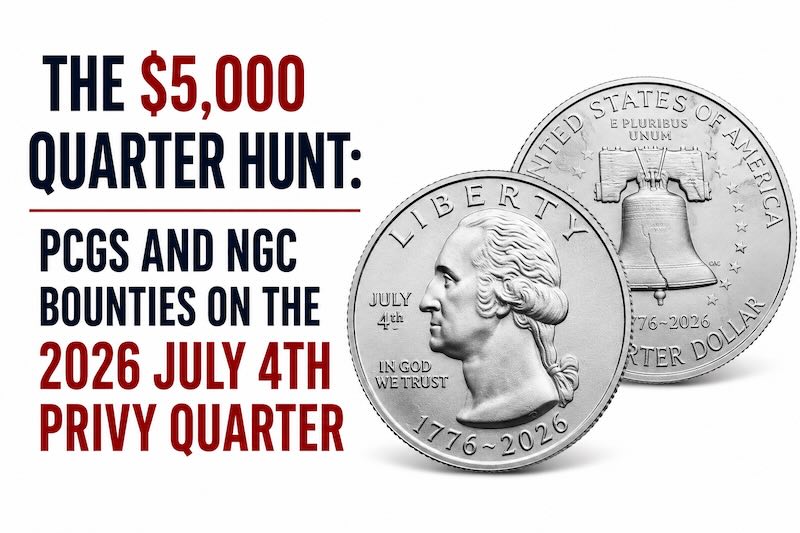
The special July 4th version differs in two ways. It carries the text “JULY 4th” as a privy mark on the obverse, positioned to the left of the portrait of Thomas Jefferson. And it has no mint mark at all.
The reverse of all 2026 Declaration of Independence quarters shows the Liberty Bell with its crack visible in the design, paired with the dual date “1776 ~ 2026.”
When checking quarters, look for the Jefferson obverse with the dual date, no P or D mint mark, and the “JULY 4th” text to the left of the portrait. If you see a Declaration of Independence quarter with a P or D mint mark, that is a standard circulation strike.
Why 250,000 Is a Small Number
The last time a major grading service ran this kind of quarter bounty was 2019, when the Mint released quarters from the West Point Mint (bearing a “W” mint mark) into general circulation for the first time. That program produced two million quarters per design across the five America the Beautiful releases that year.
FBP covered the PCGS $5,000 bounty for those 2019-W quarters at the time. The 2019-W hunt created a wave of interest in roll searching that brought new collectors into the hobby, and the coins commanded premiums of $15 to $40 depending on condition and variety.
The 2026 July 4th privy quarter has a mintage of 250,000, about one eighth of the 2019-W per-design mintage. Given that scarcity and the Semiquincentennial significance, secondary market premiums will likely exceed what the 2019-W quarters achieved.
The Mint distributed the coins through the Federal Reserve’s normal channels, mixed in with regular Philadelphia and Denver quarters, and sent them to banks around the country in time for the Fourth of July. There is no way to know which branch received privy quarters and which did not.
The PCGS Quarter Quest
According to CoinWeek’s reporting on the announcement, PCGS President Stephanie Sabin called the bounty a “Golden Ticket” moment for numismatics. The Quarter Quest program offers three tiers of recognition.
The first collector to ship a July 4th privy quarter to PCGS for grading wins the $5,000 cash bounty and receives the “First Discovery” pedigree on their certification label. That pedigree becomes a permanent part of the coin’s identity in the PCGS population database.
After the First Discovery coin arrives, PCGS will continue offering an “Early Find” pedigree for qualifying privy quarters submitted within 90 days. Every Early Find coin submitted through the Quarter Quest program also receives a free America Semiquincentennial Special Label.
The hunt does not end after the first quarter is found. Collectors who find privy quarters in the weeks ahead can still earn the Early Find pedigree, which has carried premiums on the secondary market in prior Quarter Quest campaigns.
NGC’s Bounty: Already Claimed
NGC moved first, announcing a $2,500 cash bounty for the first July 4th privy quarter submitted by a grading member. That bounty was claimed within days of the quarters entering circulation. The winning coin came back graded NGC MS 66 and was encapsulated with the official America250 label.
The claim made mainstream news through NewsNation and local affiliates, pulling public awareness beyond the usual collector audience. That media coverage could push more people to check their pocket change, which means more demand for found examples when they surface.
For collectors who missed both bounties, the coins are still worth searching for. A privy quarter in any condition is a low-mintage Semiquincentennial piece, and graded examples will carry premiums well above the 25-cent face value.
What Found Quarters Might Be Worth
It is early for a settled secondary market on the July 4th privy quarter, but the 2019-W quarters offer a baseline. Those coins, with mintages of two million per design (eight times the July 4th privy quarter), have traded at $15 to $40 in circulated grades and $50 to $150 in higher uncirculated grades. Some 2019-W key dates have sold for more.
Raw (uncertified) July 4th privy quarters in decent condition could sell in the $30 to $75 range based on early secondary market activity, while PCGS or NGC graded examples in MS65 and above could reach into triple digits. The “First Discovery” and “Early Find” pedigrees from PCGS will push those specific coins higher still.
The 2026 Quarter Program
The July 4th privy quarter is part of a larger 2026 program featuring five new reverse designs: the Mayflower (released in February), the Revolutionary War (March), the Declaration of Independence (summer), the U.S. Constitution (summer), and the Gettysburg Address (fall). Each design carries a different historical figure on the obverse: Pilgrims, George Washington, Thomas Jefferson, the Founding Fathers, and Abraham Lincoln.
Philadelphia and Denver produce each design for general circulation, and silver proof versions are included in the 2026 Silver Proof Set. The 2019 Silver Proof Quarter Set marked the first time the Mint used .999 fine silver for proof quarters, and the 2026 proofs continue that standard.
On July 4th, the Philadelphia Mint also struck 250 oversized 2.5-ounce .999 fine silver Declaration of Independence quarters, individually numbered 1 through 250, with the same “JULY 4th” privy mark. Those will be sold through a future auction. They are separate from the 250,000 circulating privy quarters.
How to Search
Ask your bank for rolls of quarters, specifically newer rolls. Each standard roll contains 40 quarters ($10 face value). Many collectors order boxes (50 rolls, $500 face value) to improve their odds.
Check every quarter in the roll. Look at the obverse first: if you see a Declaration of Independence design featuring Jefferson, check for the privy mark. If you see “JULY 4th” to the left of the portrait and no mint mark, you have one.
Not every bank branch is willing to sell large quantities of rolls to non-commercial customers. Building a relationship with your bank helps. Some collectors also frequent coin shows where roll searchers sell finds they have pulled from circulation.
Check your pocket change, too. The Mint distributed these quarters into normal commerce, so some will show up in cash registers and vending machines for months to come.
If you find a privy quarter in good condition, consider submitting it to PCGS within the 90-day Early Find window. Early submissions with special pedigrees from prior Quarter Quest campaigns have consistently outperformed standard-label examples of the same coin.
Related Reading
- US Semiquincentennial Coin Collection: A Guide to America’s 250th Anniversary Coins. The full guide to 2026 dual-dated coins and commemoratives.
- PCGS Awards $5,000 Bounty for Circulated W Mint Mark Quarters. The original 2019-W quarter hunt that started the circulation-rarity phenomenon.
- 2026 Morgan and Peace Dollar Reverse Proof: July 9 Release Guide. Another major 2026 Semiquincentennial release from the Mint.
- 2026 American Silver Eagle: Complete Buyer’s Guide. The flagship bullion coin with its own Semiquincentennial markings.
- Valuable 1776-1976 Bicentennial Quarters. The last time America celebrated a milestone anniversary on its coinage.
- Which Washington Quarters Are Silver?. Identifying silver content in Washington quarters by year.