Week of June 2–5, 2026
Gold and Silver This Week
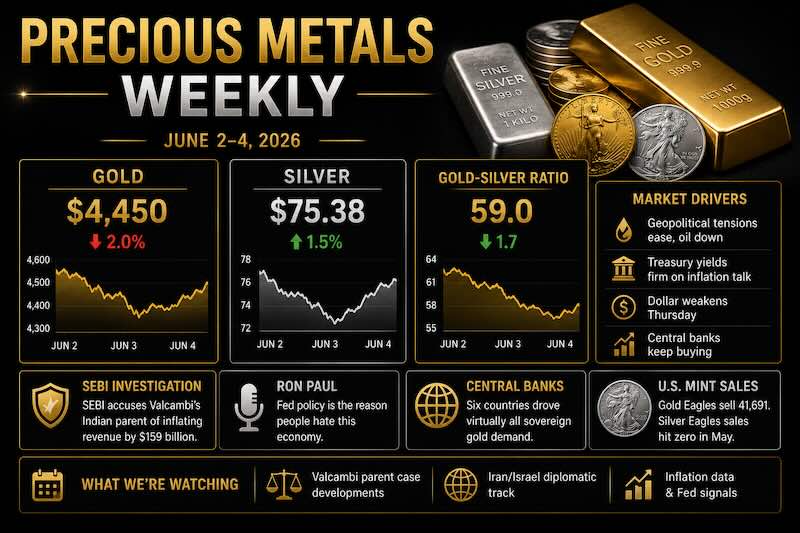
Gold opened the week above $4,520 and drifted lower through Tuesday and Wednesday as Treasury yields firmed on energy-driven inflation chatter. Thursday brought a brief de-escalation bid, but it did not survive the overnight tape. Hezbollah rejected the U.S.-brokered Israel-Lebanon ceasefire framework within hours of its announcement, Israel resumed strikes, and the U.S.-Iran track was reported to have made “no tangible progress.” Friday morning then delivered the May jobs report, which came in at 172,000 nonfarm payrolls against a consensus near 80,000, with March and April revised up by a combined 93,000 and the unemployment rate steady at 4.3%. The reaction was decisive. The 10-year Treasury yield pushed back above 4.50% to a two-week high, the dollar rallied on resurfacing rate-hike risk, and the S&P 500 fell about 1%. Gold dropped through the morning and by midafternoon Friday was trading around $4,319 per ounce, down roughly 3.5% on the day and about 4% on the week.
Silver took the brunt of it. After Thursday’s de-escalation pop carried it back to $75.38, Friday’s tape erased that and more. By midafternoon silver was around $68.00 bid, a one-day drop of about 7.8%, with the day’s range running from $67.94 to $74.26. That is one of the heaviest single-day silver declines since the February margin-call cascade earlier this year. The gold-silver ratio blew out from roughly 58 at Thursday’s close to about 64 Friday afternoon. The selling looked technical and yield-driven rather than fundamental, but it is a reminder that silver still trades like a leveraged version of gold whenever the rate narrative shifts.
The trading day is not yet over. If the afternoon firms, the weekly figures will close better than they look right now. If selling accelerates into the close, the technical damage on silver in particular is meaningful.
Track today’s precious metals prices →
SEBI Accuses Valcambi’s Indian Parent of Inflating Revenue by $159 Billion
The bigger story for the industry landed Wednesday. India’s securities regulator, SEBI, issued an interim order against Rajesh Exports — the Bengaluru-listed parent of Swiss refiner Valcambi SA — alleging the company misrepresented about ₹15.15 lakh crore ($159 billion) in revenue over the five fiscal years through March 2025. SEBI says 97–99% of consolidated revenues across FY21–FY25 were booked through overseas subsidiaries — with Valcambi cited as the most significant contributor — and Bloomberg pegs the overstated portion at as much as 99.80% of subsidiary revenue. The regulator says auditors could not match consolidated reported revenues to underlying subsidiary records. Chairman Rajesh Mehta has been barred from the securities market pending investigation; shares hit the 5% lower circuit on the news and are now down more than 40% year-to-date.
Valcambi is the world’s largest single refinery, with about 1,600 tonnes of annual gold refining capacity — roughly a third of the combined output of the seven major LBMA refiners. Rajesh Exports bought it from Newmont in 2015 for $400 million. The SEBI order is about accounting at the listed Indian parent, not about Valcambi’s physical operations. The refinery is LBMA Good Delivery accredited and its bars continue to clear normally. Mehta has denied the allegations and called the order “an interim order [where] nothing in it is true.” But for an industry whose pricing infrastructure depends on a small number of accredited refiners, anything that puts the parent of the largest one under fraud investigation is worth tracking.
Compare Valcambi Gold Bar Premiums →
Ron Paul: The Fed Is the Reason People Hate This Economy
ZeroHedge picked up a Ron Paul column this week that lines up neatly with what physical buyers have been saying for two years. The University of Michigan consumer sentiment index recently hit a record low — even as headline jobs and wage data print fine. Paul’s argument: government inflation and unemployment numbers are massaged (broader U-6-style measures put real unemployment over 10%), and the Fed’s PCE-favored inflation gauge is still running 3.8% YoY on top of a 1971-onward debasement that has eaten purchasing power for fifty years. With federal debt closing on $40 trillion, his read is that the inflation tax has become the largest single drag on household balance sheets. You don’t have to share Paul’s politics to notice that this is the same thesis driving central bank gold buying — and it’s the thesis that pulled silver from $28 to $90 over twenty-four months.
Six Countries Are Driving All Sovereign Gold Demand
A new UBS chart making the rounds on ZeroHedge underlines just how concentrated official-sector gold buying has become. The bank’s economists point out that the structural shift in central bank behavior started with the 2008 financial crisis, not the 2022 Russia sanctions — roughly 85% of the increase in official sector gold holdings happened between August 2008 and February 2022. Sanctions accelerated an existing trend; they did not start it.
More striking is the buyer concentration. Across roughly 200 countries, just six — Russia, China, Turkey, India, Poland, and Kazakhstan — accounted for nearly the entire 2008–2022 increase. Since 2022 the cast has shifted slightly to China, Poland, India, Iraq, Czechia, and Qatar. The World Gold Council logged 244 tonnes of net central bank buying in Q1 2026 alone and is guiding to a 700–900 tonne range for the full year. Poland alone added roughly 31 tonnes in Q1, the largest single buyer of the quarter. Take this with retail in mind: the marginal buyer keeping a floor under gold isn’t a U.S. household — it’s a sovereign with a reserve diversification mandate that does not care what next week’s CPI print does.
US Mint Sales
The Mint’s 1776 ~ 2026-W Proof Gold Eagle program has now sold about 41,691 coins across all sizes since its March 5 release, and the new Proof Gold Buffalo debuted with 9,865 of 15,000 available. Bullion American Silver Eagle sales remain effectively zero through May. The retail buyer has stepped back and the Mint did not need authorized purchaser orders to clear inventory.
What We’re Watching
The Valcambi parent story is the one that could matter most over the next quarter — not because of refining disruption, but because audit findings sometimes uncover physical-side surprises. The Iran/Israel diplomatic track remains the dominant short-term price driver. And the sovereign demand backdrop hasn’t changed: six countries, persistent dollar-diversification, and a U.S. fiscal trajectory that even Ron Paul and the World Gold Council seem to agree on for different reasons.
Compare silver bullion prices →