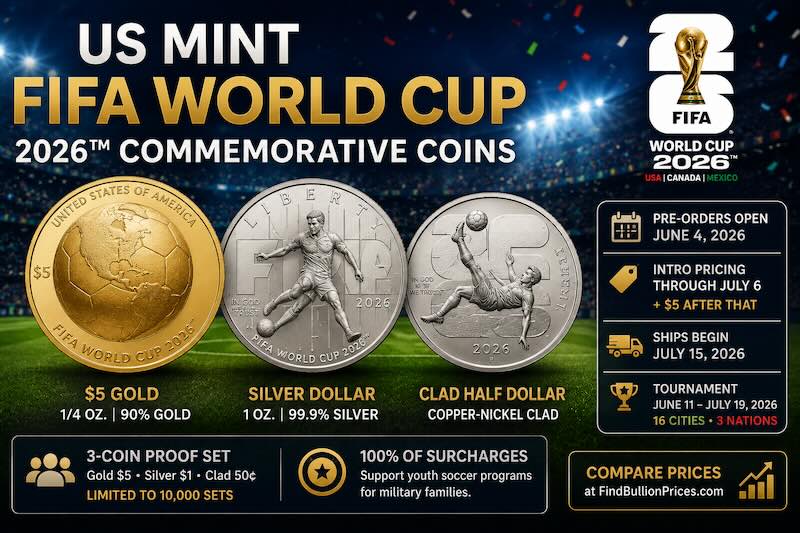
The United States Mint opened pre-orders Thursday, June 4 for seven FIFA World Cup 2026™ commemorative products: proof and uncirculated versions of a $5 gold coin, a silver dollar, and a clad half dollar, plus a three-coin proof set. Introductory pricing runs through July 6 at 3 p.m. ET. After that, the Mint adds $5 to each coin and weekly price updates take over for the gold versions based on the spot price. Shipments are expected to begin July 15 and sales continue through the end of the calendar year.
This is the first U.S. soccer commemorative since 1994 and it is a relevant comparison for collectors.
What’s Being Sold
The Mint capped mintages at 100,000 gold $5 coins, 500,000 silver dollars, 750,000 clad half dollars, and 10,000 three-coin proof sets, all backed by the FIFA World Cup 2026 Commemorative Coin Act (Public Law 118-143). All seven products share a common reverse showing three hands lifting the FIFA World Cup Trophy against stars and stripes. The obverses differ:
- $5 gold. Globe-as-soccer-ball centered on North America. 0.243 troy oz of 90% gold (the legacy commem alloy, not .9999 fine). Struck at the West Point Mint.
- Silver dollar. A player mid-action with the FIFA Unity logo behind. 0.859 troy oz of 99.9% fine silver. Struck at the Philadelphia Mint.
- Clad half dollar. A bicycle kick across the stacked “26” emblem from the official tournament logo. Also struck at Philadelphia.
Introductory Pricing and the Melt Math
| Product | Intro Price | Surcharge | Approx. Melt |
|---|---|---|---|
| Proof 3-Coin Set | $1,581.25 | $50 total | n/a |
| Proof $5 Gold | $1,338.25 | $35 | ~$1,081 |
| Uncirculated $5 Gold | $1,328.25 | $35 | ~$1,081 |
| Proof Silver Dollar | $174.00 | $10 | ~$64 |
| Uncirculated Silver Dollar | $169.00 | $10 | ~$64 |
| Proof Half Dollar | $64.00 | $5 | clad |
| Uncirculated Half Dollar | $61.00 | $5 | clad |
Melt estimates assume gold at $4,450/oz and silver at $75/oz. Gold coin pricing already reflects the Mint’s current LBMA tier of $4,450.00 to $4,599.99 and will reset weekly.
The proof $5 gold coin’s premium over melt comes in around 24% at intro pricing, or roughly $257 above bullion value. Thirty-five of those dollars are the congressional surcharge that funds youth soccer programs for service members’ children. The rest is production, packaging, and Mint margin. For modern commemorative gold coins that’s a fairly typical premium.
The silver dollar runs hotter on a percentage basis. At $174 intro pricing against roughly $64 of silver, you are paying about 170% over melt, with only $10 of that going to the surcharge. Buyers of a commemorative silver dollar are not buying it for the metal content, and the pricing reflects that.
Household limits at launch are one per household on the three-coin set and on both gold coins. There are no household limits on the silver dollars or half dollars at launch.
What 1994 Actually Sold
The Mint last struck a World Cup commemorative for the 1994 tournament held in the United States. The final sales figures, reported as of September 1995, are worth keeping in mind before deciding whether 2026 is a flip or a hold:
- $5 gold: 89,614 proof + 22,447 uncirculated = 112,061 total
- Silver $1: 577,090 proof + 81,524 uncirculated = 658,614 total
- Clad 50¢: 609,354 proof + 168,208 uncirculated = 777,562 total
The full program ran 1,548,237 coins. The 1994-W $5 Uncirculated Gold is notable today mostly because so few were made. At 22,447 pieces it sits mid-pack in the modern $5 gold commemorative range, well above the ultra-low-mintage 1996-W Olympic varieties and the 2001-W Capitol Visitor issue but well below the 1986 Statue of Liberty, 1987 Constitution, and other marquee programs. That relative scarcity, not soccer interest, is what carries the secondary-market value.
The 2026 caps are tighter than what the 1994 program actually sold across all three denominations, but the margin varies. Gold $5 is capped at 100,000 against 112,061 sold in 1994, about 11% below. Silver dollars are capped at 500,000 against 658,614 sold in 1994, about 24% below. Clad halves are capped at 750,000 against 777,562 sold in 1994, only about 4% below. If 2026 demand merely matches the 1994 program, the gold and silver are likely to clear and the halves are on the edge. Any softness in collector demand, and the halves are the first to remain available into the fall.
How 2026 Sets Up Differently
The 2026 program opened for pre-orders on June 4, a week before the tournament begins on June 11. Sales run through the end of the calendar year, so the selling window overlaps the entire tournament from June 11 through July 19 and the post-final collector buzz that typically follows a host-country event. The tournament covers 16 cities, 11 of them in the United States, three in Mexico, and two in Canada.
The surcharge story is also more focused than 1994’s. Per a statement from Treasury Secretary Scott Bessent, 100% of surcharge dollars under the 2026 program flow through FWC2026 US, Inc. to youth soccer programs benefiting children of military families. The 1994 surcharges flowed to the World Cup organizing committee, a broader recipient that did not carry the same charitable hook.
None of this guarantees a sell-out. It is the reason the 2026 program is set up better than the 1994 program for the gold and silver to clear.
Where to Buy and What to Watch
Pre-orders go through the U.S. Mint’s commemorative catalog, though most collectors will eventually buy through authorized dealers or on the secondary market once initial allocations clear. The proof $5 gold is the number to watch. If cumulative sales pass 50,000 in the first six weeks, the 100,000 cap comes into play and you should expect a flipper market to develop by early fall. If sales are still under 30,000 by Labor Day, this becomes a long-tail program closer to the surcharge in residual value.
Compare prices on US Mint gold coins from online dealers →
Track today’s gold and silver spot prices →