Disclaimer: This article is for informational purposes only and does not constitute financial, investment, or tax advice. Precious metals IRAs involve unique rules, fees, and tax considerations. Before opening a precious metals IRA or making any investment decisions, consult with a qualified financial advisor and tax professional who can evaluate your personal financial situation and retirement goals.
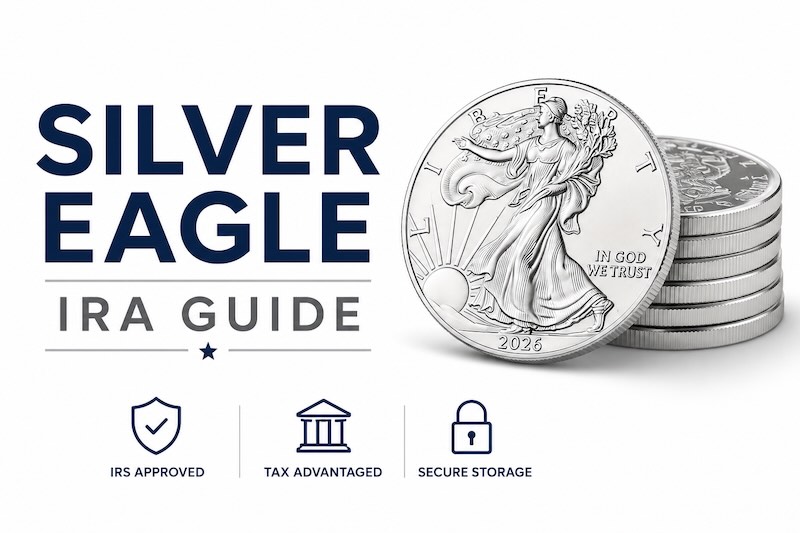
American Silver Eagles are one of the most common ways investors hold physical silver inside a retirement account. The U.S. Mint has produced them since 1986, and because they’re named directly in the tax code as an approved coin, they sidestep the fineness debate that applies to most other silver products.
This guide covers the mechanics of adding Silver Eagles to a precious metals IRA, the IRS rules you have to follow, what it actually costs, and how to decide whether the structure is worth it for your situation.
IRS Requirements for Silver in an IRA
The IRS permits certain precious metals to be held in self-directed Individual Retirement Accounts (IRAs), subject to specific fineness and purity standards outlined in Internal Revenue Code Section 408(m)(3)(A).
Silver Fineness Standards
For most silver bullion products held in an IRA, the metal must be .999 fine (99.9% pure). This requirement ensures high-quality, investment-grade products and prevents lower-purity items from being used as tax-advantaged vehicles.
American Silver Eagles are a special case. They’re named specifically in the statute as an approved coin, so they qualify regardless of the general fineness rule. As it happens, the point is moot: a Silver Eagle is .999 fine (99.9% silver) and contains one full troy ounce of silver, with a trace of copper added for durability, so it meets the standard anyway.
Other IRA-Approved Silver Products
Beyond Silver Eagles, the following silver products can be held in precious metals IRAs:
- Canadian Silver Maple Leafs — Must be .9999 fine
- Austrian Silver Philharmonics — Must be .999 fine
- British Silver Britannias — Must be .999 fine
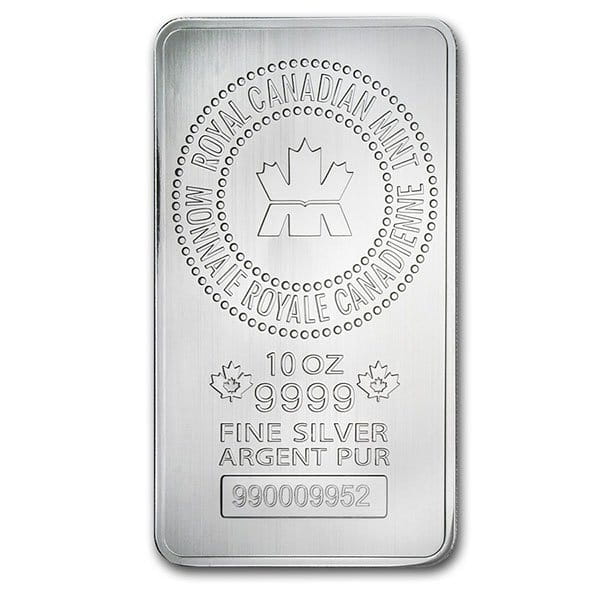
- Silver Bars and Rounds — Must be .999 fine and sourced from specific IRS-approved refiners (such as PAMP, Valcambi, Sunshine Mint, and others)
Bullion bars from major refiners are generally acceptable, but always verify with your IRA custodian before purchasing to avoid holding non-eligible metals.
Which Silver Eagle Products Are IRA-Eligible
Not all Silver Eagle products make equal sense for an IRA, though the IRS rules are more flexible than many investors assume.
Eligible Formats
- Brilliant Uncirculated (BU) Coins — Single coins or tubes of 20. Any year of minting is eligible. These represent the standard for IRA holdings.
- Monster Boxes — 500-coin boxes of BU Silver Eagles are fully eligible. Common among larger IRA holders.
- Mini Monster Boxes — 100-coin boxes offer a middle ground between singles and full monsters.
Proof and Certified Coins
Proof Silver Eagles and coins with third-party certification (PCGS, NGC) can technically be held in IRAs, but they represent a less practical choice:
- Higher Premiums: Proof coins and certified coins carry significantly higher premiums above spot price (often 15-30% or more).
- Lower IRA Value: Since an IRA’s purpose is tax-advantaged savings and growth, paying premium prices that don’t enhance investment returns diminishes the account’s efficiency.
- Rarity vs. Investment: Certified collectible coins appeal to numismatists; precious metals IRAs serve investors focused on bullion content.
Bottom line: For IRA purposes, standard BU Silver Eagles represent the most cost-effective path to physical silver exposure.
Grading Is Not Required
IRA metals don’t need to be certified or graded. Your custodian and depository care about purity and weight, not a plastic slab — grading adds cost without adding eligibility.
How a Precious Metals IRA Works
A precious metals IRA follows a specific structure to maintain its tax-advantaged status.
1. Select a Custodian
Open an account with a custodian approved by the IRS to administer precious metals IRAs. Reputable custodians include:
- Equity Trust Company
- GoldStar Trust Company
- The Entrust Group
- Directed Trust Company
- Equity Institutional
Your custodian serves as the account administrator and holds legal title to the metals on your behalf.
2. Fund Your Account
There are three primary ways to fund a precious metals IRA:
- IRA Rollover: Transfer funds from a 401(k) or other qualified retirement plan (subject to rollover rules and any applicable waiting periods).
- IRA Transfer: Move funds from an existing traditional or Roth IRA at another financial institution.
- New Contribution: Make a direct contribution if you have earned income and haven’t exceeded annual contribution limits (verify current limits at IRS.gov — amounts adjust periodically for inflation).
3. Select a Dealer and Purchase Metals
Once your IRA is funded, work with a bullion dealer to select and purchase Silver Eagles. The dealer you choose should:
- Accept IRA purchases
- Ship directly to your depository (not to your home)
- Provide competitive pricing
- Offer transparent fee structures
You never take physical possession of the metals—this is critical for maintaining IRA tax status.
4. Direct to an IRS-Approved Depository
The dealer arranges for your metals to ship directly to an IRS-approved storage facility (depository), typically via insured courier. The depository receives the metals, performs a final inspection, catalogs them, and stores them in a segregated vault.
Your metals remain in storage for the life of your IRA, or until you take a distribution.
Custodian and Storage Requirements
One of the most important rules in precious metals IRAs is the segregation requirement: You cannot store IRA metals at home, in a personal safe deposit box, or anywhere outside of an IRS-approved facility. Violation of this rule results in a taxable distribution—potentially triggering a 10% penalty if you’re under age 59½.
Approved Depositories
Major precious metals depositories approved by the IRS for custodial storage include:
- BRINKS — Multiple U.S. locations, high-security vaults
- Loomis — Regional depository services
- Delaware Depository — Specializes in precious metals storage
- International Vaults — Private vault operator with IRS-approved facilities
Your custodian will coordinate with the depository and maintain records of your holdings.
Annual Storage and Insurance Fees
Storage is not free. Expect:
- Custodian Fees: Typically $100-$300/year, depending on account activity and complexity
- Depository/Storage Fees: Usually $100-$300/year based on the value of metals stored (often charged as a percentage of holdings)
- Insurance: Included in many depository packages but verify with your provider
Total typical annual cost: $200-$600 for a modest IRA.
These fees are tax-deductible (as part of your IRA’s administrative costs) if you itemize deductions, though in most cases they’re absorbed within the IRA itself.
Cost Analysis: Is a Silver Eagle IRA Worth It?
The decision to hold Silver Eagles in an IRA requires an honest assessment of costs versus potential benefits.
Total Cost of Ownership
Four cost layers compound here: the dealer markup (typically 8–15% over spot), a one-time custodian setup fee (usually $50–$200), annual custodian and storage fees ($200–$600/year), and potential exit costs when you liquidate or take distributions.
Break-Even Analysis
Take a $10,000 Silver Eagle IRA with $250 in annual fees:
- Silver’s spot price needs to rise about 2.5% a year just to cover the administrative cost.
- Held flat for 20 years with no appreciation, the fees alone drain roughly $5,000.
- The larger the account and the stronger silver’s run, the smaller a drag those fixed fees become.
Silver Eagles vs. Silver ETFs
For investors who only want price exposure to silver, iShares Silver Trust (SLV) and similar exchange-traded funds are usually cheaper to hold:
- SLV’s expense ratio is 0.50% annually. On a $10,000 position that’s about $50/year, versus the $200-$600 in flat custodian and storage fees a precious metals IRA typically carries.
- No storage or insurance fees, and no custodian or depository required.
- For long-term gains, SLV is taxed as a collectible (up to 28%), the same treatment as physically held silver, so the ETF route doesn’t give up the tax angle.
- Shares trade instantly during market hours.
When a Silver Eagle IRA Makes Sense
A precious metals IRA is worth considering if you:
- Specifically desire physical possession and ownership of tangible silver
- Want to emphasize diversification into non-financial assets
- Believe strongly in long-term silver appreciation sufficient to justify fees
- Have a substantial IRA balance where annual fees are a smaller percentage drag
- Are uncomfortable holding a digital or ETF-based asset
A Silver Eagle IRA is less cost-effective if:
- You’re focused purely on spot-price exposure
- Your account size is small (fees represent 5%+ annual drag)
- You have a short time horizon (costs eat returns)
- You prefer liquid, easily tradable assets
Buying Silver Eagles for Your IRA
Finding IRA-Eligible Dealers
Many bullion dealers accept IRA purchases. When evaluating one, confirm:
- IRA-Eligible Sales: Ask explicitly whether they offer IRA-directed purchases.
- Custodian Relationships: Reputable dealers work with multiple custodians and can coordinate the shipping process.
- Pricing Transparency: Compare dealer markups across multiple sources (FindBullionPrices tracks live Silver Eagle prices across dealers to help with this).
- Shipping to Depository: Verify they’ll ship directly to your custodian’s approved depository, not to your home address.
Once your account is open and funded, your custodian provides depository shipping instructions and you place the order through your chosen dealer. The dealer ships directly to the depository (insured); you never physically handle or receive the metals — that separation is what keeps the IRA’s tax status intact.
Frequently Asked Questions
Can I store my IRA Silver Eagles at home?
No. Storing IRA metals at home, in a personal safe, or anywhere outside an IRS-approved depository is a prohibited transaction under IRC Section 4975. The IRS treats this as a distribution, triggering immediate taxation on the full account value. If you’re under 59½, you also face a 10% early withdrawal penalty. The only exception is if you take a qualified distribution (after age 59½, disability, or death), at which point you can take physical possession—but this terminates the IRA’s tax-advantaged status for that distributed amount.
Are Proof Silver Eagles eligible for IRAs?
Technically yes, but rarely worth it. Proof coins meet purity standards and can be held in precious metals IRAs. Their 15–30% premium over spot makes them inefficient for IRA purposes — the account’s goal is tax-advantaged growth of bullion value, not numismatic appreciation. Standard BU coins achieve the same IRA benefits at a fraction of the cost.
What is the minimum investment for a Silver Eagle IRA?
There’s no regulatory minimum, but practical considerations apply:
- Most custodians have account minimums ($500-$2,500)
- Depository and storage fees are fixed or percentage-based, making very small accounts inefficient
- Dealer purchase minimums (usually 1-10 coins) apply
- With $1,000 in annual fees on a $3,000 IRA, the cost drag is extreme
Most financial advisors suggest a minimum of $5,000-$10,000 for a Silver Eagle IRA to make fees proportionate.
Can I take physical delivery of my IRA Silver Eagles?
Yes, but with tax consequences. If you’re age 59½ or older, become disabled, or the account beneficiary receives metals after your death, you can request a distribution. The depository will ship metals to your address, but this is treated as a taxable distribution and the metals are no longer IRA-held. If you’re under 59½ and not disabled, taking a distribution on non-qualified grounds triggers full taxation plus a 10% penalty.
Summary: Is a Silver Eagle IRA Right for You?
American Silver Eagles are IRA-eligible by statute, easy to buy, widely recognized, and liquid, which makes them a reasonable core holding for retirement diversification. Held in a traditional IRA, the growth is tax-deferred; in a Roth, it’s tax-free.
However, costs matter. Annual fees ranging from $200-$600 represent real drag on returns. Before opening an account, honestly assess whether:
- Your account size is sufficient to justify annual costs
- You have a medium-to-long time horizon (10+ years)
- Silver appreciation potential justifies the fee structure relative to alternatives like ETFs
- You specifically value physical ownership over digital/fund-based ownership
For investors who fit that profile—larger IRAs, real conviction in silver, and a preference for tangible assets—a Silver Eagle IRA is a sound, tax-advantaged way to diversify. For most others, a low-cost ETF or holding the coins outside an IRA will keep more of the return.
Before opening an account, talk to a tax professional or financial advisor about how a precious metals IRA fits your overall retirement plan. To compare current dealer pricing on Silver Eagles, see the Silver Eagle price comparison. For background on how markups work, the Silver Eagle premiums guide covers what to expect from different dealers and quantities.