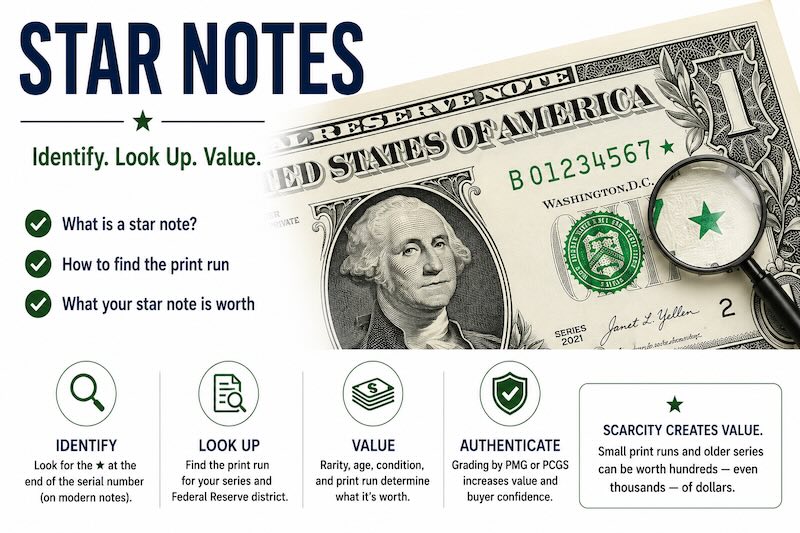
A star note is a replacement bill — printed by the Bureau of Engraving and Printing when a regular note is damaged or misprinted during production. You can spot one instantly: there’s a small star (★) at the end of the serial number instead of a letter. Most star notes are worth face value, but some — particularly those from small print runs and older series — sell for many times their denomination. The difference comes down to one thing: how many were printed.
This guide shows you how to identify a star note, look up its print run, and figure out what yours is actually worth.
This guide is part of our US Paper Money Value Guide.
What Is a Star Note?
When the BEP prints currency, every note gets a unique serial number in sequence. If a note is found defective during printing or inspection, it’s pulled and destroyed — but the serial number can’t simply be reused without breaking the count. Instead, the BEP prints a replacement note with its own separate serial range, marked with a star to show it stands in for the damaged original.
Star notes have existed since 1910. They’re printed in much smaller quantities than regular notes, and that scarcity is what creates collector value. The star appears:
- at the end of the serial on modern small-size Federal Reserve Notes (e.g., B 01234567 ★), and
- at the beginning on most older large-size notes.
A star note that also has a fancy serial number is worth a premium on both counts.
How to Tell If a Star Note Is Valuable
Three factors drive a star note’s value, in order of importance:
1. Print run size. This is everything. The BEP publishes how many star notes were printed for each series, denomination, and Federal Reserve district. A “run” can be anywhere from a few hundred thousand to several million. Small runs — roughly under 640,000, and especially under 320,000 — are where the value is. A note from a run of 9.6 million is common; a note from a run of 160,000 is genuinely scarce.
2. Series and age. Modern star notes (1990s–present) are common unless the run is unusually small. Vintage star notes carry much larger premiums — Silver Certificate stars, red seal (Legal Tender) stars, and pre-1950 Federal Reserve Note stars are all sought after regardless of run.
3. Condition. As with all paper money, crisp uncirculated notes are worth multiples of the same note in circulated condition. Notes worth $100+ benefit from PMG or PCGS grading.
How to Look Up Your Star Note’s Print Run
To value a star note you need its print-run data. Here’s the manual process:
- Record four things from the note: the denomination, the series year (printed near the portrait), the Federal Reserve district (the letter/number, or named bank), and the serial number range.
- Find the run. Star-note production figures are published by series, district, and serial block. Cross-reference your note’s serial range against the printed runs to find how many notes were in that run.
- Judge the scarcity. Under ~640,000 is collectible; under ~320,000 is scarce; the smallest runs (tens of thousands) are the valuable ones.
- Check the market. Search completed sales for the exact series, denomination, and district to see current prices.
Coming soon: we’re building a Star Note Lookup — enter your serial number and series and it returns the print run and rarity automatically, so you can skip the cross-referencing. Until then, the steps above get you there.
What Star Notes Are Worth
Approximate ranges for star notes in crisp uncirculated condition. Run size moves these substantially.
| Type | Typical value |
|---|---|
| Modern $1 star, large run (1M+) | Face value–$5 |
| Modern $1 star, small run (under 640K) | $5–$25 |
| Modern $1 star, very small run (under 250K) | $25–$100+ |
| Modern $100 star, small run | $200–$500+ |
| 1928–1957 Silver Certificate star | $20–$1,000+ |
| Red seal (United States Note) star | $25–$500+ |
| Pre-1950 Federal Reserve Note star | $50–$1,500+ |
| Star note with a fancy serial number | Premium on top of both |
The single biggest mistake collectors make is assuming any star note is valuable. Most modern ones aren’t — the print run is the deciding factor, which is exactly why the lookup step matters.
Where to Buy and Sell Star Notes
eBay is the largest marketplace; completed-listing search is the best price gauge. Collector forums and currency dealers handle the scarcer vintage stars. For valuable notes, PMG or PCGS grading provides authentication and improves liquidity — the same grading logic that applies to high-denomination bills and key-date notes.
A Note for Bullion Investors
Like sorting junk silver for key dates, star-note collecting rewards knowing what to check before everyone else does. It’s an accessible, change-jar entry point into paper money for anyone who already thinks like a precious metals stacker — the value is in the scarcity, and the scarcity is knowable.
Related Guides
- US Paper Money Value Guide — What every type of collectible US bill is worth
- Fancy Serial Numbers Guide — The other way a bill’s serial number adds value
- $2 Bill Value Chart — Including $2 star notes
- Silver Certificate Values — Including Silver Certificate star notes
Disclaimer: This article is for informational and educational purposes only. It is not financial or investment advice. FindBullionPrices.com is a price comparison platform and does not sell bullion or currency notes.