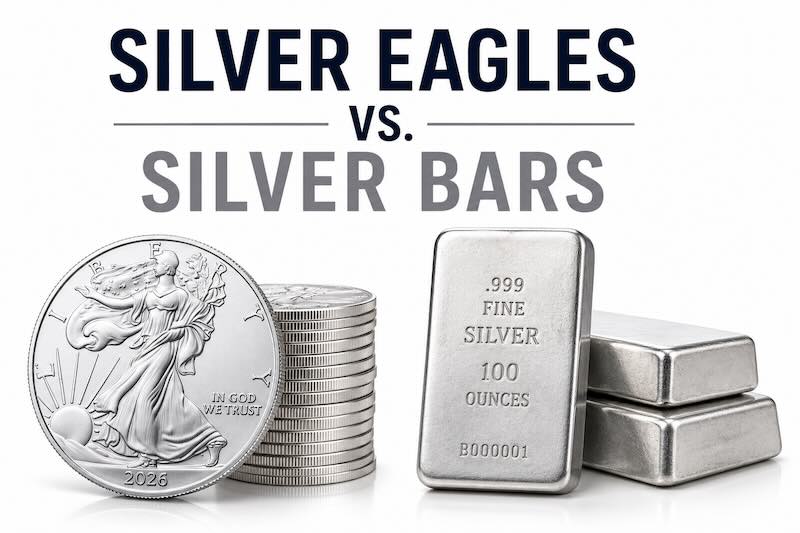
New silver buyers eventually face the same question: coins or bars? Both give you physical silver, but they differ meaningfully in premium, liquidity, authentication, divisibility, and long-term flexibility. Which is right for you depends on why you’re buying.
The Premium Comparison: Bars Cost Less Per Ounce
This is the most important practical difference. Silver bars carry the lowest premiums in the bullion market, especially in larger sizes:
- 1 oz silver bar: $2.00–$3.50 per ounce over spot
- 10 oz silver bar: $1.0–$2.55 per ounce over spot
- 100 oz silver bar: $0.75–$2.00 per ounce over spot
- Silver Eagles: $3.00–$8.00 per ounce over spot
In real dollars, on a 100-ounce purchase:
- 100 oz bar: $0.75–$2.00 premium × 100 oz = $75–$200 total
- 100 Silver Eagles: $3.00–$8.00 premium × 100 oz = $300–$800 total
That’s a $225–$600 difference on a single purchase. Over years of stacking, it adds up substantially.
The reason for the gap is straightforward: Silver Eagles are legal tender coins struck by the U.S. Mint, carry anti-counterfeiting technology, and come with the implicit backing of the federal government. Those features command a premium. Silver bars are simpler products made from refined metals, and stamped, making them less expensive to manufacture.
If your goal is accumulating the most silver per dollar, bars win.
Liquidity and Resale: Eagles Have the Edge
Silver Eagles are among the most widely recognized and traded silver products in the world. When you want to sell, every major dealer usually buys them instantly, bid/ask spreads are published and consistent, and buyers know exactly what they’re getting.
Silver bars are also highly liquid, but with caveats:
- Generic bars from lesser-known refiners may face a small discount on resale
- Branded bars from established refiners—PAMP Suisse, Valcambi, Sunshine Mint, Royal Canadian Mint—trade near coin-level liquidity
- Larger bars (100 oz, kilo) are harder to move than smaller ones because fewer retail buyers want a single large piece
For casual stackers, this difference is minimal. If you might need to liquidate quickly to cover an unexpected expense, the Silver Eagle’s become practical insurance.
Government Backing and Authentication
Silver Eagles are legal tender coins issued by the U.S. Mint, with specific weight and dimensions, a reeded edge, and anti-counterfeiting features built in. Counterfeits exists and are widely available on eBay. So be cautious of any coins being offered below spot or that ship from China.
Most silver bars carry no government backing or legal tender status. Counterfeiting risk is somewhat higher with generic bars, though still low in practice. The major refiners address this directly:
- PAMP Suisse and Valcambi include assay certificates and security features
- Sunshine Mint bars carry the MintMark SI authentication mark
- Most large refiners include serial numbers for traceability
If you buy bars from established refiners and keep your assay cards, authentication is a non-issue for the vast majority of buyers.
Size and Divisibility: Coins Win on Flexibility
Silver Eagles come in one size: 1 troy ounce. That standardization is genuinely useful. If you need to sell a portion of your holdings—to rebalance, cover something, or give as a gift—you can remove exactly what you need. 50 Eagles equals 50 ounces.
Silver bars are available in multiple sizes:
- 1 oz
- 5 oz
- 10 oz
- 1 kilo (~32.15 oz)
- 100 oz
- 1,000 oz (industrial)
The range sounds flexible, but it creates a divisibility problem. If you own a single 100 oz bar and need 30 ounces, you either sell the whole bar and take the spread in both directions, find a buyer for exactly 70 oz, or hold the bar intact. None of those are great options.
Many experienced stackers solve this by owning a mix of 10 oz and 100 oz bars rather than consolidating into one large piece.
Storage: Bars Are More Compact
Silver bars pack more efficiently than coins. A standard 100 oz silver bar measures roughly 6.5″ × 3.5″ × 1.25″ and takes up significantly less volume than 100 individual Silver Eagle coins. If you’re storing 500 ounces or more, that difference matters in a safe or safe deposit box.
Where coins have a handling advantage is portability at smaller quantities—a tube of 20 Eagles slips easily into a pocket. At larger quantities, a monster box of 500 Eagles (about 34 lbs, roughly the same weight as a five 100 ounce bars) ships in a manageable box. Five 100 oz bars, although the same weight, require individual handling.
IRA Eligibility: Both Qualify, With a Caveat
Silver Eagles are explicitly listed as permissible IRA investments under IRC Section 408(m), which references American Silver Bullion Coins by name. No additional verification required.
Silver bars qualify too, provided they meet two criteria:
- Fineness of .999 or higher
- Produced by a refiner approved by a national accreditation organization (NYMEX, COMEX, ISO 9000, or similar)
Most major brand bars meet these criteria: PAMP Suisse, Valcambi, Sunshine Mint, RCM, Asahi, and others. Generic or off-brand bars may not—verify with your IRA custodian before purchasing.
For retirement accounts, Silver Eagles are simpler because there’s nothing to verify.
The Hybrid Approach
Many experienced buyers own both. Bars handle the bulk of cost-efficient accumulation; Eagles provide liquidity and easy divisibility when needed. A common allocation:
- 60–70% silver bars — core stacking at the lowest cost per ounce
- 30–40% Silver Eagles — liquidity layer and easy partial sales
For a 200-ounce stack, that might look like 140 oz in 10 oz and 100 oz bars (7 bars total), plus 60 Silver Eagles for the liquid portion.
This gives you cost efficiency on the bulk of your holdings and flexibility on the portion you might actually need to access.
FAQ
Are silver bars cheaper than Silver Eagles?
Yes. Silver bars typically carry $0.50–$1.75/oz premiums depending on size, while Silver Eagles carry $3.00–$6.00/oz premiums. Over time, buying bars saves hundreds of dollars per 100 ounces. The trade-off is slightly lower divisibility and, in some cases, marginally less liquidity.
Do Silver Eagles hold their value better than bars?
Both are valued primarily for their silver content, so both rise and fall with the silver price. Silver Eagles sometimes retain a modest premium advantage during uncertain markets because of their government backing and instant recognition, but the difference is typically small.
What size silver bar offers the best value?
10 oz and 100 oz bars generally offer the lowest premiums per ounce. The 1 oz and 5 oz bars carry slightly higher markups because handling costs don’t scale down proportionally. The kilo bar (32.15 oz) sits in the middle and offers solid value. Very large bars (500+ oz) are best held long-term—they’re difficult to liquidate in a hurry.
Can I hold both Silver Eagles and bars in an IRA?
Yes. You can hold both in a self-directed IRA as long as both meet the fineness requirement (.999 or higher). Silver Eagles are automatically eligible. Major brand bars typically qualify; confirm with your IRA custodian before purchasing.
Which Should You Buy?
If you’re focused on accumulating maximum ounces at the lowest cost and plan to hold long-term, bars make more sense. If you might need to liquidate portions, want something universally recognized, or prefer the simplicity of a government-issued product, Silver Eagles are worth the premium.
For most buyers with a meaningful stacking goal, the right answer is a mix of both.