The serial number printed on a US bill is more than a tracking code. To collectors, certain number patterns turn an ordinary $1 note into something worth $20, $200, or in rare cases thousands of dollars — even on a crisp bill straight from the bank. These are called fancy serial numbers, and checking for them takes about ten seconds once you know what to look for.
This guide covers every major fancy-serial pattern, what each is realistically worth, and how to check the bills in your wallet right now.
Every modern US note carries an eleven-character serial number: a letter, eight digits, and a letter — for example B 12345678 C. On Federal Reserve Notes, the first letter identifies the issuing Federal Reserve district, and the digits run in sequence as notes are printed. A small star (★) in place of the final letter marks a replacement (star) note, which carries its own premium.
For fancy-serial collecting, the part that matters is the eight digits. Collectors look for digits that form a recognizable, low-probability pattern. The rarer the pattern, the higher the premium — and the lower the denomination on which it appears, the more impressive the find (a fancy serial on a $1 is just as collectible as on a $100).
The Collectible Patterns — and What They’re Worth
Values below are typical ranges for modern small-size notes in crisp uncirculated condition. Vintage notes, star notes, and notes graded by PMG or PCGS can bring substantially more. The market is driven heavily by eBay and dedicated collector communities, so values move with demand.
Low Serial Numbers
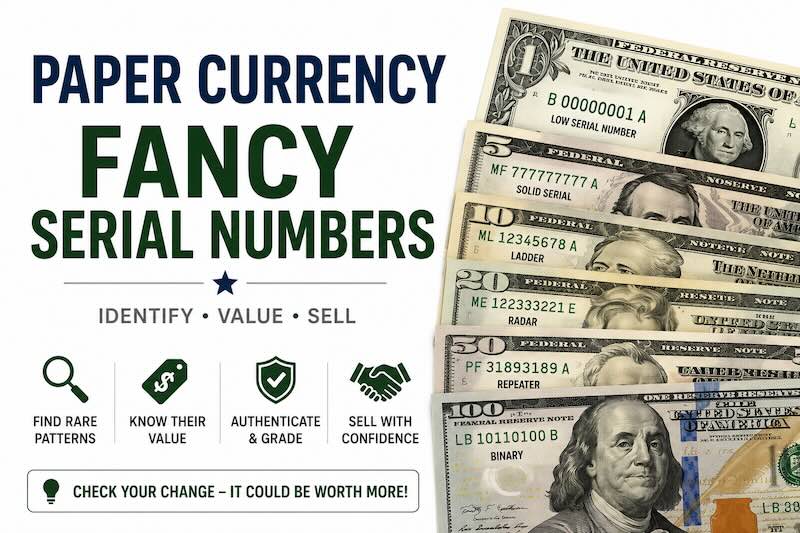
Notes numbered from 00000001 upward. The lower the number, the higher the value. A serial under 100 is collectible; single-digit serials (00000001–00000009) are trophies.
00000100–00001000: $25–$75
00000010–00000099: $50–$300
00000001–00000009: $300–$15,000+ (number 1 notes of a series command the most)
Solid Serial Numbers
All eight digits the same — 77777777. Eight-of-a-kind. Among the most sought-after patterns; only one in roughly 11 million notes qualifies.
Typical: $500–$1,500+
Ladders
Digits ascending or descending in perfect sequence — 12345678 or 87654321. A “true ladder” uses all eight positions.
True ladder: $1,000–$2,500+
Near-ladder (e.g., 12345670): $50–$200
Radars (Palindromes)
Reads the same forwards and backwards — 12344321. A “super radar” has matching digits except the middle two (e.g., 17777771).
Radar: $20–$150
Super radar: $75–$400
Repeaters
The first four digits repeat as the last four — 31893189. A “super repeater” repeats a two-digit block four times — 81818181.
Repeater: $20–$100
Super repeater: $100–$400
Binary and Trinary Notes
A binary uses only two distinct digits (e.g., 10110100). A true binary uses only 0s and 1s. A trinary uses only three digits.
Binary: $10–$50
True binary (0s and 1s only): $100–$500
Birthday and Date Notes
Eight digits that read as a date — 07041976 (July 4, 1976) or 12252000. Not rare, but there’s a steady sentimental market for them.
Typical: $5–$50 (more for milestone or famous dates)
Bookends (first three digits mirror the last three): $10–$40
Flipper (reads as a valid number upside down, using only 0,1,6,8,9): $25–$150
How to Check Your Bills
Pull the eight digits out of the serial number (ignore the prefix and suffix letters).
Scan for a pattern from the list above — solids and ladders jump out; radars and repeaters take a second look.
Check for a star (★) at the end of the serial — a star note with a fancy serial is worth a premium on both counts.
Note the denomination and condition. Crisp, uncirculated notes are worth multiples of the same serial on a worn bill.
Confirm the market. Search completed listings for the exact pattern and denomination to see what buyers are actually paying right now.
Coming soon: we’re building a Fancy Serial Number Checker — enter your serial number and it identifies every pattern your note matches, instantly. Until then, the manual steps above will catch every major type.
Where to Sell Fancy Serial Number Notes
The two main markets are eBay (largest volume; use completed-listing search to gauge price) and dedicated collector communities and forums where “cool serial number” specialists trade. For high-value patterns — true ladders, solids, very low serials — third-party grading by PMG or PCGS improves both authentication and price, the same way grading works for high-denomination notes. Notes worth $500+ generally sell better graded than raw.
A Note for Bullion Investors
Fancy-serial collecting is a low-cost, high-curiosity entry point into paper money — you can start by checking change you already have. For precious metals investors, it’s the same instinct that drives sorting junk silver for key dates: the value is hiding in plain sight, and knowing what to look for is the entire edge.
Disclaimer: This article is for informational and educational purposes only. It is not financial or investment advice. FindBullionPrices.com is a price comparison platform and does not sell bullion or currency notes.