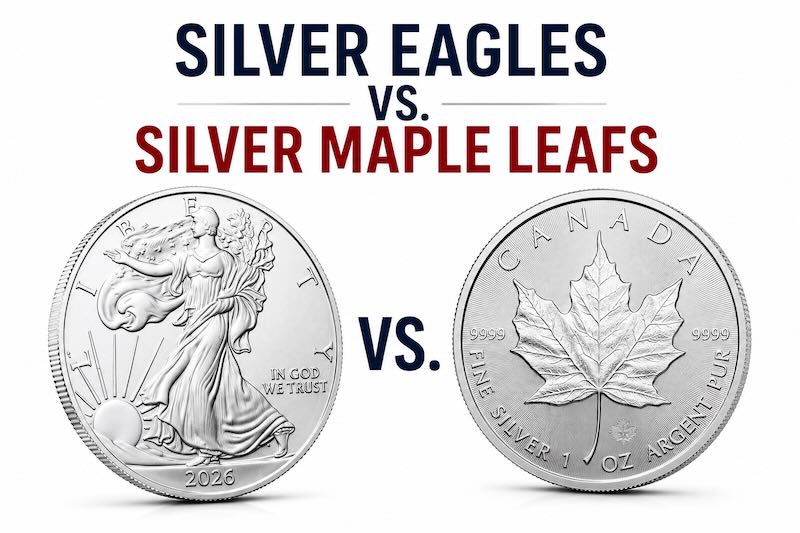
The American Silver Eagle and the Canadian Silver Maple Leaf are the two most widely traded silver bullion coins in the world. Both are one-troy-ounce government-minted coins, both are IRA-eligible, and both are liquid enough to sell anywhere silver is bought and sold. For most buyers the choice comes down to premium, purity preference, and where you plan to sell.
Here’s what actually separates them.
Specs at a Glance
| American Silver Eagle | Canadian Silver Maple Leaf | |
|---|---|---|
| Issuing mint | U.S. Mint | Royal Canadian Mint |
| First issued | 1986 | 1988 |
| Silver content | 1 troy oz | 1 troy oz |
| Purity | .999 fine | .9999 fine |
| Face value | $1 USD | $5 CAD |
| IRA eligible | Yes | Yes |
| Typical premium over spot | Higher | Lower |
Purity: .999 vs. .9999
The Maple Leaf is purer — .9999 fine (four nines) versus the Eagle’s .999 fine (three nines). In practice, both coins contain exactly one troy ounce of silver, so the difference in silver content is negligible: a .9999 coin has 0.03% less alloy filler than a .999 coin. Neither has a meaningful investment implication.
The Eagle’s .999 purity reflects the small amount of copper alloyed in for durability. The Maple Leaf’s .9999 purity actually makes it slightly softer, which is one of the reasons Maple Leafs are more prone to milk spotting (more on that below).
The four-nines purity matters more to buyers in some international markets — particularly in Asia, where .9999 is a common standard and .999 coins sometimes sell at a slight discount relative to purer alternatives.
Premiums and Pricing
Silver Eagles consistently carry a higher premium over spot than Maple Leafs. In a normal market, the gap runs roughly $2–4 per coin, though it widens during supply crunches (like 2021–2022, when ASE premiums hit $8–10 over spot) and narrows when supply is ample.
The premium gap exists because:
- U.S. Mint pricing. The Mint charges authorized purchasers a fixed premium above spot, and that floor gets passed through to retail buyers. The Royal Canadian Mint’s structure is more flexible.
- Domestic demand. Silver Eagles are the default choice for American buyers and dealers. Higher demand relative to supply supports the premium.
- Collector crossover. The Eagle’s rich proof and special-edition history (see the Special Editions guide) creates a broader collector base that competes for the same bullion supply.
For a cost-conscious stacker focused purely on silver ounces, Maple Leafs typically get you more metal per dollar. Compare live prices on Silver Eagles and Maple Leafs across dealers before buying.
Liquidity and Resale
Both coins are highly liquid. Any coin dealer, pawn shop, or online precious metals buyer in North America will buy either without hesitation.
Silver Eagles have a slight edge in the U.S. market. Dealers know them immediately, don’t need to weigh or test them on sight, and can sell them quickly to retail buyers who specifically want Eagles. That familiarity means you rarely lose anything on the spread versus a lesser-known product.
Maple Leafs are arguably more liquid internationally. They’re the standard bullion coin across much of Europe, Asia, and the Middle East, where Silver Eagles are recognized but less actively sought. If you ever plan to sell outside the U.S., this matters.
For most American retail sellers, the practical liquidity difference is small enough that premium cost dominates the decision.
IRA Eligibility
Both coins are IRA-eligible, but via different routes.
Silver Eagles are named specifically in the tax code (IRC Section 408(m)(3)(A)) as an approved coin, so they qualify regardless of the general fineness rules. See the Silver Eagle IRA Guide for the full mechanics.
Silver Maple Leafs qualify under the general fineness rule — .9999 easily clears the .999 minimum for silver bullion held in a self-directed IRA. Any custodian that handles precious metals IRAs will accept them.
There’s no tax or account advantage to holding one over the other in an IRA. The choice comes back to premium cost and your custodian’s current pricing.
Collectibility
This is where the coins diverge most sharply. The Silver Eagle has a deep collector market built over nearly 40 years of production:
- Annual proof issues (West Point, San Francisco)
- Burnished uncirculated coins
- Special editions: the 2019-S Enhanced Reverse Proof, the 2021 Type 1/Type 2 transition, the 2021-W Reverse Proof, anniversary sets
- Key dates with meaningful numismatic premiums above bullion value
The Silver Eagle Special Editions Guide covers the collector side in depth.
Maple Leafs have their own collector issues — privy marks, special finishes, colored coins — but the numismatic market for them in the U.S. is thin compared to Eagles. A collector building a complete date set or targeting specific mint marks will find far more to work with in Eagles.
For straight bullion stackers who never intend to collect, collectibility is irrelevant. For anyone who might crossover into collecting, Eagles offer more upside.
Milk Spotting
Milk spots are white or gray blotches that appear on silver coin surfaces, caused by a chemical reaction between residual mint chemicals and airborne contaminants. They can’t be removed without damaging the coin.
Maple Leafs have a well-documented milk spot problem. The Royal Canadian Mint has acknowledged the issue and introduced incremental improvements over the years, but it persists across many dates. A significant percentage of raw (ungraded) Maple Leafs develop spots within months or years of purchase, even in proper storage.
Silver Eagles are considerably less prone to milk spots. The alloy composition and minting process seem to reduce the risk, though it’s not zero — proofs and burnished coins can develop hazing under certain storage conditions.
If you plan to hold coins loose in tubes or roll them regularly, milk spotting risk matters. For investors who immediately slab their coins (PCGS or NGC), the risk is contained at certification.
Anti-Counterfeiting
The Royal Canadian Mint has invested heavily in security features since around 2014. Current Maple Leafs include:
- Bullion DNA: A laser-micro-engraved maple leaf on the reverse, readable only under a special RCM scanner used by authorized dealers. The pattern is unique to each coin’s production run.
- Radial lines: Fine concentric lines in the fields that are difficult to replicate and make counterfeits visible under direct light.
- Security privy mark: A small maple leaf with a laser-engraved year.
Silver Eagles rely on the complexity of their design and the reeded edge. The U.S. Mint has made periodic die improvements, and the Type 2 redesign (2021-present) introduced finer detail that raises the counterfeiting bar. That said, Eagles lack a coin-specific serialization or authentication technology equivalent to Bullion DNA.
For large-volume buyers dealing with unknown sources, the Maple Leaf’s authentication infrastructure is more robust. For buyers purchasing from reputable dealers, both coins are reliably authentic.
Which Should You Buy?
Silver Eagles make more sense if:
- You’re buying primarily to resell in the U.S. retail market
- You want IRA holdings with the broadest custodian familiarity
- You collect or plan to collect — the proof and special-edition market is far deeper
- You’re buying dates or mintmarks with numismatic potential
- Milk spotting risk concerns you
Silver Maple Leafs make more sense if:
- You’re focused on accumulating the most silver per dollar (lower premium)
- You plan to sell outside the United States
- You want the higher purity (.9999) for international markets where it matters
- You’re buying in large enough quantities that the per-coin premium gap compounds significantly
For most American investors who are building a silver position without a specific sale target, the premium difference is the deciding factor. Check live pricing on both — the gap fluctuates, and occasionally a supply shift narrows it enough to change the math.
Frequently Asked Questions
Are Silver Maple Leafs accepted by U.S. coin dealers?
Yes. Any dealer that buys bullion will take Maple Leafs. The price they offer is based on spot and their spread — the same as for any other .999+ silver coin.
Which coin has better resale value?
Over the long run, both track spot silver. Silver Eagles sometimes carry a slightly higher resale premium because U.S. dealers know they can resell them quickly at a premium to retail buyers. But the difference is modest and market-dependent.
Do Silver Maple Leafs tarnish?
They can develop milk spots (see above), which are a form of oxidation. They’ll also tarnish from improper storage — oils from handling, humidity, or acidic packaging accelerate surface changes. Store in airtight capsules or tubes, avoid touching the fields, and keep in low-humidity conditions.
Is the .9999 purity of Maple Leafs a meaningful advantage?
For investment purposes, no. The incremental silver content is negligible. It matters in some international markets as a quality signal, and some buyers prefer it on principle, but it doesn’t translate to higher returns in the U.S. market.