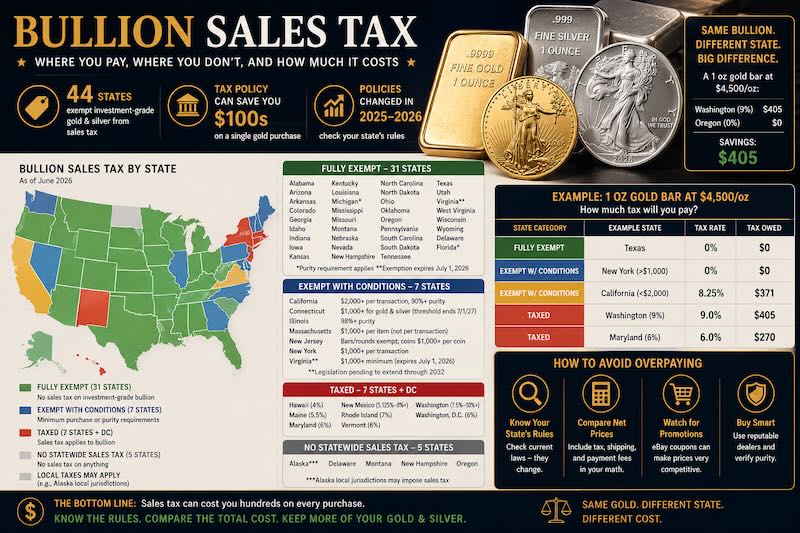
An investor in Washington state pays roughly $300 in sales tax when buying a single 1 oz gold bar. A buyer in neighboring Oregon pays zero. Same bar, same spot price, based entirely on state tax policy. That $300 gap is wider than the premium spread between the cheapest and most expensive online dealer on any gold product.
As of mid-2026, 44 states exempt investment-grade precious metals from sales tax, but the landscape shifted in 2025–2026. Washington and Maryland reversed their exemptions. Alaska, Florida, and Texas passed legal tender laws. Virginia’s exemption is set to expire. Here’s where every state stands right now.
No Sales Tax States
Alaska, Delaware, Montana, New Hampshire, Oregon — no statewide sales tax on anything. Bullion is tax-free by default.
Alaska’s 152 local tax jurisdictions can levy their own sales taxes, but HB 1 (passed May 2026, awaiting the governor’s signature) recognizes gold and silver as legal tender and prohibits municipalities from taxing specie transactions.
Online dealers calculate tax based on shipping destination. Buyers in taxed states who maintain storage in Oregon or Delaware pay no sales tax on those shipments — a strategy worth considering on large purchases. Compare gold and silver prices across dealers to find the lowest premium, and in these states, what you see is what you pay.
Fully Exempt States
These 31 states charge sales tax on most goods but fully exempt investment-grade bullion with no purchase minimum:
Alabama — bullion at 80%+ purity, the lowest threshold nationally. 90% silver coins qualify.
Arizona, Colorado, Kansas, Louisiana, Oklahoma, West Virginia, Wyoming — full exemption. All seven also recognize gold and silver as legal tender.
Arkansas (2021), Kentucky (2022), Ohio (2021), Mississippi, Tennessee, Wisconsin — all eliminated sales tax on precious metals in recent years.
Florida — exempt since July 2025. HB 999 also makes gold and silver legal tender starting July 1, 2026. Requires 99.5% gold / 99.9% silver purity. Passed unanimously in both chambers.
Georgia, Idaho, Indiana, Iowa, Missouri, Nevada, North Dakota, Pennsylvania, South Carolina, South Dakota — full exemption, no notable conditions.
Michigan — 90%+ purity threshold. Standard bullion products qualify.
Minnesota — 99.9% purity threshold, the strictest. American Silver Eagles meet it; some older coins may not.
Nebraska — full exemption on currency and bullion. Legislative efforts to repeal this have surfaced — worth monitoring.
North Carolina — expanded exemptions in January 2025 to cover coins, leaf, and foil forms alongside bullion.
Texas — full exemption. Governor Abbott signed HB 1056 (June 2025), making gold and silver legal tender effective September 2026 and authorizing an electronic payment system through the Texas Bullion Depository — depositors will be able to spend gold- and silver-backed digital credits via a debit card. No other state has built anything like this.
Utah — full exemption plus capital gains tax credits on precious metals. One of the first states to recognize gold and silver as legal tender.
In all 31 states, dealer premium is the only variable above spot. Find the cheapest gold and cheapest silver across dealers to maximize ounces per dollar.
Exempt with Conditions
Seven states offer exemptions but with purchase thresholds, purity requirements, or expiration dates:
California — exempt above $2,000 per transaction at 90%+ purity. Below $2,000, expect 7.25%+ (over 10% in some counties). Three $1,500 orders get taxed; one $4,500 order doesn’t. Consolidate purchases.
Connecticut — exempt above $1,000 for gold and silver. Copper, platinum, and palladium remain fully taxable. The $1,000 threshold disappears July 1, 2027.
Illinois — exempt at 98%+ purity. Most standard bullion qualifies.
Massachusetts — exempt on individual items valued at $1,000+. Per-item threshold, not per-transaction — a tube of 20 Silver Eagles at $35 each doesn’t qualify, even though the tube costs $700+.
New Jersey — bullion bars and rounds are fully exempt, no minimum. Coins need $1,000+ fair market value per coin. The coin threshold drops in July 2027.
New York — exempt above $1,000 per transaction. Below that, combined rates exceed 8% in NYC.
Virginia — currently exempt at $1,000+ minimum, but the exemption sunsets July 1, 2026. HB 2336 would extend it to 2032; HB 1600 (budget bill) extended it through July 2026. Verify current status before buying. If the exemption lapses, 5.3%+ applies.
Buyers near a threshold should check the current spot price and plan order size accordingly. Paying 7% tax on a $900 order costs $63 — adding $200 to clear the threshold costs nothing in tax and gets you more metal.
States That Tax Bullion
Seven states plus D.C. impose full sales tax on precious metals with no exemption:
Hawaii — 4% General Excise Tax.
Maine — 5.5%.
Maryland — 6%. This is a reversal: Maryland exempted purchases over $1,000 until HB 352 repealed the exemption effective July 2025. A $3,000 gold purchase now costs $180 more than it did a year ago.
New Mexico — gross receipts tax, 5.125%–8%+ depending on jurisdiction.
Rhode Island — 7%, one of the highest rates among states that tax bullion.
Vermont — 6%.
Washington — 7.5%–10%+ combined rate since January 1, 2026. Washington repealed its 40-year-old exemption under ESSB 5794. On a 1 oz gold bar, that’s $250–$350 in tax. This is the biggest negative change for bullion buyers in recent years, affecting both local and online purchases shipped to Washington addresses.
Washington, D.C. — 6%.
For buyers in these states, sales tax dwarfs any dealer premium difference. An 8% tax on a 1 oz gold coin is roughly $264 — a 1% premium difference on the same coin is about $33. Check the cheapest gold bullion and cheapest silver bullion across all dealers, then add your state’s rate to see the real per-ounce cost.
The Legal Tender Movement
A growing number of states now recognize gold and silver as money, not just a taxable commodity: Arizona, Colorado, Florida (July 2026), Kansas, Louisiana, Oklahoma, Texas (September 2026), Utah, West Virginia, Wyoming, and Alaska (pending). Legal tender recognition typically comes with full sales tax exemption. Some of these states are also reducing or eliminating state capital gains tax on precious metals, which cuts the cost of eventually selling.
Texas is the furthest along operationally, with its Bullion Depository infrastructure building toward a gold- and silver-backed electronic payment system. Whether other states follow that model or stick with symbolic recognition will shape how practical it becomes to hold and transact in physical metal.
What This Means for Buying
Sales tax should be the first variable you check — before comparing dealer premiums. In exempt states, the closest-to-spot gold and closest-to-spot silver pages show your real cost per ounce. In taxed states, add your rate on top. In threshold states, plan your order size to clear the minimum.
The dealer directory lists local shops by state with tax policy details. The deals page tracks spot-price promotions that can eliminate the dealer premium entirely — making tax status the only cost above spot.