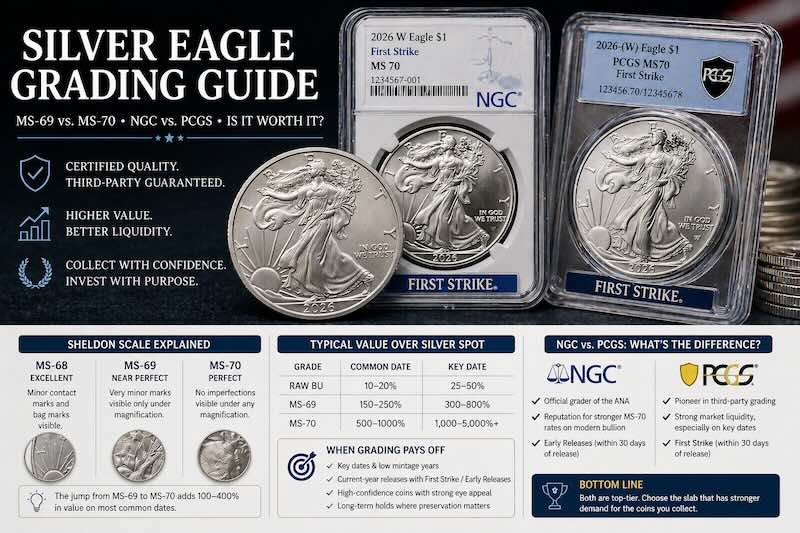
Coin grading turns a raw bullion coin into a certified collectible, and in the case of American Silver Eagles, can multiply its market value several times over. Whether that premium covers the cost of grading depends on the date, the grade, and how much you trust your eye.
What Grading Means for Modern Silver Eagles
The Sheldon scale runs 1 to 70, but for modern bullion only the top end matters:
- MS-65 to MS-68: Visible bag marks, scratches, or strike weakness. Rare on submitted Silver Eagles.
- MS-69: Near-perfect. Minor contact marks visible only under magnification. Most raw “BU” Silver Eagles from recent years grade here.
- MS-70: Flawless under any magnification. The collector ceiling.
A “BU” or “Brilliant Uncirculated” coin from a bullion dealer hasn’t been examined by a third party. You can’t predict if it will grade anywhere from MS-65 to MS-70.
MS-69 vs. MS-70: The Real Difference
To the naked eye, MS-69 and MS-70 coins are usually indistinguishable. The grade jump is decided by graders working with magnification and standardized lighting. The market doesn’t care about that — it cares about the label on the slab.
For common-date Silver Eagles, MS-70 typically trades at a higher premium than an MS-69. The step from MS-68 to MS-69 adds little to the coin’s value. The step from MS-69 to MS-70 can add 20 to 40%. Most of the grading-cost economics live in that final step.
In numismatic-premium terms (over silver spot):
- Raw BU: ~5–10% over spot
- MS-69, common date: ~30–40% over spot
- MS-70, common date: ~50–60% over spot
These ranges shift with spot, but the ratios between grades are common.
NGC vs. PCGS
Both are tier-1, both are widely respected, and both use tamper-evident slabs. Choosing between them is more a question of market liquidity than quality.
NGC — official grading service of the ANA. Often perceived to grade modern bullion slightly more generously, which translates into higher MS-70 rates on contemporary issues. Their Early Releases label applies to coins received within 30 days of the Mint’s release.
PCGS — pioneered third-party grading. Slabs from PCGS can command modestly higher premiums on older key dates. Their equivalent label is First Strike.
For Silver Eagles, the practical question is which slabs trade more actively for the dates you collect. Check recent sold comps on each service’s price guide before deciding.
First Strike, Early Releases, and FIRST30
Both labels mean the same thing: coin submitted within 30 days of the Mint’s initial release. They’re about timing, not condition. The label adds roughly 10–15% premium to a current-year graded coin.

SD Bullion’s MintCertified FIRST30 program with NGC handles the timing logistics. Coins are sourced directly from the Mint in sealed Monster Boxes, and then submitted for grading within the 30-day window. Buyers get the Early Releases designation when the seal is broken and the coin is slabbed. Convenient if you want the label without submitting the coin yourself.
The Grading Economics
Grading fees are a flat dollar cost regardless of the coin’s value:
- Standard (~20–40 business days): $20–$40
- Expedited (~10 business days): $50–$100
- Rush (~5 business days): $100–$150
The math problem: grading fees don’t scale with the coin. On a common-date Silver Eagle that’s only ~10–20% over spot raw, even a successful MS-70 grade has to cover that flat fee in absolute dollars before it makes sense. Only 30–60% of submitted modern coins grade MS-70 (the rest land at MS-69 with little or no premium recovered).
For common dates, the breakeven is usually a coin-flip. For key dates and current-year releases with First Strike eligibility, the math tilts in favor.
When Grading Pays Off
Key dates. 1986, 1996, 2011. These are low-mintage years where MS-70 premiums dwarf common-date premiums. Grading economics shift dramatically when certified survivors are few.
Current-year releases with First Strike eligibility. Label premium plus the launch-window MS-70 premium make the math more favorable than for an aged common date.
High-confidence coins. If a loupe shows no flaws, the MS-70 odds are better. Graders catch things you miss, but they also won’t reject things you’d worry about.
Long-term storage. Slabs are archival quality. If you’re holding for 20+ years, the protective value alone justifies the fee for a meaningful portion of the collection.
One IRA note: raw Silver Eagles are IRA-eligible. You do not need certified coins for an IRA, despite a common misconception.
How to Submit
Direct. Create an account at NGC or PCGS, prep coins in non-PVC holders, complete the submission form, ship insured. Standard turnaround is 20–40 business days at the lowest fee tier.
Through a dealer. SD Bullion, JM Bullion, and others are authorized submitters. Many offer MintCertified-style programs that bundle sourcing, sealing, and submission for current-year releases — the easiest path to a First Strike or Early Releases label.
FAQ
What percentage of Silver Eagles grade MS-70? Roughly 30–60% on modern dates, depending on year and grading service. Older dates from the 1990s and early 2000s can run as low as 20–30%.
Is NGC or PCGS better for Silver Eagles? Both are tier-1. NGC has a slight reputation for grading modern bullion higher; PCGS can carry stronger premiums on older key dates. Decide based on which slabs trade more actively for your target dates.
What does “First Strike” mean? The coin was submitted within 30 days of the Mint’s initial release. It’s a timing label, not a condition label. Adds roughly 5–15% premium to a current-year graded coin.
How much does grading cost? $20–$40 standard, $50–$100 expedited, $100–$150 rush per coin. Fees don’t scale with coin value, which is why grading economics favor high-value dates.
Are graded Silver Eagles worth more than raw? For MS-70, yes — typically 2–5× an MS-69 of the same date, which is itself a multiple of the raw BU price. For MS-69 of a common date, the premium over raw is small and usually doesn’t recover grading costs.
Final Verdict
The sweet spot for most collectors is a mix: raw BU for bullion exposure, slabbed key dates for collectibility, and First Strike or Early Releases coins for current-year releases. Indiscriminate grading of common dates loses money. Selective grading of the right coins is one of the few areas of the secondary market that still rewards effort over capital.