The $1 gold coin is the smallest gold piece the U.S. Mint ever produced. Just 13–15mm in diameter, the gold $1 coin was struck from 1849 to 1889 in response to the California Gold Rush. Roughly 19 million were minted across four decades, but the public never warmed to a coin small enough to slip out of a purse, and most surviving examples are scarcer than higher-denomination pre-1933 gold from the same era.
For pre-1933 gold collectors, the $1 denomination is the affordable entry point. It carries real gold content (0.04837 troy oz), trades at meaningful numismatic premiums, and offers genuine scarcity in most date-and-mint combinations.
Specifications
| Authorized | Coinage Act of 1849 |
| Years minted | 1849–1889 |
| Composition | 90% gold, 10% copper |
| Pure gold content | 0.04837 troy oz (23.22 grains) |
| Total weight | 1.672 g |
| Diameter | 13mm (Type 1) / 15mm (Types 2 & 3) |
| Edge | Reeded |
| Designer | James B. Longacre |
| Mints | Philadelphia (no mark), Charlotte (C), Dahlonega (D), New Orleans (O), San Francisco (S) |
At less than 1/20 of an ounce, $1 gold coins function primarily as numismatic pieces rather than bullion. Larger denominations ($5, $10, $20) deliver better gold-per-dollar if pure metal content is the goal.
The Three Types
Type 1 — Liberty Head (1849–1854)
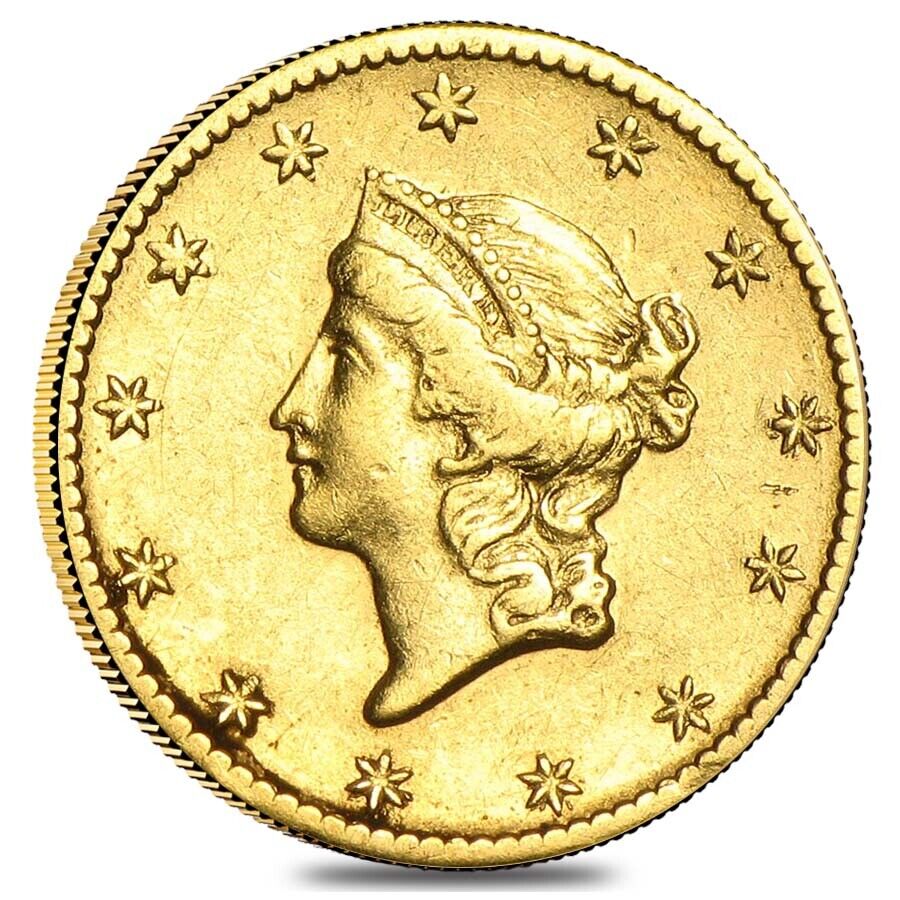
Longacre’s original design: left-facing Liberty in a coronet, thirteen stars, and a reverse with the denomination and date inside an agricultural wreath. At 13mm, this is the smallest of the three. Struck at all five mints, with key dates concentrated at Charlotte and Dahlonega — most notably the 1849-C Open Wreath (~11,634 minted) and several Dahlonega issues with extremely low mintages.
Type 2 — Indian Princess, Small Head (1854–1856)
Longacre’s redesign introduced a young Liberty in a feathered headdress on a 15mm planchet struck thinner than Type 1. Striking quality suffered — central design weakness is common, and full-detail examples are scarce. Production lasted only three years, making Type 2 the rarest of the three types overall.
The 1855-D is the headline rarity of the entire $1 gold series — only 1,811 struck at Dahlonega, with surviving examples genuinely scarce. The 1854-D and 1855-C are also highly prized. Even Type 2 common dates trade well above bullion because of the type’s overall scarcity.
Type 3 — Indian Princess, Large Head (1856–1889)
The Mint enlarged the head and increased relief to fix Type 2’s striking problems. Diameter remained 15mm. This is the longest-running and highest-mintage type, which makes common dates the most affordable entry to the series.
Within Type 3, Dahlonega 1860–1861 issues are scarce — these were the last gold coins struck at Dahlonega before the Civil War, and the mint never reopened. The proof-only 1875 (mintage 420) is the other major key. Most surviving Type 3 examples are circulated; Mint State pieces command meaningful premiums.
Values by Type and Condition
Melt value of any $1 gold coin: 194.76 at current gold spot price.
Premiums below are expressed as multiples of that melt value. They reflect common-date examples — key dates and rare mint marks command much more.
| Grade | Type 1 (common date) | Type 2 (common date) | Type 3 (common date) |
|---|---|---|---|
| Good–VG | ~2× melt | ~4–5× melt | ~1.5–2× melt |
| Fine | ~2–2.5× melt | ~5–6× melt | ~1.7–2.3× melt |
| VF | ~2–3× melt | ~6–8× melt | ~2–3× melt |
| XF | ~3–4× melt | ~8–11× melt | ~2.5–3.5× melt |
| AU | ~3–5× melt | ~9–16× melt | ~3–4× melt |
| MS60–62 | ~4–6× melt | ~19–31× melt | ~3.5–5.5× melt |
| MS63+ | ~7×+ melt | ~30×+ melt | ~6×+ melt |
The jump from circulated to Mint State is steep on Type 1 and Type 3 — often 2–3× the lower-grade premium. On Type 2, the type’s underlying scarcity raises every grade’s baseline; condition still matters, but it’s stacked on top of an already elevated number.
Key Dates
| Date / Mint | Mintage | Approximate value | Notes |
|---|---|---|---|
| 1849-C Open Wreath (Type 1) | ~11,634 | ~20–90× melt | First-year Charlotte issue |
| 1851-D (Type 1) | ~13,873 | ~15–75× melt | Dahlonega scarcity |
| 1852-D (Type 1) | ~6,360 | ~20–110× melt | Major key date |
| 1854-D (Type 2) | ~2,935 | ~40–125× melt | Type 2 + Dahlonega |
| 1855-C (Type 2) | ~9,803 | ~20–110× melt | Charlotte Type 2 |
| 1855-D (Type 2) | ~1,811 | ~95–310× melt | Series key — exceptional rarity |
| 1856-D (Type 3) | ~1,460 | ~50–155× melt | Very low mintage |
| 1860-D (Type 3) | ~1,566 | ~60–185× melt | Pre–Civil War Dahlonega |
| 1861-D (Type 3) | ~1,250 (est.) | ~95–250× melt | Last Dahlonega gold issue |
| 1875 Proof (Type 3) | ~420 | ~50–95× melt | Proof-only issue |
The Dahlonega Mint stopped striking gold in 1861 and never reopened. Any D-marked $1 gold coin is scarcer than its Philadelphia or San Francisco counterpart from the same year, and 1860–1861 D issues are the final gold coins struck at the facility across all denominations.
Buying Considerations
Premiums. Common-date $1 gold coins trade at roughly 2–3× melt — high relative to a $20 Liberty (close to melt for common dates), but the trade-off is access to authentic pre-1933 gold at a smaller per-coin commitment. If pure gold-per-dollar is the priority, larger denominations are more efficient.
Grading. The value gap between circulated and Mint State on Type 1 and Type 3 is large enough that PCGS or NGC certification is worth the cost on anything VF or higher with eye appeal, and on every Type 2 example regardless of grade. Certification typically adds a 5–15% premium over a comparable raw coin and gives both buyer and seller a defensible condition reference.
Authentication. Counterfeiting at this denomination has historically been limited — the gold content doesn’t justify the effort for most fakes — but high-grade scarce dates, particularly Type 2 and Dahlonega pieces, do attract counterfeit activity. Weight (1.672 g exactly), diameter, edge reeding, and design sharpness under magnification are the basic checks. Anything unusual goes to a third-party grader before money changes hands.
Mint mark premiums (over the Philadelphia issue at the same date and grade):
- C (Charlotte) — ~25–75%
- D (Dahlonega) — ~100–300%, with rare dates exceeding multiples of that
- O (New Orleans) — ~25–50%
- S (San Francisco) — ~10–30%
The mint mark is on the reverse, below the wreath. No mark = Philadelphia.
Related Guides
- Pre-1933 Gold Coins: The Complete Collector & Investor Guide
- Common-Date $20 Liberty Double Eagle Values and Conditions
- $10 Gold Coin Guide: Liberty and Indian Head Eagles
- Liberty Head Half Eagle $5 Gold Coins
- $2.50 Quarter Eagle Gold Coin Guide
- Understanding NGC and PCGS Grading for Pre-1933 Gold
- Executive Order 6102: The 1933 Gold Ownership Ban
Disclaimer: Educational content only — not financial, investment, or tax advice. Pre-1933 gold values fluctuate with both spot prices and numismatic demand. FindBullionPrices.com is a price comparison platform and does not sell coins.