A Gold Certificate was a promise printed on paper: bring this note to the US Treasury and we will hand you its face value in gold coin. That promise held from 1865 until FDR’s Executive Order 6102 killed it in 1933 — and most Gold Certificates were surrendered and destroyed in the process.
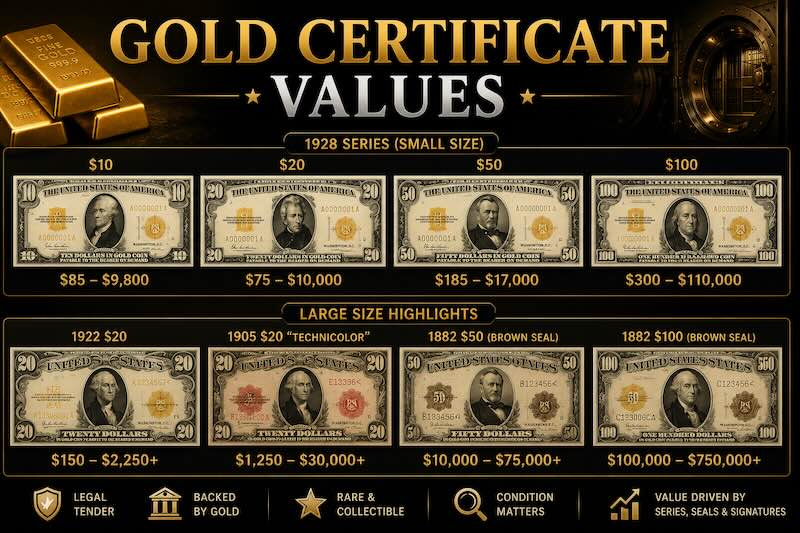
The ones that survived are now collectible currency. A common 1928 small-size $20 Gold Certificate starts around $75 circulated. A rare 1882 $100 with a brown seal sold for $750,000 at Heritage in 2022. The spread depends on series, denomination, seal color, signature combination, and condition.
This guide is part of our US Paper Money Value Guide.
What Is a Gold Certificate?
Gold Certificates were issued by the US Treasury from 1865 through the 1928 series in denominations from $10 to $10,000. Each note stated on its face that the equivalent amount in gold coin had been deposited at the Treasury and was payable to the bearer on demand. They were warehouse receipts for physical gold.
They circulated alongside regular Federal Reserve Notes. Seal colors changed across series — brown and red on 1882 issues, red on the 1905 “Technicolor,” gold on the 1906–1922 series, and bright yellow on the 1928 small-size notes.
Gold Certificate Value Chart
Small-Size Gold Certificates (1928 Series)
The 1928 series is where most collectors start. These are the same dimensions as modern currency (6.14″ × 2.61″) and are the most affordable Gold Certificates.
| Denomination | Portrait | Circulated | Uncirculated (MS 63) | Star Note Premium |
|---|---|---|---|---|
| $10 | Alexander Hamilton | $85–$250 | $1,500–$9,800 | 2–3x regular |
| $20 | Andrew Jackson | $75–$250 | $500–$10,000 | 3–5x regular |
| $50 | Ulysses S. Grant | $185–$600 | $3,000–$17,000 | 10x+ regular |
| $100 | Benjamin Franklin | $300–$800 | $5,000–$110,000 | Extremely rare |
The $10 and $20 are common enough that circulated examples appear regularly on eBay and at dealer shops. The $50 and $100 are scarcer and trade primarily through auction houses and specialist dealers.
Star notes exist for the $10 and $20 denominations and carry significant premiums. A 1928 $10 Gold Certificate star note in MS 63 sells for $2,250–$2,500. The $50 star note is a five-figure note in any grade.
Higher denominations: The 1928 series also included $500, $1,000, $5,000, and $10,000 Gold Certificates, but these are museum-grade rarities. The $500 and $1,000 Gold Certificates are covered in our $500 bill and $1,000 bill guides. Only one each of the $5,000 and $10,000 Gold Certificates is known to survive — both in the Smithsonian.
Large-Size Gold Certificates (1882–1922)
Large-size Gold Certificates measure 7.4″ × 3.1″ and were printed from 1882 through 1922. Values depend on denomination, seal color, signature combination, and condition.
1922 Series — The Entry Point
The 1922 $20 Gold Certificate is the most common large-size Gold Certificate and the most affordable way into the category. George Washington appears on the front.
| Condition | Approximate Value |
|---|---|
| Very Good (VG) | $150 |
| Very Fine (VF) | $300 |
| Extremely Fine (EF) | $750 |
| Uncirculated (MS 63) | $2,250 |
| Star Note (any grade) | ~3x regular |
The 1922 series also exists in $10, $50, $100, $500, and $1,000 denominations. The $10 is nearly as common as the $20. The $50 and above get expensive quickly.
1882 Series — Where Signature Combinations Matter
The 1882 series is where Gold Certificate collecting gets complicated — and expensive. These notes were issued over 18+ years with multiple signature combinations and seal colors (brown, large red, small red). The signature and seal pairing determines rarity far more than condition does.
For the $20 denomination: one 1882 $20 Gold Certificate might be worth $300 while another that looks nearly identical could be worth $40,000. The difference is the signature combination. Early brown seal notes from before 1891 had far smaller print runs, and survivors from that period are scarce.
For the $50: brown seal notes are five-figure bills in any passable condition. Small red seal notes with common signatures are more affordable.
For the $100: an 1882 $100 Gold Certificate with a brown seal — one of two known, the other in the Smithsonian — sold for $750,000 at Heritage Auctions in October 2022.
1905 “Technicolor Note” — The Trophy Piece
The 1905 $20 Gold Certificate is called the “Technicolor Note” because of its rich, vivid colors — it’s the only 20th-century Gold Certificate with a red seal and red serial numbers. George Washington on the front. Printed only in 1905 with two signature varieties (Lyons-Roberts and Lyons-Treat).
| Condition | Approximate Value |
|---|---|
| Very Good (VG) | $1,250 |
| Very Fine (VF) | $4,000 |
| Extremely Fine (EF) | $10,000 |
| Uncirculated (MS 63) | $30,000+ |
| Serial Number 1 (Theodore Roosevelt provenance) | $552,000 (Aug 2018, Stack’s Bowers) |
No star notes were issued for the 1905 series. Both signature varieties trade at comparable prices.
1906 and 1907 Series
The 1906 $20 replaced the Technicolor with a gold seal — same Washington portrait, much less visual drama. Values start around $200 circulated and $2,000+ uncirculated. The 1907 $10 Gold Certificate (Michael Hillegas portrait) is similar in value range.
The 1933 Gold Seizure and Why So Few Survive
On April 5, 1933, President Roosevelt signed Executive Order 6102, requiring all persons to surrender gold coins, gold bullion, and Gold Certificates to the Federal Reserve by May 1, 1933. The exchange rate was $20.67 per troy ounce. Violation carried penalties of up to $10,000 in fines and ten years in prison.
Most Gold Certificates were turned in and destroyed — which is why even common series like the 1922 $20 and 1928 $20 carry premiums well above face value.
EO 6102 exempted notes with “recognized special value to collectors,” but the exemption was interpreted narrowly. Restrictions on owning Gold Certificates were lifted in 1964. Full private gold ownership was restored on December 31, 1974, under Gerald Ford’s Executive Order 11825.
Are Gold Certificates Worth the Gold?
No. The gold backing was revoked in 1933 — these notes are no longer redeemable for metal. Their value comes from rarity, condition, and collector demand.
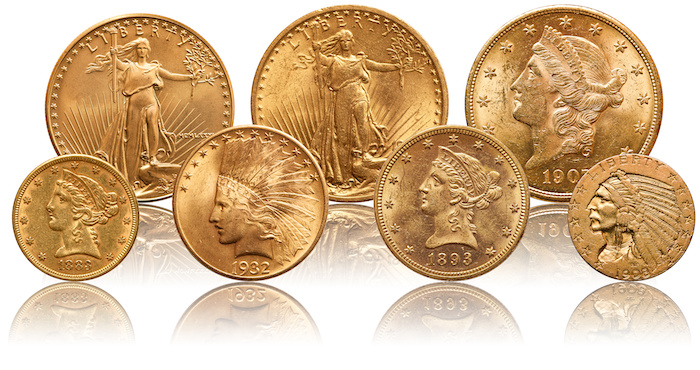
That said, Gold Certificates appeal to the same audience that collects Pre-1933 gold coins. If you collect $10 Eagles, $20 Double Eagles, or $5 Half Eagles, a Gold Certificate from the same period is a natural companion — paper from the same monetary system that produced the coins.
Track live gold spot prices →
Where to Buy Gold Certificates
1928 small-size ($10 and $20): PMG or PCGS graded examples in VF to EF run $100–$300 from online currency dealers, eBay’s certified currency section, and coin shows.
1922 large-size: The $20 is available from Heritage Auctions, Stack’s Bowers, and established dealers at $150–$750 depending on condition.
1882 and 1905 series: These trade through auction houses. Authentication and grading by PMG or PCGS is essential — the same principles that apply to Pre-1933 gold coins apply here.
Related
- US Paper Money Value Guide — Complete overview of all collectible US currency
- Silver Certificate Values — Paper backed by silver, the companion to Gold Certificates
- $500 Bill Value Guide — Includes $500 Gold Certificate coverage
- $1,000 Bill Value Guide — Includes $1,000 Gold Certificate coverage
- $5,000 & $10,000 Bill Guide — The rarest Gold Certificates
- Executive Order 6102 — The gold seizure that destroyed most Gold Certificates
- Pre-1933 Gold Coins — Gold coins from the same era
- Gold Spot Price — Live gold pricing
Disclaimer: This article is for informational and educational purposes only. It is not financial or investment advice. FindBullionPrices.com is a price comparison platform and does not sell bullion or currency notes.