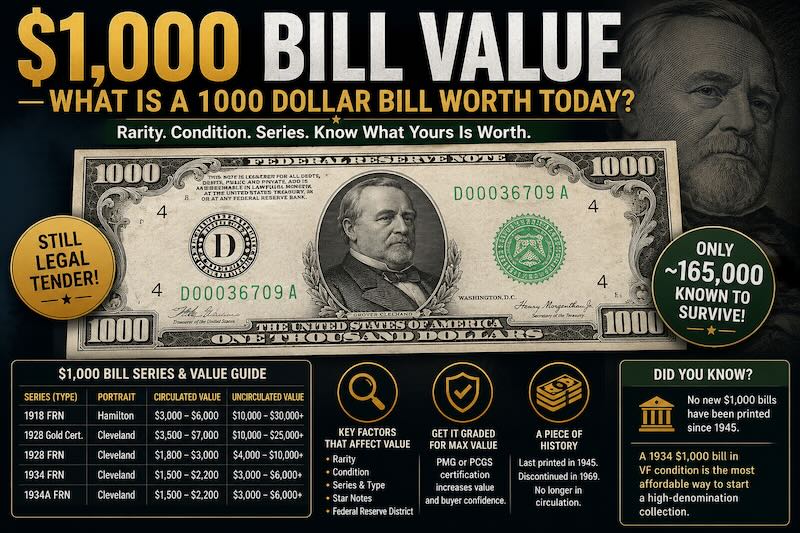
The $1,000 bill is the sweet spot of high-denomination currency collecting. It’s expensive enough to feel significant, scarce enough to hold its value, and common enough that you can actually find one to buy. More $1,000 bills survive than $500 bills — approximately 165,000 versus 75,000 — and circulated examples start around $1,500–$2,200 for the most common series.
That makes the $1,000 bill, dollar for dollar, the most accessible entry point into high-denomination US currency.
This guide is part of our US Paper Money Value Guide.
Who Is on the $1,000 Bill?
Grover Cleveland — the only US president to serve two non-consecutive terms (1885–1889, 1893–1897). His portrait appears on the 1928 and 1934 Federal Reserve Note series, which account for the vast majority of surviving $1,000 bills.
On the 1918 Federal Reserve Note series, Alexander Hamilton appears. On the 1928 Gold Certificate, Cleveland again.
$1,000 Bill Value by Year
| Series | Type | Portrait | Estimated Survivors | Circulated Value | Uncirculated Value |
|---|---|---|---|---|---|
| 1918 | Federal Reserve Note | Hamilton | ~1,500 | $3,000–$6,000 | $10,000–$30,000+ |
| 1928 | Gold Certificate | Cleveland | ~2,500 | $3,500–$7,000 | $10,000–$25,000+ |
| 1928 | Federal Reserve Note | Cleveland | ~9,000 | $1,800–$3,000 | $4,000–$10,000+ |
| 1934 | Federal Reserve Note | Cleveland | ~85,000 | $1,500–$2,200 | $3,000–$6,000+ |
| 1934A | Federal Reserve Note | Cleveland | ~67,000 | $1,500–$2,200 | $3,000–$6,000+ |
The 1934 and 1934A Federal Reserve Notes are by far the most common and most affordable. Together they account for roughly 150,000 of the 165,000 known survivors. If you’re buying your first $1,000 bill, this is where to start.
The 1928 Gold Certificate carries a meaningful premium — roughly 2x–3x over the 1934 FRN — because Gold Certificates were recalled during FDR’s gold seizure in 1933. Many were turned in and destroyed, making survivors proportionally scarcer than the numbers suggest.
The 1918 Federal Reserve Note is the large-size version, measuring 7.4″ × 3.1″. Only about 1,500 survive. These are trophy notes: $3,000–$6,000 circulated, with uncirculated examples reaching $30,000+.
How Many $1,000 Bills Exist?
Approximately 165,372 $1,000 bills are known to survive, according to Federal Reserve recall data and numismatic census records. The original combined print runs across all series exceeded 2.4 million notes, meaning about 7% have survived.
The survival rate is heavily skewed toward the 1934 and 1934A series because those were the last printed and had less time in circulation before the denomination was discontinued in 1969. Many were held in bank vaults rather than circulated, which is why so many survive in reasonable condition.
For context, that’s more survivors than the $500 bill (75,000 known) but vastly more than the $5,000 bill (342 known) or $10,000 bill (336 known).
Gold Certificate vs. Federal Reserve Note $1,000 Bills
The key distinction for collectors is the type of note, not just the year.
Gold Certificates (1928 series with gold-orange seal) were backed by gold on deposit at the Treasury. When FDR issued Executive Order 6102 in 1933, citizens were required to surrender gold coins, bullion, and Gold Certificates. Most were turned in. The surviving $1,000 Gold Certificates are legal to own (since 1964) and carry a premium that reflects both their scarcity and their connection to the gold standard era.
If you collect Pre-1933 gold coins — whether $10 Eagles, $20 Double Eagles, or $5 Half Eagles — a $1,000 Gold Certificate is a natural companion piece. It’s paper from the same era and backed by the same metal.
Federal Reserve Notes (1918, 1928, 1934 series with green seal) are the more common and affordable option. The 1934 FRN is where most collectors start because it offers the lowest entry price and the highest availability.
Star Notes and Rare Varieties
Star notes exist on $1,000 bills but are rare across all series. A $1,000 star note from any series carries a substantial premium — often 2x–5x over a regular issue of the same grade. They appear infrequently at auction and are actively sought by advanced collectors.
Beyond star notes, the Federal Reserve district matters. $1,000 bills were issued by all twelve Federal Reserve Banks, but some districts had much smaller allocations. Notes from low-volume districts (Minneapolis, Dallas, Kansas City) command premiums over high-volume districts (New York, Chicago). A 1934 $1,000 FRN from the Dallas district might bring $2,500–$3,500 circulated, versus $1,500–$2,000 for the same note from New York.
Light Green Seal (LGS) varieties on the 1934 series are another collector focus. Early printings used a slightly lighter shade of green ink for the Treasury seal, distinguishable under comparison. LGS notes carry a modest premium.
Are $1,000 Bills Still Legal Tender?
Yes. All US currency ever issued by the federal government remains legal tender at face value. You could technically deposit a $1,000 bill at your bank for $1,000 in your account. Obviously, no one does this — the collector value far exceeds the face value.
The $1,000 denomination was discontinued in 1969 by executive order alongside the $500, $5,000, and $10,000. The stated reason was to combat organized crime and money laundering, though by that point electronic wire transfers had already made high-denomination bills obsolete for legitimate large transactions. No new $1,000 bills have been printed since 1945.
Where to Buy and Sell $1,000 Bills
Buying: The most common avenue is online dealers and auction houses. Heritage Auctions has the deepest auction inventory for high-denomination bills. eBay’s certified currency section has regular listings. Dealers like APMEX occasionally carry high-denomination notes. For a first purchase, a PMG or PCGS-graded 1934 FRN in Very Fine (VF-25 to VF-35) condition offers the best balance of price and presentation — expect to pay $1,800–$2,500.
Selling: If you’ve inherited or found a $1,000 bill, get it graded by PMG or PCGS before selling. The grading fee ($30–$65 depending on the note’s value tier) is trivial relative to the note’s value, and a graded note will sell for 10–20% more than an equivalent raw note. For notes in VF or better condition, Heritage Auctions typically achieves stronger results than fixed-price selling.
Authentication matters. Counterfeits of high-denomination bills exist, particularly of the 1934 series. PMG and PCGS grading includes authentication. If buying raw (ungraded), buy only from established dealers with return policies. The same grading principles that apply to Pre-1933 gold coins apply to high-denomination currency — third-party grading eliminates guesswork.
For a more detailed buying guide covering authentication, pricing, and trusted sources, see our US Paper Money Value Guide.
Related
- US Paper Money Value Guide — Complete overview of all collectible US currency
- $500 Bill Value Guide — The other common high-denomination note
- $5,000 & $10,000 Bill Guide — The rarest US bills still legal tender
- Pre-1933 Gold Coins Guide — Gold coins from the same era
- Saint-Gaudens Double Eagle Guide — The most collected Pre-1933 gold coin
- Gold Spot Price — Live gold pricing
Disclaimer: This article is for informational and educational purposes only. It is not financial or investment advice. FindBullionPrices.com is a price comparison platform and does not sell bullion or currency notes.