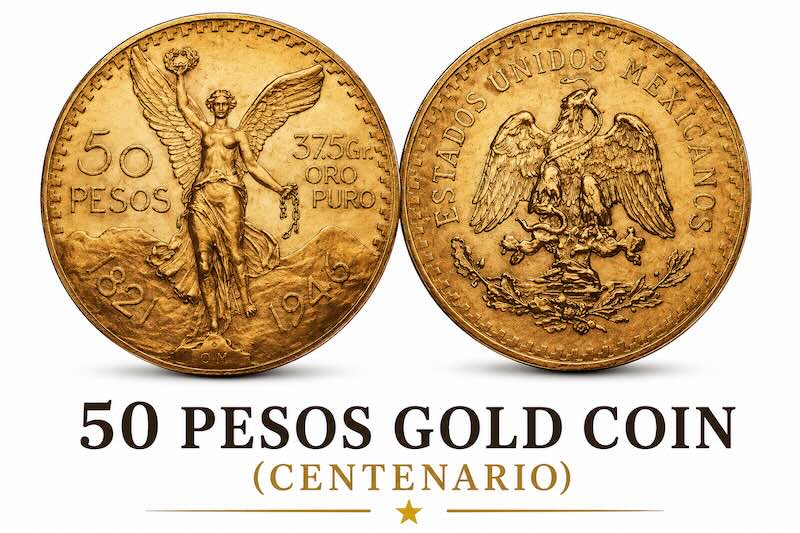
The Mexican 50 Pesos Gold Coin, widely known as the Centenario, is one of the most recognizable large-format gold coins in the world. First issued in 1921 to mark the centennial of Mexico’s independence from Spain (hence “Centenario”), each coin contains 1.2057 troy ounces of .900 fine gold, making it one of the heaviest sovereign-issued gold bullion coins still regularly traded today. Both coin collectors and bullion investors prize the Centenario for its size, low premiums, and historic design.
How Much Is a Centenario Coin Worth?
The value of a Centenario is driven primarily by its gold content. Each coin holds 1.2057 troy ounces of pure gold, so melt value moves directly with the live spot price:
Melt value formula: 1.2057 troy oz x current gold spot = melt value
- At a spot price of $4,059.56, a Centenario’s melt value is approximately $4,894.61
Market pricing varies by condition, date, and demand:
- Common 1947-dated restrikes (the vast majority of coins available today) typically trade at 2-6% over melt value, depending on condition
- Choice BU examples with attractive original luster can bring 5-8% over melt
- Original 1921-1931 issues carry collector premiums that vary widely by date, mint state grade, and market conditions
- Dealer buyback prices generally run 1-3% under melt for common restrikes
These spreads fluctuate with market volatility and retail demand. During periods of tight physical supply or elevated buying activity, premiums and buy/sell spreads can temporarily widen. Compare current Centenario prices from reputable online dealers to find the best available premium.
For gold investors focused on acquiring the most metal per dollar, the Centenario’s low premium profile makes it one of the most efficient ways to stack over a troy ounce of gold in a single coin, alongside other low-premium gold coins.
Size Compared to Other Large-Format Gold Coins
The Centenario stands out among sovereign gold coins for its sheer size and gold content. Here is how it measures up against other widely traded options:
| Coin | Gold Content | Purity | Diameter | Gross Weight |
|---|---|---|---|---|
| Mexican 50 Pesos (Centenario) | 1.2057 oz | .900 | 37 mm | 41.67 g |
| American Gold Eagle (1 oz) | 1.0000 oz | .9167 | 32.7 mm | 33.93 g |
| Canadian Gold Maple Leaf (1 oz) | 1.0000 oz | .9999 | 30.0 mm | 31.10 g |
| South African Krugerrand (1 oz) | 1.0000 oz | .9167 | 32.8 mm | 33.93 g |
| Austrian 100 Corona | 0.9802 oz | .900 | 37 mm | 33.88 g |
At 41.67 grams total weight and 37 mm in diameter, the Centenario is physically larger and heavier than every standard 1 oz bullion coin. Among vintage large-format coins, it shares its 37 mm diameter with the Austrian 100 Corona but contains over 20% more gold.
Centenario Design and Specifications
Obverse
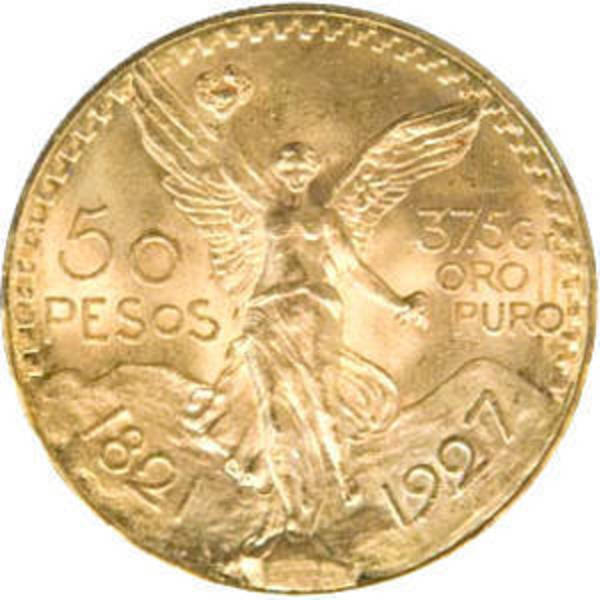
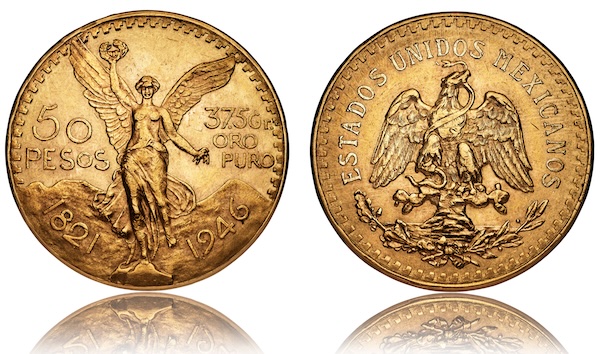
The obverse depicts Winged Victory (“El Angel de la Independencia”), the same figure that crowns the Independence Monument on Mexico City’s Paseo de la Reforma. She stands with a laurel wreath raised in one hand and broken chains in the other, backed by the twin volcanoes Popocatepetl and Iztaccihuatl. The inscriptions include “50 PESOS” and “37.5 Gr. ORO PURO” (37.5 grams of pure gold), along with “1821” (the year of independence) and the coin’s date.
Reverse
The reverse carries the Mexican coat of arms: a golden eagle perched on a prickly pear cactus with a serpent in its beak, encircled by “ESTADOS UNIDOS MEXICANOS.” The design has remained unchanged across all production runs.
Technical Specifications
| Attribute | Detail |
|---|---|
| Country / Mint | Mexico / La Casa de Moneda de Mexico |
| Denomination | 50 Pesos (legal tender; face value is nominal) |
| Fineness / Alloy | .900 gold (21.6 karat), 10% copper |
| Fine Gold Content | 1.2057 troy oz (37.50 grams) |
| Gross Weight | 41.6666 grams |
| Diameter | 37 mm |
| Thickness | 2.69 mm |
| Edge | Lettered: “INDEPENDENCIA Y LIBERTAD” |
The .900 purity (same alloy used in pre-1933 U.S. gold coins and Mexican Gold Pesos across all denominations) gives the Centenario a warm, slightly orange hue from the copper content. The alloy also makes the coin more durable and scratch-resistant than .999 or .9999 fine coins.
50 Pesos Gold Coin Mintage History
The Centenario was produced in two distinct eras, with restrikes continuing well into the modern period.
Original Issues (1921-1931)
Production began in 1921 with an initial mintage of 180,000 coins. Output increased through the 1920s as the coin gained acceptance as a gold savings vehicle. The final original-date production occurred in 1931.
| Year | Mintage | Notes |
|---|---|---|
| 1921 | 180,000 | First year of issue |
| 1922 | 463,000 | |
| 1923 | 432,000 | |
| 1924 | 439,000 | |
| 1925 | 716,000 | Highest original-era mintage |
| 1926 | 600,000 | |
| 1927 | 606,000 | |
| 1928 | 538,000 | |
| 1929 | 458,000 | |
| 1930 | 372,000 | |
| 1931 | 137,000 | Final original date; lowest mintage |
Total original issues: approximately 4.9 million coins.
Restrikes (1943-1972 and 1996-2009)
Beginning in 1943, the Mexican Mint resumed production of the Centenario as restrike bullion coins, all bearing the 1947 date regardless of actual production year. From 1949 through 1972, the mint produced approximately 3.95 million restrikes. A second wave of restrikes began in 1996 and continued through 2009, adding at least 7.95 million more coins.
Total estimated production across all eras exceeds 16 million coins, making the Centenario one of the most widely produced large-format gold coins in history.
How to Identify a Restrike
Most Centenarios available in the market today are 1947-dated restrikes. Distinguishing between an original 1947 coin and a later restrike can be difficult, as both share identical specifications and design. A few general observations:
- 1996 restrikes often exhibit a matte or satin finish rather than the brilliant luster of earlier production
- Original 1921-1931 coins bear their actual production year and may show wear consistent with circulation
- All coins dated 1947 may be original-year strikes, early restrikes (1949-1972), or later restrikes (1996-2009)
For bullion purposes, the distinction between original and restrike is typically irrelevant since both contain identical gold content. Collector premiums apply primarily to low-mintage original dates (particularly 1931 and 1921) in uncirculated condition. For graded or certified coins, third-party services like NGC and PCGS can provide attribution.
Centenario Legacy
The Centenario occupies a unique position among world gold coins. It served as a practical store of value during periods of currency instability in Latin America, became a vehicle for gold investment during the era when U.S. citizens were prohibited from owning gold bullion, and continues today as one of the most affordable ways to acquire more than a troy ounce of gold in a single, government-issued coin.
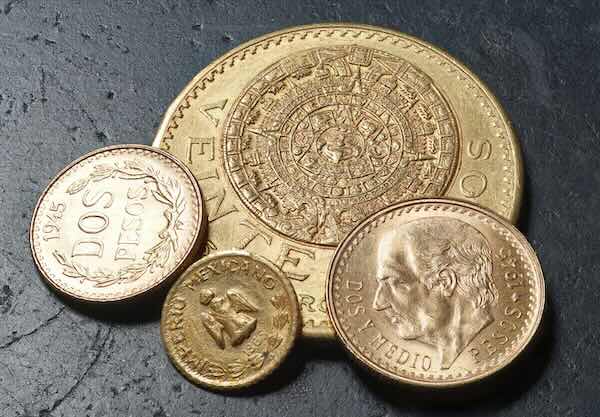
For investors building a diversified gold position, the Centenario pairs naturally with other denominations in the Mexican Gold Pesos series. The full lineup ranges from the smallest Dos Pesos (0.0482 oz), Dos y Medio Pesos, the 5 Pesos, 10 Pesos, and 20 Pesos, up to the Centenario itself. Together they offer gold in increments from just over $200 to over $5,000, all from the same historic Mexican mint. Browse the complete Mexican Gold Pesos buying guide to compare denominations and premiums.
Mexican Peso Guides
- Collecting Mexican Dos Pesos Gold Coins
- Mexico 5 Pesos Gold Coin Buying Guide
- Mexican Gold Pesos: Low Premium Gold Coins
- Modern Restrikes vs. Vintage Bullion
- Investing in Vintage Gold Coins
- Pre-1933 Gold Coins
Compare Centenario prices from trusted dealers | Gold spot prices | Lowest premium gold coins
The Mexican 50 Pesos Gold Coin, widely known as the Centenario gold coin, is one of the most recognizable large-format gold coins in the world. First issued in 1921 to commemorate the 100th anniversary of Mexico’s independence (hence “Centenario”), it blends a striking national design with exceptional bullion utility, which is why both coin collectors and bullion investors prize it today.
How Much Is a 50 Pesos Gold Coin Worth?
With premiums on many sovereign gold coins volatile, Centenarios typically trade at low spreads close to melt, offering one of the most efficient ways to add >1.20 troy ounces of gold per coin to a stack, while still owning a historic, globally recognized piece. The 50 Pesos Centenario is one of the most famous and sought-after gold coins from Mexico.
The core driver is the coin’s melt value (its fine gold content multiplied by the live gold spot price):
Melt value formula:
1.2057 troy oz × current gold spot = melt value
- Example: if spot = $4,059.56, melt ≈ $4,894.61 (before premiums/fees).
Typical market pricing (illustrative ranges in normal conditions):
- Common 1947 restrike (circulated to nice BU): ~2%–6% over melt
- Choice BU / attractive luster: can reach ~5%–8% over melt
- Original 1920s–1931 issues: collector premiums vary widely by date/grade
- Dealer buybacks: often ~1%–3% under melt for common restrikes (market dependent)
Reality check: Spreads move with volatility, supply, and demand. During tight supply or heavy retail demand, premiums and buy/sell spreads can temporarily widen.
Centenario Restrikes
Production of restrike coins began in 1949, with all coins minted continuing to bear the 1947 date. 1947 Centenario restrike coins were minted through 1972.
In 1996, the Mexican Mint began another production run of restrikes and minted at least 7,954,777 coins. These restrike Centenario coins are commonly available as bullion gold coins.
Centenario Design & Specifications
Obverse (front)
- Winged Victory (“Independencia”) stands with laurel wreath and broken chains, backed by the volcanoes Popocatépetl and Iztaccíhuatl.
- Legends typically include “50 PESOS” and “37.5 Gr. ORO PURO” with “1821” (independence) and the coin date.
Reverse (back)
- Mexican coat of arms—a golden eagle on a cactus with a serpent—encircled by “ESTADOS UNIDOS MEXICANOS.”
Technical specs (standard issue)
| Attribute | Detail |
|---|---|
| Country / Mint | Mexico / La Casa de Moneda de México |
| Denomination | 50 Pesos (legal tender; face value is nominal) |
| Fineness / Alloy | .900 gold (21.6 kt) / 10% copper (for durability & reddish hue) |
| Actual Gold Weight (AGW) | 1.2057 troy oz (37.5 g fine) |
| Gross Weight | 41.67 g |
| Diameter | 37.0 mm |
| Thickness | ~2.69 mm |
| Edge | Lettered (“INDEPENDENCIA Y LIBERTAD”) |
The copper alloy makes Centenarios more durable than .999 coins, helping reduce contact marks in circulation and storage, helpful for bullion buyers.
50 Pesos Gold Coin Mintage History
Highlights
- 1921–1931: Original Centenario production to honor the centennial of independence.
- 1943–1947: Minting resumed during WWII-era gold demand.
- 1949–1972: Restrikes produced bearing the date 1947 (all struck later still show 1947).
- 1996 onward: The Mexican Mint initiated another restrike program; modern restrikes are common as investment-grade bullion. (Cumulative restrike output is substantial; later restrikes remain dated 1947.)
Full Mintage History
| Year | Mintage Amount |
|---|---|
| 1921 | 180,000 |
| 1922 | 463,000 |
| 1923 | 432,000 |
| 1924 | 439,000 |
| 1925 | 716,000 |
| 1926 | 600,000 |
| 1927 | 606,000 |
| 1928 | 538,000 |
| 1929 | 458,000 |
| 1930 | 372,000 |
| 1931 | 137,000 |
| 1943 | 89,000 |
| 1944 | 593,000 |
| 1945 | 1,012,000 |
| 1946 | 1,588,000 |
| 1947 | 309,000 |
| 1949-1972 | 4,449,554 * |
Collector note: Most Centenarios on the market today are 1947-dated restrikes. Earlier 1920s–1931 coins can command numismatic premiums in better grades.
Centenario Legacy
From the 1930s until the 1970s, many American investors and collectors looked to foreign gold coins due to their status as numismatics as a way to bypass the ban on gold ownership and legally acquire gold during this period.
Because the Centenario was considered a collectible from a foreign country, it was a way to avoid the strict regulations imposed on gold investing. American collectors viewed it as a reliable store of value that was also portable, durable, and globally recognized. Mexico Gold Pesos became popular for those who wanted to store wealth in physical gold without violating the U.S. prohibition.