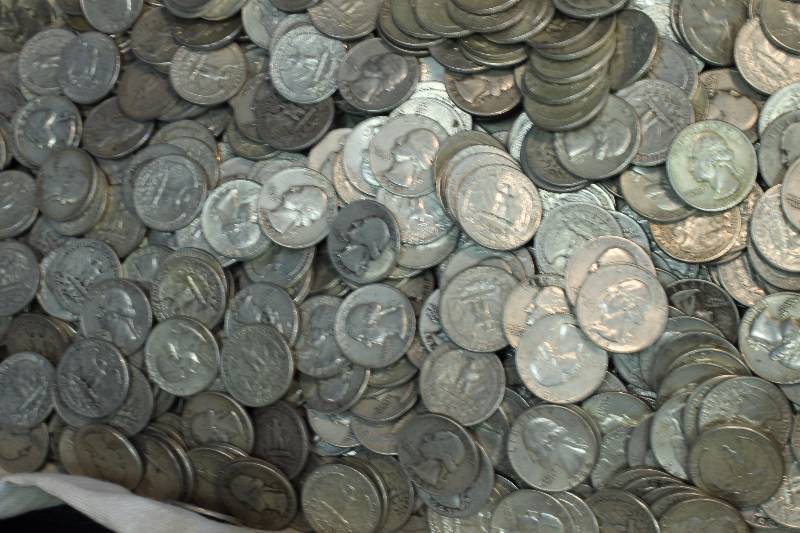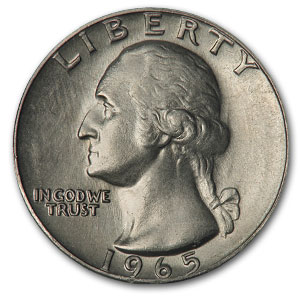
The 1965 Washington quarter is the first U.S. quarter struck without silver. The Coinage Act of 1965, signed by President Lyndon B. Johnson, ended the use of 90% silver in dimes and quarters and replaced it with a copper-nickel clad composition. That same act suspended proof coin production and removed mintmarks from all coins from 1965 through 1967.
With a total mintage of 1,819,717,540 coins (all struck at Philadelphia, none carrying a mintmark), most 1965 quarters are common. But a few categories carry real premiums: high-grade uncirculated examples, Special Mint Set (SMS) coins, doubled die varieties, and the rare transitional silver planchet error.
1965 Quarter Value by Grade
Most circulated 1965 quarters are worth 25 cents. Value starts climbing in uncirculated grades, and jumps sharply at MS66 and above due to low certified populations at those levels.
| Grade | Estimated Value |
|---|---|
| Good to AU58 (circulated) | $0.25 (face value) |
| MS63 | $1 – $3 |
| MS64 | $3 – $5 |
| MS65 | $8 – $22 |
| MS66 | $15 – $30 |
| MS67 | $100 – $400 |
| MS68 | $5,000+ |
The price gap between MS66 and MS67 reflects how few 1965 quarters survived without bag marks or contact damage. Even with 1.8 billion struck, gem-quality survivors are scarce.
You can check the current silver spot price on FindBullionPrices.com for context on melt value calculations referenced below.
1965 Quarter Composition and Specs
| Feature | Detail |
|---|---|
| Composition | Copper-nickel clad (75% Cu, 25% Ni bonded to pure copper core) |
| Weight | 5.67 grams |
| Diameter | 24.3 mm |
| Edge | Reeded |
| Mint | Philadelphia (no mintmark) |
| Designer | John Flanagan (obverse and reverse) |
| Mintage | 1,819,717,540 |
The easiest way to identify a clad 1965 quarter is the edge. Look for the visible copper stripe sandwiched between the nickel-clad layers. Pre-1965 silver quarters show a uniform silver-white edge with no copper line.
1965 Special Mint Set (SMS) Quarters
The U.S. Mint suspended proof production from 1965 through 1967. Congress wanted all Mint capacity dedicated to producing circulation coinage during the coin shortage. In place of proof sets, the Mint issued Special Mint Sets.
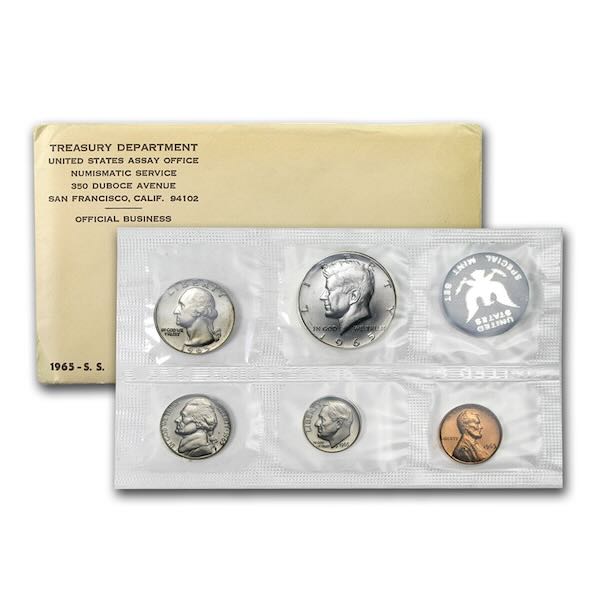
SMS coins are not proofs and are not regular business strikes. They occupy a middle ground: struck on polished planchets with slightly higher pressure, producing a semi-mirror or satin finish. SMS quarters were packaged in flat cellophane packs (not the hard plastic cases used for proof sets) and sold directly to collectors.
SMS Quarter vs. Business Strike: How to Tell
| Feature | Business Strike | SMS Quarter |
|---|---|---|
| Finish | Standard circulation luster | Satin to semi-prooflike |
| Strike quality | Normal | Sharper details, fuller hair lines |
| Cameo contrast | Rare | Possible; Cameo and Deep Cameo designations exist |
| Packaging | Circulated through banks | Flat cellophane Mint pack |
| Mintmark | None | None |
1965 SMS Quarter Values
| Grade | Estimated Value |
|---|---|
| SP63 – SP64 | $3 – $5 |
| SP65 | $5 – $15 |
| SP66 | $15 – $30 |
| SP67 | $50 – $100 |
| SP67+ Cameo | $100 – $200 |
| SP68 Deep Cameo | $300+ |
SMS coins are disproportionately represented in high-grade populations because they were sold to collectors who stored them carefully. An SP67 with a Cameo designation is where values start to get interesting.
1965 Silver Quarter Transitional Error
This is the most valuable 1965 quarter variety. A small number of 1965-dated quarters were struck on leftover 90% silver planchets intended for 1964 production. These are called transitional errors because they were produced during the transition from silver to clad coinage.
The error happened because the Mint was running 1964-dated dies well into 1965 and 1966 (Congress froze die dates to prevent hoarding). When production switched to 1965-dated dies, some silver planchets left over in the feeding system were struck with the new clad-era dies.
How to Identify a 1965 Silver Quarter
Two quick tests:
- Weight: A silver planchet weighs 6.25 grams. A clad planchet weighs 5.67 grams. That 0.58-gram difference is detectable on a precision scale.
- Edge: A silver quarter shows a uniform silver-white edge. A clad quarter shows the copper-nickel sandwich with a visible copper stripe.
If your 1965 quarter passes both tests, get it authenticated by PCGS or NGC before drawing conclusions. The Mint also produced some off-weight clad strikes, and worn clad edges can sometimes look ambiguous.
1965 Silver Quarter Values
Authenticated 1965 silver transitional errors have sold in the range of $9,000 to $16,800 at auction, depending on grade and certification. These are rare coins with a small certified population.
The silver content of a 1965 transitional error is 0.18084 troy ounces of pure silver, giving it a current melt value of approximately $11.69. But the numismatic premium dwarfs the melt value on these coins. You can run your own melt calculations using the silver coin melt value calculator.
For context on how rare silver transitional errors from this era are: in June 2026, the only known 1966 silver quarter surfaced in Pennsylvania and was certified by PCGS at AU53, with auction bids exceeding $24,400. The same die-date freezing and planchet mixing that produced 1965 silver errors also created that 1966 example. The 1965 silver errors are slightly less rare (multiple examples exist), but they remain among the most sought-after Washington quarter varieties.
1965 Doubled Die Obverse (DDO)
The 1965 DDO is a recognized die variety where misalignment during the die hubbing process created visible doubling on the obverse. The doubling is most apparent in “IN GOD WE TRUST,” “LIBERTY,” and the date. Severity varies across different die pairs.
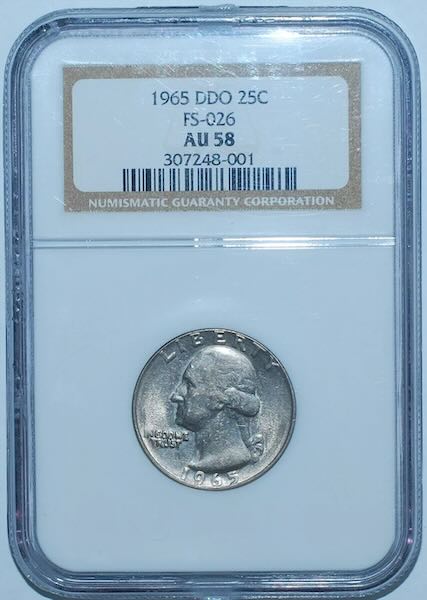
PCGS has attributed at least one DDO variety (FS-026). Values depend on the strength of the doubling and the coin’s grade:
| Grade | Estimated Value (DDO) |
|---|---|
| AU55 – AU58 | $75 – $200 |
| MS63 – MS64 | $200 – $500 |
| MS65+ | $500+ |
Minor doubled dies and machine doubling (which is mechanical damage, not a die variety) are often confused. True doubled dies show a shelf-like separation of the design elements. Machine doubling produces flat, shelf-less distortion and adds little to no premium.
Other 1965 Quarter Errors Worth Checking
Beyond the silver planchet and DDO, a few other error types have been documented on 1965 quarters:
- Off-center strikes: Coins struck with the planchet misaligned in the press. Value depends on the percentage off-center and whether the date is visible. A 10-15% off-center with full date can bring $50 to $200.
- Clipped planchets: Coins struck on blanks that were improperly cut, leaving a curved clip. Minor clips bring $10 to $30; large clips with date visible bring more.
- Die cracks and cuds: Raised lines or blobs from cracked dies. Minor die cracks add a few dollars; large die breaks (cuds) near the rim can bring $20 to $75.
- Wrong planchet errors: Beyond the silver transitional, 1965 quarters struck on dime planchets or other denominations exist in theory but are extremely rare.
How to Check If Your 1965 Quarter Is Silver
If you are sorting through pocket change, rolls, or inherited collections, here is a practical checklist:
- Look at the edge. If you see a copper stripe, the coin is clad. No further testing needed.
- Weigh it. Clad: 5.67g. Silver: 6.25g. If your scale reads between 6.1g and 6.3g, you may have a silver planchet.
- Listen to the ring. Silver coins produce a higher-pitched, longer ring when dropped on a hard surface. Clad coins produce a dull thud. This is subjective, but experienced coin handlers can hear the difference.
- Do NOT clean or polish the coin. If you suspect a silver error, any cleaning will reduce the grade and the value.
- Get it professionally authenticated. PCGS and NGC are the two major grading services. An unattributed silver transitional error is just a claim; a slabbed one is a five-figure coin.
The 1964 quarter was the last year of regular silver quarter production. Any quarter dated 1965 or later that tests positive for silver is an error, not a standard issue.
FAQ
Is a 1965 quarter silver? No. Standard 1965 quarters are copper-nickel clad with no silver content. A very small number of transitional errors exist where 1965 quarters were struck on leftover silver planchets, but these are rare and require professional authentication.
Why is there no mintmark on my 1965 quarter? Congress removed mintmarks from all U.S. coins produced from 1965 through 1967 to discourage collectors from hoarding coins by mintmark during the nationwide coin shortage. All 1965 quarters were struck at the Philadelphia Mint.
What is a 1965 Special Mint Set (SMS) quarter worth? An SMS quarter in typical SP65 condition is worth $5 to $15. At SP67 with a Cameo designation, values rise to $100 or more. The highest-graded examples with Deep Cameo contrast can exceed $300.
How can I tell if my 1965 quarter is from a Special Mint Set? SMS quarters have a satin or semi-prooflike finish with sharper strike details than business strikes. If the coin came in an original flat cellophane pack from the Mint, it is an SMS coin. Loose SMS coins can be harder to identify without experience or professional grading.
What is a 1965 doubled die quarter worth? Values range from around $75 in About Uncirculated grades to $500 or more in MS65 and above, depending on the strength of the doubling. Minor doubling or machine doubling (which is different from a true doubled die) adds little premium.
How much is a 1965 quarter worth in 2026? A circulated 1965 quarter is worth face value: 25 cents. Uncirculated examples start at $1 to $3 in MS63 and can reach $100 or more in MS67. The rare silver transitional error has sold for $9,000 to $16,800 at auction.
Are all 1965 quarters from Philadelphia? Yes. The entire mintage of 1,819,717,540 quarters was produced at Philadelphia. No 1965 quarters were struck at Denver or San Francisco.
Should I get my 1965 quarter graded? If the coin is uncirculated with strong luster and minimal marks, grading may be worthwhile if it grades MS66 or higher. If you suspect a silver planchet error (edge looks silver, weight near 6.25g), professional authentication is essential. For average circulated examples, grading fees exceed the coin’s value.
Related Guides
- 1964 Quarter Value: The Last Silver Quarter
- 1966 Quarter Value Guide
- 1967 Quarter Value Guide
- Which Quarters Are Silver?
- 90 Percent Silver Coins
Disclaimer: This article is for informational and educational purposes only and should not be considered financial or investment advice. Coin values are estimates based on recent auction results and market data and may vary depending on condition, buyer demand, and market conditions. Always consult a qualified numismatic professional before making significant purchasing or selling decisions. FindBullionPrices.com is a price comparison platform and does not buy or sell coins directly.