Gold is trading around $4,500 per ounce, and there are now more ways to buy it than ever. The options include everything from physical coins, ETFs, blockchain tokens, vault platforms, and fractional apps. They all track the same metal, but what you own, what you pay, and what happens when things go sideways are very different depending on which one you pick.
The Four Kinds of “Digital Gold”
Gold ETFs
GLD, IAU, and their cousins hold physical gold in vaults on behalf of shareholders. You own shares in the fund, not the gold. You can’t take delivery. When you sell, you get dollars, not metal.
That said, ETFs work well for what they are: liquid, cheap, easy to hold in a brokerage or retirement account.
- GLD (SPDR Gold Shares): 0.40%/year
- IAU (iShares Gold Trust): 0.25%/year
- GLDM (SPDR Gold MiniShares): 0.10%/year — cheapest major gold ETF
- SGOL (Aberdeen Physical Gold): 0.17%/year, vaulted in Zurich
At current spot prices, GLDM costs about $4.50 per year per ounce of exposure. Over a decade, that’s roughly 1% of your position. Cheap, but it’s a pure expense. A physical coin premium works differently, as we’ll get into below.
Tokenized Gold
Pax Gold (PAXG) and Tether Gold (XAUt) dominate the tokenized gold market, holding roughly 90% of a ~$5–6 billion total market cap. Each token represents one troy ounce backed by vaulted gold — PAXG at Brink’s in London, XAUt in Swiss vaults.
Smaller players like Kinesis Gold (KAU) and Aurus (tGOLD) take different approaches: KAU is denominated in grams with a yield-sharing model, Aurus allows multiple vault providers to mint tokens to reduce single-custodian risk.
The appeal is 24/7 trading and fractional ownership. The risks are real: smart contract vulnerabilities, exchange failures, regulatory gray areas, and the practical difficulty of actually redeeming for metal. During a 2025 crypto selloff, at least one gold-backed token did the one thing it’s designed not to do and briefly lost its peg.
Digital Vault Platforms
This is the category most comparable to physical ownership. You buy allocated gold stored in insured, audited vaults. You own specific metal, not fund shares.
| Platform | Backed By | Vaulted At | Storage (Annual) | Buy/Sell Cost | Min. Investment | Delivery? |
|---|---|---|---|---|---|---|
| OneGold | APMEX + Sprott | Sprott vaults (Canada) | 0.12% | Spread only | $1 | Yes, via APMEX |
| Vaulted | McAlvany/ICA | Royal Canadian Mint | 0.40% | 1.8% each way | $10 | Yes, min 1 oz |
| BullionVault | BullionVault | London, NY, Zurich, Singapore, Toronto | 0.12% | 0.05%–0.5% | ~$100 | Yes, min 100g |
| GoldSilver InstaVault | GoldSilver.com | Third-party vaults | 0.72% | Varies | 1/100 oz | Yes |
| Hard Assets Alliance | HAA | Multiple global | ~0.35% | Varies | $500 | Yes |
| Goldmoney | Goldmoney Inc. | Brink’s vaults | 0.12% | 0.50% | ~$10 | Yes |
Two things stand out. OneGold and BullionVault charge 0.12% per year, an amount less than any ETF except GLDM. And Vaulted’s 1.8% transaction fee on both buys and sells adds up fast: $90 in, $90 out on a $5,000 purchase. That $180 in round-trip friction is roughly equal to the entire premium on a 1 oz gold bar.
All three major platforms (OneGold, BullionVault, Vaulted) offer allocated storage — your gold is segregated and assigned to you, not pooled on the company’s balance sheet. With unallocated accounts, if the provider goes under, your gold may be treated as a company asset in bankruptcy.
Fractional Gold Apps
Glint Pay offers a gold-backed debit card. Acre Gold runs a subscription that accumulates toward a physical bar. These work for micro-purchases but tend to be expensive per ounce compared to all of the other options.
Physical Gold: Premiums Are Not Fees
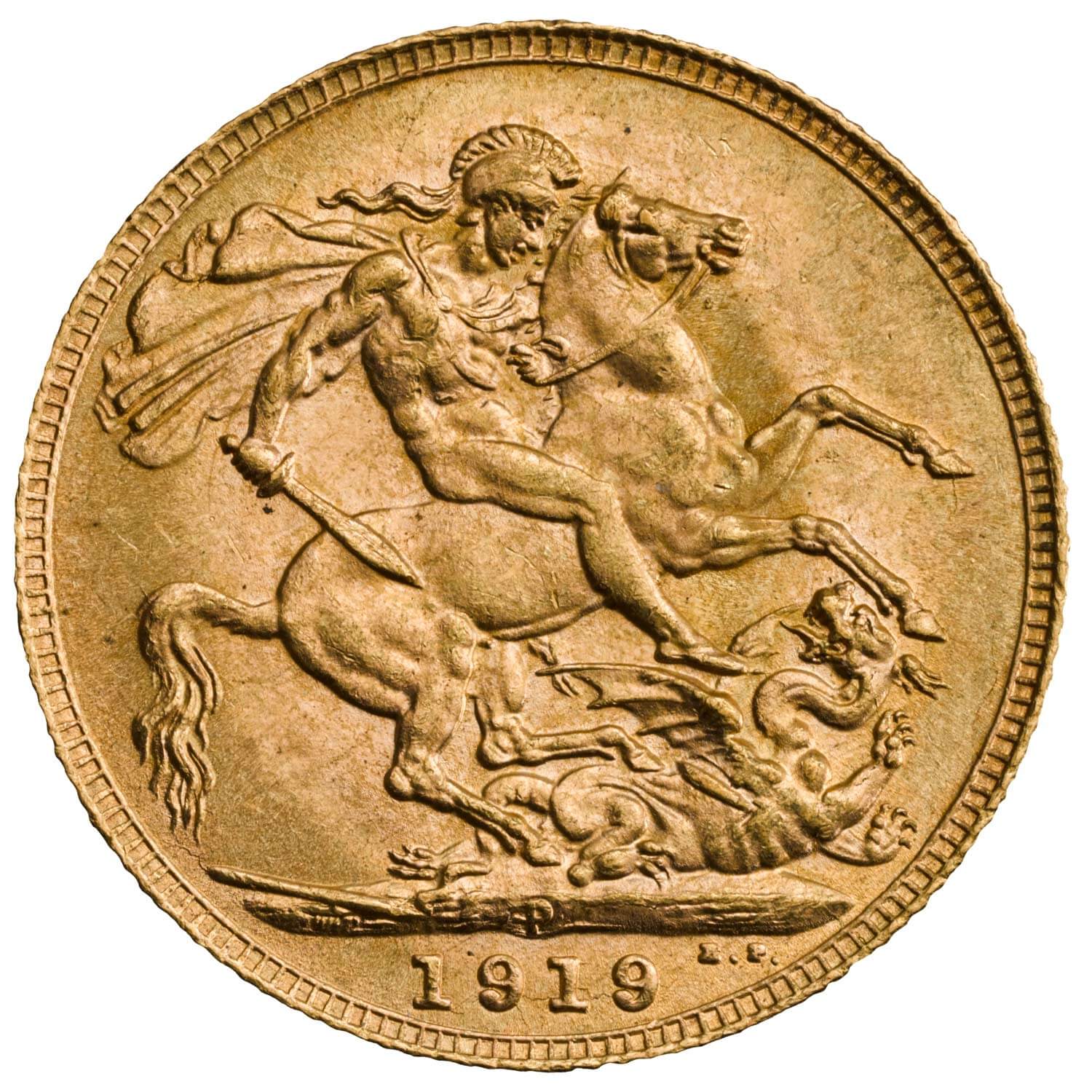
A one-ounce American Gold Eagle contains a guaranteed troy ounce of fine gold backed by the U.S. Mint. No custodian, no blockchain, no counterparty. Central banks hold over 36,000 tonnes in bars, not fund shares, and the total has grown every year since 2010.
Physical gold costs more than spot. Here’s what premiums actually look like right now across online dealers:
| Coin | Purity | Premium Range | IRA Eligible |
|---|---|---|---|
| American Gold Eagle | .9167 (22k) | 4–7% over spot | Yes |
| American Gold Buffalo | .9999 (24k) | 5–8% over spot | Yes |
| Canadian Gold Maple Leaf | .9999 (24k) | 3–5% over spot | Yes |
| Austrian Gold Philharmonic | .9999 (24k) | 3–5% over spot | Yes |
| South African Krugerrand | .9167 (22k) | 3–5% over spot | Yes |
Gold bars run 2–4% over spot for 1 oz, 1.5–3% for 10 oz. Bars are always lower than coins because they’re cheaper to produce.
Premium differences of 1–3% between dealers are common. At $4,500/oz, that’s $45–90 per coin. The closest-to-spot gold page shows which dealer is cheapest right now.
The Cost Comparison Most Articles Get Wrong
Conventional wisdom says ETFs are cheaper than physical gold. That analysis treats the coin premium as a sunk cost, and it’s wrong.
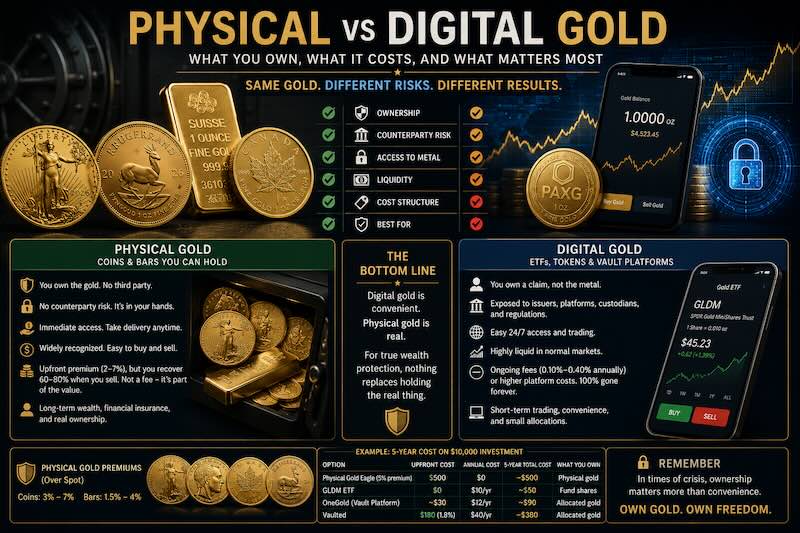
When you sell a Gold Eagle or Maple Leaf, you typically sell at spot plus a premium. You don’t recover the full buy-side premium, but on widely recognized sovereign coins, sellers typically recover 60–80% of what they paid. The net cost — the portion you don’t get back — is usually 1–2%, not 4–7%.
Here’s how that changes the math on a $10,000 position held for five years:
| Method | Upfront | Annual | 5-Year Total | On Sale |
|---|---|---|---|---|
| Physical Gold Eagle (5% prem.) | $500 | $0 (self-stored) | ~$500 | Recover ~$300–400 |
| GLDM ETF | $0 | $10/yr | ~$50 | $0 — no metal |
| GLD ETF | $0 | $40/yr | ~$200 | $0 — no metal |
| OneGold | ~$30 spread | $12/yr | ~$90 | ~$30 spread |
| Vaulted | $180 (1.8%) | $40/yr | ~$380 | $180 (1.8%) |
GLDM is cheapest at ~$50 over five years, but you hold fund shares, not gold. For actual metal ownership, OneGold (~$120 all-in) and physical gold stored at home (~$100–200 net after premium recovery) are essentially tied. Vaulted ends up more expensive than buying a coin at a competitive dealer price.
Premiums are not fees. The premium on a Gold Eagle is partially embedded in its resale value. An ETF expense ratio is gone forever.
When Paper and Physical Diverge
In calm markets, the price of a Gold Eagle and the price of GLD move together. In stress, they split.
March 2020: Gold ETFs sold off 13–14% from their February highs as leveraged investors scrambled for cash and met margin calls. At the same time, physical premiums at dealers jumped. The metal got harder to buy even as the paper price fell.
April 2025: Same thing, worse. Paper gold dropped on forced liquidations. Physical premiums hit levels not seen in decades. Dealers reported shortages.
This has happened twice in five years. Paper gold moves on financial market plumbing — margin calls, forced selling, ETF redemption mechanics. Physical gold moves on real demand from people who want the metal. Under enough stress, they go in opposite directions.
If you’re using gold as a short-term hedge, an ETF handles it fine. If you’re holding gold against the kind of scenarios where the financial system is under real pressure, paper claims have a track record of behaving differently than the metal they’re supposed to represent.
Why Central Banks Hold Bars, Not Fund Shares
France repatriated its gold from U.S. custody between mid-2025 and early 2026. Not speculation — a sovereignty decision. A major Western government decided that holding its own gold mattered more than the convenience of leaving it in someone else’s vault.
Central banks collectively hold over 36,000 tonnes of physical gold bars, growing every year since 2010. No ETF shares. No tokens. No vault platform accounts. Bars.
When you hold physical gold, no institution sits between you and the asset. Nobody can freeze it, gate redemptions, or rehypothecate it. Whether that matters to you depends on what you think gold is for. For central banks, the answer has been clear for over a decade.
What to Buy If You Go Physical
Lowest premium per ounce: Gold bars from PAMP Suisse, Valcambi, or the Royal Canadian Mint. Always cheaper than coins.
Best global liquidity: The Canadian Gold Maple Leaf. Pure .9999 gold, recognized worldwide, and consistently one of the lowest premiums among sovereign coins.
U.S. standard / IRA eligible: The American Gold Eagle. Most widely traded gold coin in the United States. Higher premium than Maple Leafs, but unmatched domestic liquidity.
24-karat from the U.S. Mint: The American Gold Buffalo. The only .9999 gold coin from the U.S. Mint.
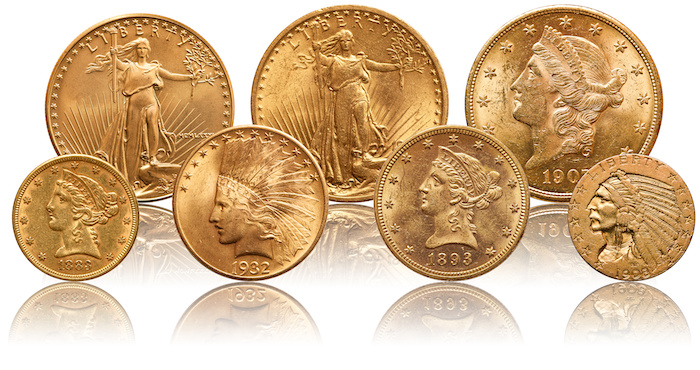
Historical character: Pre-1933 U.S. gold coins — $2.50 Quarter Eagles, $5 Half Eagles, $10 Eagles, $20 Double Eagles. Gold content plus historical premium for investors who value provenance.
Whichever product you choose, compare premiums across dealers first. At $4,500 per ounce, a 1% premium difference is $45 per coin. The gold price comparison page shows what every major dealer is charging right now.
Matching the Method to What You Need
Short-term hedge or trading position: GLDM or GLD. You need price exposure, not metal.
Long-term wealth preservation: Physical gold. No counterparty, no dependency on institutions. Store it yourself or in a depository.
Metal ownership, no storage hassle: OneGold or BullionVault. Allocated, insured, with delivery available when you want it. Not the same as possession, but a real step up from an ETF.
Gold in a retirement account: ETFs are the simple path. For physical metal in an IRA, Gold Eagles, Buffalos, and Maple Leafs all qualify for self-directed precious metals IRAs.
Dollar-cost averaging small amounts: OneGold ($1 min), Vaulted ($10 min), or Glint. Build up to a full ounce, then consider converting to physical.
A lot of experienced investors hold both: ETFs for tactical positions and tax-advantaged accounts, physical metal for the portion of their wealth that isn’t supposed to depend on the financial system working correctly.
The Point
Digital gold tracks the price. Physical gold is the thing the price measures. In normal markets, the difference is academic. When markets break, it’s not.
If you choose physical, compare premiums before every purchase — the savings on one ounce can exceed what you’d pay in ETF fees for an entire year.