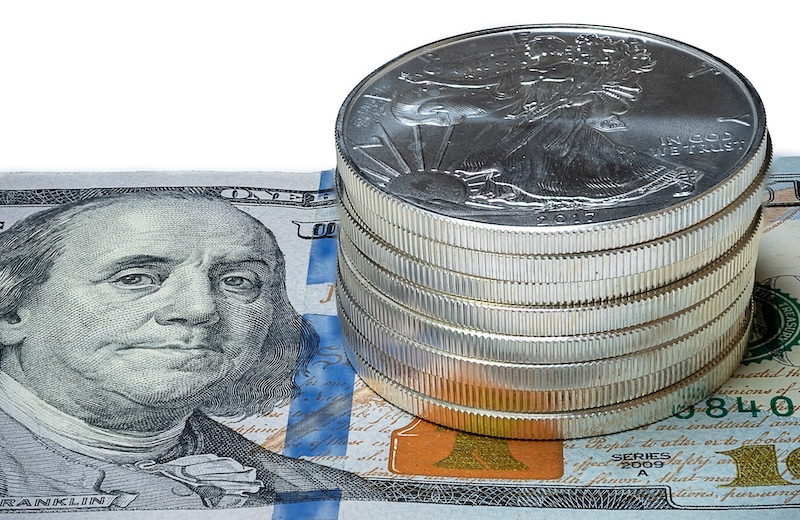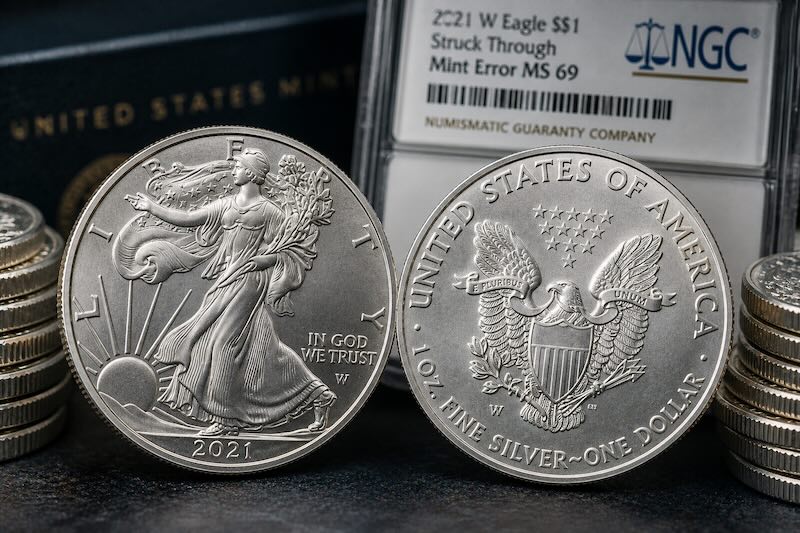
The American Silver Eagle is the most widely collected bullion coin in the world, with over 600 million struck since the series launched in 1986. The U.S. Mint runs tight quality control on the program, so the errors that do slip through tend to draw serious collector attention. A Silver Eagle with a verified minting defect sits at the intersection of the bullion market and the error coin market, and the right example can be worth many times its silver content.
Error coins are not damaged coins. A Silver Eagle that was scratched in a junk drawer is worth melt. A Silver Eagle that left the Philadelphia or West Point Mint with a design flaw caused by a malfunctioning die, a misaligned strike, or foreign material caught between the planchet and the press is a manufacturing defect, and when authenticated by NGC or PCGS, those are the coins collectors chase.
How Silver Eagle Errors Happen
The Mint strikes American Silver Eagles at high volume and high speed. Modern coining presses cycle rapidly, and the dies take enormous pressure with each strike. Over thousands of impressions, things go wrong. A die cracks. Foreign material falls onto the planchet. The collar that constrains the coin’s diameter shifts or fails. Two dies come together without a blank between them, transferring ghost images of each design onto the opposing die.
Each of these failures produces a different category of error, and each has its own collector following.
Known Silver Eagle Error Coins
Die Clash Errors — A die clash occurs when the obverse and reverse dies strike each other without a planchet in between. The impact transfers a faint, mirrored impression of each design onto the opposite die, and every coin struck from those dies afterward carries the transferred image. The most dramatic known example is a 2016 Silver Eagle certified by NGC that shows “LUR” and “BUS” from “E PLURIBUS UNUM” transferred from the reverse to the obverse. It remains the most severe die clash NGC has documented on any U.S. bullion coin, and the coin is currently unique. A related group of about 20 die-clashed 2017 Silver Eagles turned up in a single roll, showing slightly less severe clashing from the same type of error.
Struck-Through Errors — These occur when foreign material, such as cloth fibers, metal fragments, grease, or shop debris, sits on the die or planchet during striking. The obstruction blocks part of the design from being fully impressed, leaving a visible depression or blank area on the finished coin. Struck-through errors are the most common Silver Eagle error type and have been certified across multiple years. Recent examples include 2022, 2023, 2024, and 2025 coins graded MS69 by NGC, with certified pieces typically selling in the $450 to $1,000 range depending on the size of the obstruction and any special designations like First Day of Issue.
2008-W Reverse of 2007 — When the Mint updated the reverse die for the 2008 production year, about 47,000 Burnished Uncirculated 2008-W Silver Eagles were struck with leftover 2007-dated reverse dies. The U.S. Mint later confirmed that 15 incorrect dies were used before the mistake was caught. The error is identifiable by the letter “U” in “United” on the reverse — the 2007 die lacks a serif on the lower right of the letter. This variety is recognized by both NGC and PCGS and trades in a wide range depending on grade: uncirculated examples start around $500 to $750, while higher-graded pieces (MS70) have sold for over $3,000.
2021 Type 1 / Type 2 Transitional Varieties — The 2021 redesign of the Silver Eagle reverse, the first change in the series’ 35-year history, created a one-time window where mismatched Type 1 and Type 2 dies could theoretically have been paired. No confirmed transitional error (a coin struck with a Type 1 die on one side and a Type 2 die on the other) has been authenticated by NGC or PCGS as of mid-2026. However, the 2021 production year remains significant because both designs were actively in use at the same facility, and collectors continue to search for transitional pieces.
Off-Center Strikes and Broadstrikes — An off-center strike happens when the planchet is not seated in the collar before the dies engage, producing a coin with the design shifted partially off the blank. A broadstrike occurs when the collar fails entirely, allowing the planchet to spread beyond its normal diameter under striking pressure. Both error types are rare on Silver Eagles and bring strong premiums when certified.
Die Cracks, Cuds, and Die Chips — As dies wear, they develop stress fractures that show as raised lines on finished coins. A cud, a more severe form of die break, appears as a raised blob of metal where a piece of the die face has broken away entirely. These errors range from subtle to dramatic depending on the severity of the break.
What Collectors Should Know
Authentication matters more than anything else in this market. Post-mint damage is routinely misrepresented as minting errors, and Silver Eagles are a frequent target because of their high base value. Any Silver Eagle error worth collecting should be submitted to NGC or PCGS for professional grading and error attribution. A certified error in an NGC or PCGS holder sells for multiples of what a raw, unverified coin would bring.
If you primarily buy Silver Eagles for the metal, error coins are still worth watching for when you break open rolls or monster boxes. A struck-through error or minor die clash might not look like much at first glance, but a grading submission can turn a bullion-priced coin into something worth several hundred dollars or more.
Related Guides
- American Silver Eagles — Compare Prices
- 2026 American Silver Eagle: Buyer’s Guide for the Semiquincentennial Year
- Silver Eagle Special Editions & Anniversary Sets Guide
- Coin Grading: The Sheldon Scale & NGCX
- Understanding NGC and PCGS Grading for Pre-1933 Gold Coins