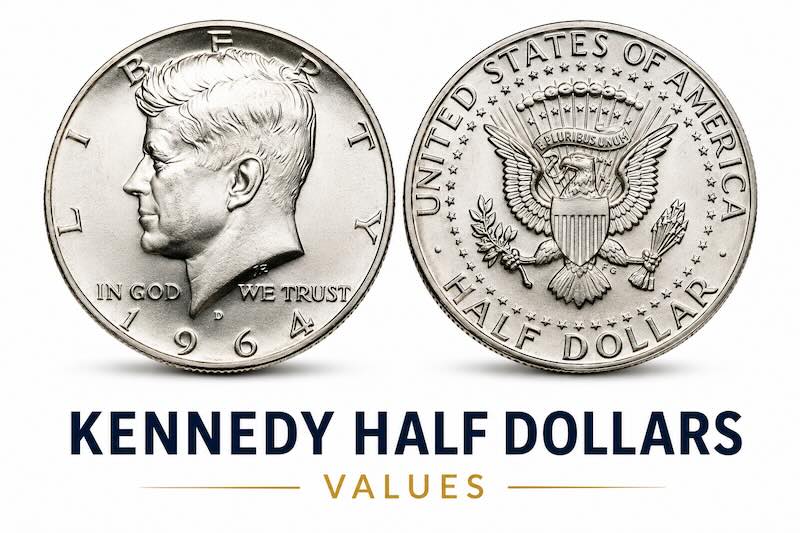
Kennedy half dollars have been struck every year since 1964, but what each coin is worth depends almost entirely on its date. A 1964 Kennedy contains 0.3617 troy ounces of 90% silver. A 1972 Kennedy contains none at all. That single variable, silver content, separates coins worth $15+ from coins worth fifty cents.
This guide breaks down Kennedy half dollar values by year, explains the three composition eras, and shows you how to calculate what your coins are worth based on today’s silver spot price.
Three Eras of Kennedy Half Dollars
The U.S. Mint changed the Kennedy half dollar’s composition twice, creating three groups that determine whether a coin has any silver value.
1964: 90% Silver
The first Kennedy halves were struck in 90% silver, the same alloy used for U.S. half dollars since the late 1830s. Each coin weighs 12.50 grams and contains 0.3617 troy ounces of pure silver. These are the most valuable Kennedy halves for bullion buyers.
1965 to 1970: 40% Silver
The Coinage Act of 1965 eliminated silver from dimes and quarters but kept a reduced silver content in half dollars. These coins use a silver-clad sandwich: an outer layer of 80% silver bonded to an inner core of 21% silver. Each coin weighs 11.50 grams and contains 0.1479 troy ounces of pure silver, roughly 40% of a 1964 coin’s silver weight.
1971 to Present: Copper-Nickel Clad
Starting in 1971, the Mint removed all silver from circulation-strike half dollars. These coins use the same copper-nickel clad composition as modern quarters and dimes. They contain no precious metal and are worth face value in circulated condition.
The exception: silver proof Kennedy halves struck at the San Francisco Mint from 1992 to present. From 1992 through 2018, these collector coins used the original 90% silver composition. Starting in 2019, the Mint switched to .999 fine silver for proof sets. Either way, silver proofs are sold through collector sets, not released into circulation.
How to Tell If Your Kennedy Half Dollar Is Silver
Before looking up values, determine which era your coin falls into.
Check the date. If the coin reads 1964, it is 90% silver. If it reads 1965 through 1970, it is 40% silver. If it reads 1971 or later, it is clad (unless it is an S-mint proof from 1992 onward).
Check the edge. This is the fastest confirmation. A 1964 half dollar has a solid silver edge with no visible color change. A 1965-1970 half dollar shows a thin line of copper visible at the rim where the silver-clad layer meets the copper core. A clad coin from 1971 onward has a thick copper-orange stripe on the edge.
Weigh the coin. A 1964 Kennedy weighs 12.50 grams. A 40% silver Kennedy weighs 11.50 grams. A clad Kennedy weighs 11.34 grams. A basic kitchen scale accurate to 0.1 grams is enough to distinguish them.
For a detailed breakdown of silver coin identification across all denominations, see our guide on collecting 90% silver half dollar coins.
1964 Kennedy Half Dollar Value
The 1964 Kennedy half dollar is the coin that started the series and remains the one most people ask about. Two mints produced them: Philadelphia (no mint mark) and Denver (D mint mark on the reverse, below the eagle’s tail feathers).
Mintage: Approximately 277 million from Philadelphia and 156 million from Denver, for a combined total exceeding 430 million coins. Despite those production numbers, the coins were hoarded almost immediately after release. The public demand following President Kennedy’s assassination meant most 1964 halves went straight into dresser drawers rather than cash registers.
Silver content: 0.3617 troy ounces of .900 fine silver. You can check the current 1964 Kennedy half dollar melt value on our live calculator, which updates with the spot price.
What they’re worth:
| Condition | 1964 (P) Value | 1964-D Value |
|---|---|---|
| Circulated (AG-VF) | Silver melt value | Silver melt value |
| AU (About Uncirculated) | Melt + $1-3 | Melt + $1-3 |
| MS63 (Uncirculated) | $20-$30 | $20-$30 |
| MS65 | $30-$80 | $30-$80 |
| MS66 | $80-$200 | $80-$200 |
| MS67+ | $200-$500+ | $200-$500+ |
The vast majority of 1964 Kennedy halves in circulation are worth their silver melt value, nothing more. The mintage was simply too large for common examples to carry a numismatic premium. Only coins in MS66 or higher grade begin to separate from melt.
If you own 1964 Kennedy halves and want to sell based on silver content, our silver melt value calculator shows what your coins are worth at the current spot price and helps you compare dealer buy-back offers.
Several rare 1964 Kennedy varieties, including the Accented Hair Proof and the 1964-D Doubled Die Obverse (DDO FS-101), carry premiums of hundreds to thousands of dollars. We cover those in detail in our Kennedy half dollar key dates and errors guide.
1965 Kennedy Half Dollar Value
The 1965 Kennedy was the first year of 40% silver composition. Approximately 65.9 million coins were struck. No mint marks were used on any 1965-1967 coins; the Mint temporarily suspended mint mark usage as part of the Coinage Act of 1965 reforms, so coins from Philadelphia and Denver are indistinguishable.
Silver content: 0.1479 troy ounces of silver. Check the live 40% Kennedy half dollar melt value on our calculator.
| Condition | Value |
|---|---|
| Circulated | Silver melt value |
| MS63 | $4-$8 |
| MS65 | $15-$30 |
| MS66+ | $50-$200 |
The 1965 Kennedy is common in all grades. Most are worth their 40% silver melt value. The only 1965 halves that command premiums are coins grading MS66 or higher, and SMS (Special Mint Set) specimens, which have a slightly different finish than regular business strikes.
1966 Kennedy Half Dollar Value
Similar to 1965 in composition and availability. Mintage: 108.9 million. No mint mark.
| Condition | Value |
|---|---|
| Circulated | Silver melt value |
| MS63 | $4-$8 |
| MS65 | $15-$30 |
| MS66+ | $75-$250 |
SMS specimens from 1966 special mint sets can bring $10-$20 in average condition and up to $100+ with deep cameo contrast.
1967 Kennedy Half Dollar Value
The last year without mint marks and the final year of the Special Mint Set program. Mintage: 295.0 million, the highest of any 40% silver Kennedy.
| Condition | Value |
|---|---|
| Circulated | Silver melt value |
| MS63 | $4-$6 |
| MS65 | $12-$25 |
| MS66+ | $50-$150 |
Due to the enormous mintage, 1967 Kennedy halves are among the most common 40% silver coins in existence. They are readily available in rolls and bags from bullion dealers. FBP tracks 40% silver Kennedy half dollar prices across dealers so you can compare premiums.
1968 Kennedy Half Dollar Value
Mint marks returned in 1968, but only the Denver Mint (D) produced business-strike half dollars that year, with a mintage of approximately 246.9 million. Philadelphia did not strike half dollars for circulation in 1968 or 1969. The San Francisco Mint (S) began producing proof Kennedy halves in 40% silver.
| Condition | 1968-D Value |
|---|---|
| Circulated | Silver melt value |
| MS65 | $12-$25 |
| MS66+ | $50-$150 |
The 1968-S proof halves in 40% silver are worth $8-$15 in typical proof condition, with deep cameo examples bringing $20-$50.
1969 Kennedy Half Dollar Value
The 1969-D had a lower mintage of 129.9 million, making it slightly scarcer than other 40% silver dates but still common enough that circulated examples are worth only melt value.
| Condition | 1969-D Value |
|---|---|
| Circulated | Silver melt value |
| MS65 | $15-$30 |
| MS66+ | $75-$200 |
1970 Kennedy Half Dollar Value
The 1970-D Kennedy is the sleeper of the 40% silver era. It was produced only for mint sets and not released into general circulation. Mintage was just 2.15 million, making it the lowest-mintage Kennedy half dollar from the silver era by a wide margin.
| Condition | 1970-D Value |
|---|---|
| MS63 | $15-$20 |
| MS65 | $30-$60 |
| MS66 | $75-$200 |
| MS67+ | $300+ |
The 1970-D is the one date in the 40% silver run where the coin itself carries a premium well above melt, even in lower uncirculated grades. If you find one in a junk silver bag or a collection, set it aside rather than selling it at melt.
1971 to 1974 Kennedy Half Dollar Values
Starting in 1971, all circulation-strike Kennedy halves switched to copper-nickel clad. These coins contain no silver and are worth face value in circulated condition.
| Year | Mintage (P+D) | Circulated | MS65 | MS66+ |
|---|---|---|---|---|
| 1971 | 457.3M | $0.50 | $3-$5 | $15-$50 |
| 1971-D | (included above) | $0.50 | $3-$5 | $15-$40 |
| 1972 | 295.1M | $0.50 | $3-$5 | $15-$50 |
| 1972-D | (included above) | $0.50 | $3-$5 | $15-$40 |
| 1973 | 148.1M | $0.50 | $3-$5 | $20-$60 |
| 1973-D | (included above) | $0.50 | $3-$5 | $20-$60 |
| 1974 | 266.2M | $0.50 | $3-$5 | $15-$50 |
| 1974-D | (included above) | $0.50 | $3-$5 | $15-$40 |
The only coins from this era worth more than face value are uncirculated examples in original mint sets or rolls, and even those typically sell for just a few dollars. Two error varieties stand out: the 1972 (no mint mark) Doubled Die Obverse (FS-101), with visible doubling on “TRUST” and “LIBERTY,” sells for $100-$850+ depending on grade. The 1974-D also has a Doubled Die Obverse variety worth $100-$300 in MS65. See our key dates and errors guide for details on both.
1776-1976 Bicentennial Kennedy Half Dollar Value
The Bicentennial Kennedy half dollar features a special reverse design by Seth Huntington showing Independence Hall. These coins carry a dual date “1776-1976” and were produced in both 1975 and 1976. No 1975-dated Kennedy halves exist.
Two versions were made:
Copper-nickel clad (Philadelphia and Denver): Mintage exceeded 521 million. These are worth face value in circulated condition and $2-$5 in uncirculated grade.
40% silver clad (San Francisco): Approximately 11 million struck for collector sets. These contain 0.1479 troy ounces of silver and are worth their silver melt value plus a modest collector premium of $5-$10.
| Version | Circulated | MS/PR 65 | MS/PR 67+ |
|---|---|---|---|
| Clad (P or D) | $0.50 | $3-$5 | $15-$50 |
| Silver (S) | Silver melt + $3 | $10-$15 | $25-$75 |
The Bicentennial halves are extremely common. Despite being popular with non-collectors who assume they are rare, the half-billion-plus mintage makes them one of the most available Kennedy varieties.
1977 to Present: Modern Clad Kennedy Half Dollars
From 1977 to 2001, the Mint continued producing Kennedy halves for general circulation, though they were increasingly uncommon in everyday commerce. From 2002 to 2020, Kennedy halves were produced only for collector products (mint sets, proof sets, rolls, and bags ordered directly from the Mint). In 2021, the Mint resumed shipping half dollars to the Federal Reserve for general circulation.
Most modern clad Kennedy halves are worth face value. Exceptions are limited to:
- Proof coins from annual proof sets: $3-$10 in typical condition
- Silver proofs (1992-present, S-mint, 90% silver through 2018, .999 silver from 2019): worth silver melt value ($10-$15 at current spot) plus a $3-$10 collector premium
- High-grade business strikes (MS67+): $10-$50 for common dates, more for scarce dates
- The 1998-S Matte Finish: The key modern rarity, worth $150-$3,000+ depending on grade (see our key dates guide)
How to Calculate Your Kennedy Half Dollar’s Melt Value
If your coin is from 1964 or 1965-1970, its floor value is tied to the price of silver. Here is the math:
1964 (90% silver): Weight (12.50g) x 0.900 purity / 31.1035 (grams per troy oz) = 0.3617 troy oz silver. Multiply by today’s spot price.
1965-1970 (40% silver): Total silver content = 0.1479 troy oz. Multiply by today’s spot price.
You do not need to do this math yourself. Our silver coin melt value calculator runs these calculations live for 1964 Kennedy halves, and we have a separate page for 40% silver Kennedy halves. Both update automatically with the current spot price and show what each coin is worth in silver right now.
If you are looking to sell silver Kennedy halves, our silver melt value calculator also shows dealer buy-back pricing so you can compare offers before accepting a price.
Where to Buy Silver Kennedy Half Dollars
Kennedy halves are one of the most liquid silver coins on the secondary market. They trade in standard quantities:
- $1 face value = 2 coins (1964: 0.7234 oz silver; 1965-70: 0.2958 oz silver)
- $10 face value roll = 20 coins
- $100 face value bag = 200 coins
Premiums over melt are typically 3-10% on 1964 coins when purchased in roll or bag quantities. The 40% silver halves (1965-1970) often carry lower premiums since they require more coins to accumulate the same silver weight.
FBP tracks live pricing on 1964 Kennedy half dollars and 40% silver halves across dealers, so you can sort by lowest premium and buy at the best available price.
Kennedy Half Dollars vs. Other Silver Half Dollars
The Kennedy half is the youngest of four 20th-century silver half dollar series. Each has its own value profile:
| Series | Years | Silver | Typical Circulated Value |
|---|---|---|---|
| Barber Half Dollar | 1892-1915 | 90% | Melt + 20-50% premium |
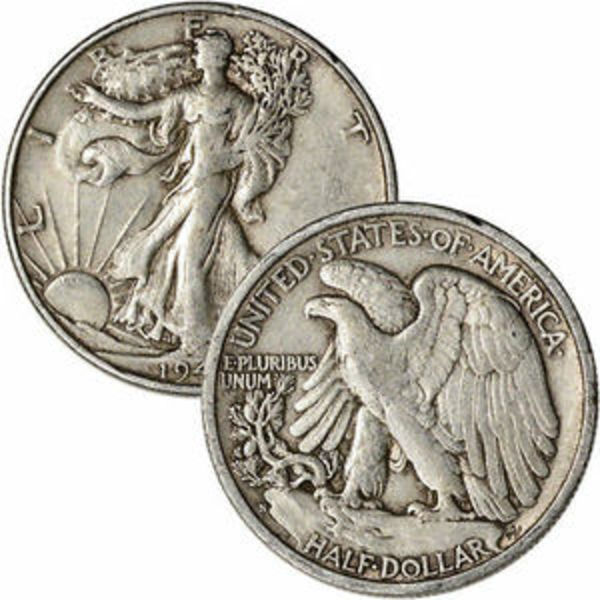
| Walking Liberty Half Dollar | 1916-1947 | 90% | Melt + 10-30% premium |
| Franklin Half Dollar | 1948-1963 | 90% | Melt + 5-15% premium |
| Kennedy Half Dollar | 1964 | 90% | Melt + 3-10% premium |
| Kennedy Half Dollar | 1965-1970 | 40% | Melt + 0-5% premium |
Kennedy halves consistently trade at the lowest premiums among 90% silver half dollars because of their massive mintage and modern appearance. For silver stackers focused purely on accumulating ounces at the lowest cost over spot, Kennedy halves are often the best value in the half dollar category. Browse all available silver half dollars in our Silver Half Dollars collection.
Frequently Asked Questions
How much is a 1964 Kennedy half dollar worth? In circulated condition, a 1964 Kennedy half dollar is worth its silver melt value. Each coin contains 0.3617 troy ounces of 90% silver. Check the current value on our 1964 Kennedy melt value calculator. Uncirculated examples in MS65 or higher can sell for $30-$500+ depending on grade.
What makes a 1964 Kennedy half dollar rare? Standard 1964 Kennedy halves are not rare. Over 430 million were produced. What makes certain 1964 Kennedys valuable is condition (MS67+), or a die variety like the Accented Hair Proof or the DDO FS-101. See our key dates and errors guide for details on these varieties.
How much is a 1967 Kennedy half dollar worth? A 1967 Kennedy half dollar contains 40% silver (0.1479 troy oz) and is worth its silver melt value in circulated condition. Check the current 40% silver Kennedy melt value. In MS65, expect $12-$25.
How much is a 1971 Kennedy half dollar worth? A 1971 Kennedy half dollar is copper-nickel clad with no silver content. In circulated condition, it is worth face value: fifty cents. Uncirculated examples in MS65 bring $3-$5.
What makes a 1971 Kennedy half dollar rare? Standard 1971 Kennedy halves are not rare. Over 457 million were produced between Philadelphia and Denver. There are no widely recognized error varieties for 1971 that carry large premiums, though individual die cracks or minor doubling can occasionally interest variety collectors.
How much is a 1972 Kennedy half dollar worth? Like the 1971, the 1972 Kennedy is a clad coin worth face value in circulated condition. MS65 examples sell for $3-$5. However, the 1972 (no mint mark) has a well-known Doubled Die Obverse variety (FS-101) worth $100-$850+. Check our key dates and errors guide for identification tips.
How much silver is in a 1964 Kennedy half dollar? Exactly 0.3617 troy ounces of .900 fine silver. The coin weighs 12.50 grams total, of which 11.25 grams is pure silver.
Are Kennedy half dollars still made of silver? Only the silver proof versions struck at the San Francisco Mint. These have been available in silver proof sets since 1992 (90% silver through 2018, .999 fine silver from 2019). All circulation-strike Kennedy halves from 1971 onward are copper-nickel clad with no silver content.
What is a 1776-1976 Kennedy half dollar worth? The Bicentennial Kennedy half dollar with the Independence Hall reverse was produced in huge numbers (521+ million clad coins). Clad versions are worth face value. The 40% silver San Francisco versions are worth their silver melt value plus a small premium.
Should I sell my Kennedy half dollars for silver or collect them? If your coins are common-date 1964 halves in circulated condition, they are worth more as silver than as collectibles. Use our silver melt value calculator to check current buy-back pricing. If you have coins from 1970-D, 1998-S Matte Finish, or any recognized error variety, have them evaluated for numismatic value before selling for melt.