On July 15, 2026, Treasury Secretary Scott Bessent announced that the U.S. Mint will begin striking a new $1 coin featuring President Donald Trump as part of the nation’s 250th anniversary celebrations.
The night before, Bessent had previewed the coin during a Fox News interview with Jesse Watters, giving the host a tour of a secret 1863 Treasury vault and showing the finished coin design on camera.
The coin joins a growing lineup of <a href=”/blog/us-semiquincentennial-coin-collection/”>2026 Semiquincentennial coins and commemoratives</a> already in production, but it carries a distinction no other modern U.S. coin can claim: it places a living, sitting president on American coinage for the first time in a century.
The last time this happened was 1926, when Calvin Coolidge appeared on the Sesquicentennial half dollar. Everything that has happened in the 100 years between those two coins is part of this story.
What the Coin Actually Is (and What It Is Not)
Bessent’s announcement called it a “$1 gold coin,” and that language spread through social media within hours. For bullion buyers and coin collectors, the wording matters, so here is the distinction.
This is a manganese-brass clad dollar coin. It uses the same composition and dimensions as every dollar coin the Mint has produced since the Sacagawea dollar launched in 2000: a copper core with outer layers of manganese brass that give the coin its golden color. It is not struck in gold. It does not contain gold. The “gold” in Bessent’s tweet refers to the coin’s appearance, not its metal content.
The coin has a face value of $1 and a metal value measured in cents. If you are looking for gold content, this is not that coin. (There is a separate 24-karat gold commemorative in the pipeline, covered below.)
For reference, the same manganese-brass composition is used in the Sacagawea dollars, the Presidential $1 coins, and the Native American $1 coins that have circulated since 2000. The Trump dollar will be the same size, weight, and edge lettering style as those coins.
The Final Design
The U.S. Mint had posted several candidate designs on its media kit page for the Semiquincentennial $1 coin. Based on Bessent’s announcement and the images released on July 15, the Mint selected from the designs recommended by the Commission of Fine Arts in a January 2026 letter to Mint Director Paul Hollis.
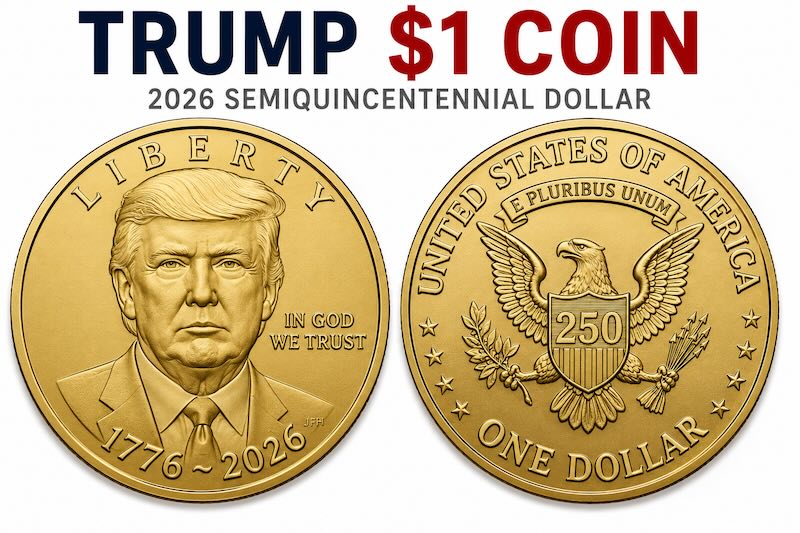
Obverse: A forward-facing portrait of President Trump in a suit and tie. “LIBERTY” arcs across the top of the coin. “IN GOD WE TRUST” appears to the right of the portrait. “1776 ~ 2026” curves along the bottom, marking the 250th anniversary span. Designer initials “JFH” appear below the bust.
Reverse: A heraldic eagle with spread wings and a shield on its breast. “UNITED STATES OF AMERICA” curves along the top. “E PLURIBUS UNUM” appears on a ribbon above the eagle. The number “250” is displayed on the shield, marking the Semiquincentennial. “ONE DOLLAR” appears at the bottom, with stars around the rim.
The CFA had recommended obverse design #3 and reverse design #5 from the candidate pool. The final coin appears to match those recommendations.
When the Treasury first released draft designs in October 2025, FBP covered the initial concepts in The New Trump $1 Coin Drafts: What Collectors Should Know. Those early drafts included a different reverse showing Trump with a raised fist and the phrase “FIGHT FIGHT FIGHT,” referencing remarks made after the 2024 assassination attempt. That design drew immediate scrutiny, both politically and legally, and the Mint moved to traditional eagle imagery for the final reverse.
The Legal Framework
The legal basis for this coin is the Circulating Collectible Coin Redesign Act of 2020, which Trump signed during his first term. That law authorizes the U.S. Treasury to issue special coins and medals for the 2026 Semiquincentennial, with designs “emblematic of the United States semiquincentennial.” The coins must be minted within the 2026 calendar year.
Placing a living president on the coin raises questions that go back more than 150 years.
The 1866 Thayer Amendment prohibits the use of living persons’ portraits on U.S. currency. Historically, this restriction has been applied primarily to paper money produced by the Bureau of Engraving and Printing. Treasury’s position is that coins and paper currency fall under different sections of federal law, so the paper-money restriction does not automatically extend to numismatic or circulating coins.
The Presidential $1 Coin Act of 2005 requires that any president featured in the Presidential $1 Coin Series must have been deceased for at least two years. Treasury argues this requirement applies only to that specific program, not to the separate Semiquincentennial authorization.
The 2020 Act itself contains a restriction: the reverse of certain 2026 coins may not include a head-and-shoulders portrait or bust of any person, living or dead, and no portrait of a living person may appear on the reverse. This explains why the early “FIGHT FIGHT FIGHT” reverse was abandoned in favor of eagle designs. Trump’s portrait appears only on the obverse, which the Mint maintains falls within the law.
In December 2025, Senators Jeff Merkley (D-Ore.) and Catherine Cortez Masto (D-Nev.) introduced the Change Corruption Act, which would have banned the likeness of any living or sitting president on U.S. currency. That bill did not advance.
The Coolidge Precedent: 1926
The only historical parallel is the 1926 Sesquicentennial of American Independence half dollar, struck to mark the 150th anniversary of the Declaration of Independence.
That coin placed President Calvin Coolidge alongside George Washington on the obverse, making Coolidge the first (and until now, only) living president to appear on a U.S. coin. The coin was a 90% silver commemorative, not a general circulation issue, and it was authorized through a special act of Congress.
The Coolidge coin was controversial at the time, too. George Washington himself had argued against placing living leaders on American coinage, viewing the practice as monarchical. The Philadelphia Mint struck 1,000,141 Sesquicentennial half dollars, but public reception was mixed and a large portion went unsold.
Today, the 1926 Sesquicentennial half dollar is a collectible piece valued between $80 and $200 in typical circulated grades, with higher-grade examples reaching into the thousands. Its historical significance as the “living president” coin has kept collector interest alive for a full century.
The Trump dollar now becomes the second data point in that history.
The Separate 24-Karat Gold Commemorative
Distinct from the $1 circulating coin, the Mint is also producing a 24-karat gold commemorative coin featuring Trump. This is a different program entirely.
Only 47 of these gold coins will be struck, each containing a substantial amount of gold (at current spot prices, the raw gold content per coin is estimated near $90,000). The design shows Trump in a suit, leaning forward over a desk with his fists on the table. The image is based on a Daniel Torok photograph that was placed in the Smithsonian National Portrait Gallery. The Commission of Fine Arts, composed of Trump appointees, approved the design unanimously in March 2026.
These coins were originally planned for release around the July 4th Semiquincentennial celebrations, but production has been delayed. No release date or pricing has been announced. Given the limited mintage of 47, these will be targeted at high-end collectors and institutions rather than the broader numismatic market.
If you see the phrase “Trump gold coin” in news coverage, check whether the source means the $1 brass circulating coin or the 47-piece 24-karat commemorative. They are completely different products at completely different price points.
What to Expect as a Collector
Bessent’s announcement said the Mint will begin striking the coins with the possibility of reaching circulation “as soon as this fall.” A few things to watch for.
Mintage numbers have not been announced. The 2020 Act authorizes the coins to be minted during the 2026 calendar year, which means production could run from now through December 31. Unlike the July 4th privy quarter with its capped 250,000 mintage, the $1 coin could see production in the millions if demand supports it.
Distribution method is also unclear. Will these be available at banks like standard dollar coins? Sold through the Mint’s online store as collector items? Distributed through the Federal Reserve’s normal channels? The answers will affect both availability and premiums.
Secondary market pricing will depend heavily on mintage, packaging, and whether the Mint offers special finishes (proof, reverse proof, uncirculated). The Presidential $1 coins from 2007-2016 are widely available for a few dollars each in most grades, but those had multi-year production runs with mintages in the hundreds of millions. If the Trump dollar has a more limited run tied strictly to the 2026 anniversary, collector premiums could be higher.
Grading service interest is guaranteed. Both PCGS and NGC will likely create special labels for this coin, similar to the America250 labels used for other Semiquincentennial issues. First-day-of-issue, first strike, and early release designations will carry premiums, as they always do.
The Broader 2026 Coin Program
The Trump $1 coin joins an already busy Semiquincentennial year from the Mint. Other 2026 releases include the redesigned circulating coins (penny, nickel, dime, quarter, half dollar), the 2026 American Silver Eagle with its dual “1776 ~ 2026” dating, and the five-design quarter program that includes the July 4th privy quarter.
Between redesigned circulating denominations, commemoratives, bullion issues, and now a politically charged dollar coin, the 2026 program is shaping up to be the most active year for U.S. coinage since at least the 1976 Bicentennial.
For bullion buyers watching gold prices and tracking premiums across the market, the key takeaway on the Trump $1 coin is simple: the brass dollar is a numismatic collectible, not a bullion product. The 24-karat commemorative is where the gold content lives, but at 47 coins worldwide, most collectors will never hold one.
Related Reading
- The New Trump $1 Coin Drafts: What Collectors Should Know. Our October 2025 coverage of the original draft designs, including the “FIGHT FIGHT FIGHT” reverse that was later dropped.
- The $5,000 Quarter Hunt: PCGS and NGC Bounties on the 2026 July 4th Privy Quarter. Another Semiquincentennial coin with serious collector interest.
- 2026 Morgan and Peace Dollar Reverse Proof: July 9 Release Guide. The latest collector release from the Mint.
- 2026 American Silver Eagle: Complete Buyer’s Guide. The flagship bullion coin with Semiquincentennial markings.
- Valuable 1776-1976 Bicentennial Quarters. The last time America marked a milestone anniversary on its coinage.
- Live Gold and Silver Spot Prices. Track today’s gold spot price and compare premiums.