The 1945 penny holds special significance in American numismatic history. As the final year of wartime penny composition and the last of the shell casing copper-zinc alloy coins minted during World War II, the 1945 wheat penny represents a fascinating transitional period. The following year, the U.S. Mint would return to standard copper composition, making 1945 pennies uniquely positioned at the intersection of military necessity and industrial normalization.
Whether you’ve discovered a 1945 penny in circulation or inherited one from a collection, understanding its value requires knowledge of mint marks, grades, and the subtle characteristics that distinguish common specimens from valuable rarities.
At a Glance
- Mint Marks: P (Philadelphia), D (Denver), S (San Francisco)
- Total Mintage: 1.49 billion coins across all three mints
- Composition: 70% copper, 30% zinc (recycled shell casing material)
- Common Values: $0.02–$0.04 (circulated); $1.74–$1.92 (MS-60)
- High-Grade Records: Up to $20,400 for exceptional red specimens
- Key Error: Doubled Die Obverse (FS-101) worth $100–$500+
- Best Grade Indicators: Deep red color and sharp details command premium prices
1945 Penny Value by Grade and Mint Mark
| Grade | 1945-P | 1945-D | 1945-S |
|---|---|---|---|
| Good (G-4) | $0.02 | $0.02 | $0.02 |
| Fine (F-12) | $0.02 | $0.02 | $0.03 |
| Extremely Fine (EF-40) | $0.03 | $0.03 | $0.04 |
| About Uncirculated (AU-50) | $0.50 | $0.55 | $0.60 |
| Mint State 60 (MS-60) | $1.88 | $1.92 | $1.74 |
| Mint State 63 (MS-63) | $3.50 | $4.25 | $3.75 |
| Mint State 65 (MS-65) | $8.00 | $9.50 | $8.50 |
| Mint State 67 Red (MS-67RD) | $200–$500 | $300–$650 | $150–$400 |
Values represent typical market ranges as of April 2026. High-grade red designations command significant premiums over standard grades.
Historical Significance: The Final Year of Wartime Composition
The 1945 penny occupies a unique position in American coinage history. Throughout World War II, the U.S. Mint faced critical copper shortages as the military required massive quantities for ammunition, wiring, and other munitions. In 1944, the Mint initiated production of pennies using recycled shell casing material—a copper-zinc-manganese composition that gave these coins their distinctive brassy appearance.
This wartime composition continued through 1945, making it the final year of this experimental alloy. When the Mint returned to standard 95% copper composition in 1946, the transition marked not only a technical shift but symbolized America’s transition from wartime to peacetime production. This historical significance, combined with the distinctive appearance of these coins, makes 1945 pennies especially desirable to collectors studying WWII-era numismatics.
The 1945 penny was produced at three facilities:
- Philadelphia (P): No mint mark; 1,040,515,000 coins minted
- Denver (D): D mint mark; 266,268,000 coins minted
- San Francisco (S): S mint mark; 181,770,000 coins minted
Despite the massive mintage totals, high-grade examples—particularly those retaining original red luster—remain scarce due to handling and oxidation over eight decades.
How to Identify a 1945 Penny
Visual Characteristics
A genuine 1945 penny exhibits several diagnostic features:
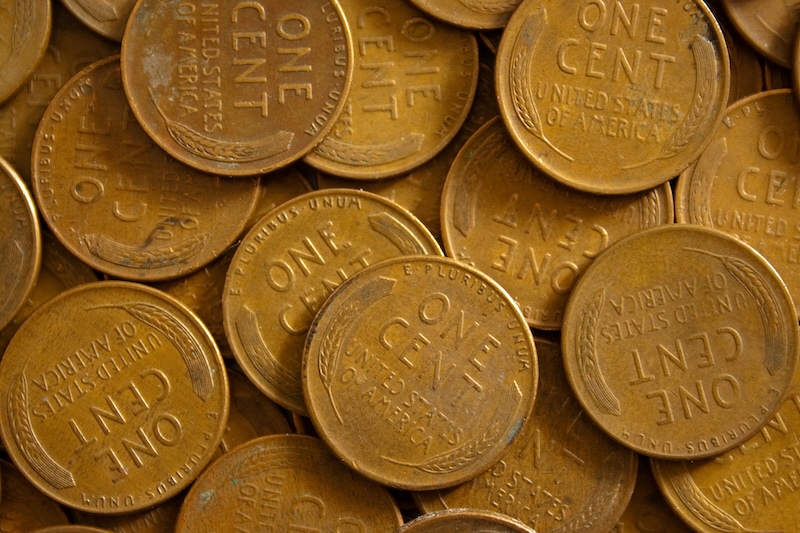
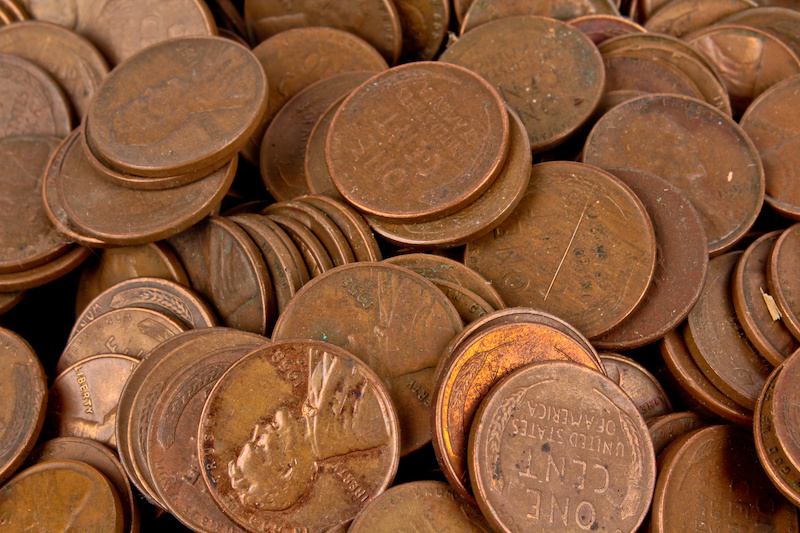
Brassy Appearance: The wartime zinc-copper composition creates a noticeably brassy or slightly yellowish tone compared to the warm reddish tones of standard copper pennies. This distinctive color is the most obvious identifier of 1945 wartime composition coins.
Weight: 1945 pennies weigh approximately 3.1 grams. Standard copper pennies (1946 onward) also weigh 3.1 grams, so weight alone cannot distinguish them. The visual appearance of the metal itself provides the most reliable identification.
Sharp Striking: Pennies from the Philadelphia Mint’s presses in 1945 often exhibit sharp, well-defined strikes with good detail on Liberty’s hair and the wheat ears on the reverse.
Mint Mark Locations
All U.S. pennies from this era display their mint marks just below the date on the obverse. On 1945 pennies:
- P mint mark (Philadelphia): Absent; Philadelphia pennies bore no mint mark
- D mint mark (Denver): Appears as a clear “D” just below the date
- S mint mark (San Francisco): Appears as a clear “S” just below the date
Carefully inspect your penny under magnification. Mint marks from 1945 are generally well-struck and clearly visible.
Identifying Mint Marks and Mintage Distribution
The mintage distribution reveals important information about availability:
1945-P (Philadelphia): The most abundant, with 1.04 billion coins produced. Most circulated examples trade for face value to a few cents. Uncirculated examples remain relatively affordable for a wartime penny.
1945-D (Denver): 266 million coins minted. Slightly more available in high grades than the S mintmark variant. Values typically range 5-10% above the P variety in equivalent grades.
1945-S (San Francisco): The scarcest of the three, with 182 million coins minted. Higher population in better grades, but still scarce in MS-65 and above.
Known Errors and Varieties
Beyond the standard production, several 1945 penny errors command significant premiums from specialized collectors:
1945 Doubled Die Obverse (FS-101)
The most famous 1945 error involves doubling on the obverse side. The distinctive doubling appears on LIBERTY and the phrase IN GOD WE TRUST, with secondary images noticeably offset from the primary design elements. This error resulted from a die that received multiple striking impressions during the hubbing process.
Value Range: $100–$500+, depending on grade and the prominence of the doubling effect. Well-struck examples with clear doubling command the higher end of this range. This error appears on 1945-P coins exclusively.
Identification: Examine the lettering carefully under magnification. The doubling is most obvious on LIBERTY and GOD WE TRUST. Lesser doubling may appear on the date and other reverse elements.
1945-S/D Overmintmark Error
A scarce variety exists where an “S” punch was used initially on dies subsequently used at the Denver Mint, creating an S over D (S/D) overmintmark. This error reflects a die reuse that occurred during mint operations.
Value Range: $50–$200, depending on the clarity of the overmintmark and overall condition.
Identification: The overmintmark appears below the date. Examine carefully—the S should be partially visible beneath or above the D.
Wrong Planchet Error
In 2015, Heritage Auctions documented a 1945-D penny struck on a Netherlands East Indies planchet—a metal blank intended for Dutch colonial coinage. This remarkable error represents one of the most dramatic minting mistakes ever recorded.
Notable Sale: A 1945-D on Netherlands East Indies planchet realized $7,050 at Heritage Auctions in 2015. This represents the ceiling for 1945 error prices.
Why So Valuable: Wrong planchet errors are extraordinarily rare, often appearing only once per decade across all U.S. coinage. The specificity of the Dutch colonial planchet adds numismatic significance.
Cud and Die Break Errors
Die cracks and cuds (breaks where a section of the die is missing, creating a raised blob of metal on the coin) appear occasionally on 1945 pennies. These errors formed as dies aged and fractured during production.
Value Range: $200–$660+, depending on the size and prominence of the error. Large, dramatic cuds command premium prices.
Appearance: Look for raised lines or blobs on the coin’s surface, typically on the obverse. Cuds appear as raised sections without corresponding design details.
Lamination Errors
Lamination errors occur when layers of the planchet separate during the striking process, leaving a raised “flake” of metal. These errors are less common on 1945 pennies than on later issues but do occur.
Value Range: $90–$200, depending on size and prominence.
Identification: A lamination error appears as a bent or raised flake of metal along an edge, sometimes with a missing section of design.
Clipped Planchet Errors
When a planchet fails to advance properly in the blanking press, a partial clip results. These coins are struck but missing a visible segment of the circular edge.
Value Range: $25–$300, depending on the size of the clip. Small clips (less than 5% of the diameter) are less valuable than substantial clips.
Appearance: A portion of the coin’s circular edge is simply missing, creating an irregular profile.
High-Grade Premiums and Record Auction Sales
Red designation coins—those retaining original copper color with no oxidation—command extraordinary premiums. The most exceptional 1945 pennies have realized remarkable prices at major auction houses.
Record-Setting Sales
1945-P MS-67+RD: Heritage Auctions recorded a sale of $20,400 on December 18, 2022. This coin represents the highest-grade 1945 penny from Philadelphia ever certified, with exceptional luster and original red coloring that had been protected from oxidation for nearly eight decades.
1945-D MS-68-RD: Heritage Auctions sold an exceptional Denver example for $14,400 on January 14, 2019. The MS-68 grade places this coin in the top tier for this mint mark.
1945-S MS-68-RD: A San Francisco example achieved $6,600 at Heritage Auctions on January 19, 2025. This recent sale demonstrates sustained collector demand for high-grade wartime pennies.
Understanding Red Designations
The “RD” designation (Red) indicates that a coin retains 95% or more of its original copper color. This is remarkable given that 1945 pennies are composed of 70% copper and 30% zinc—a mixture more prone to oxidation than standard copper pennies.
Coins that have oxidized to a brown or dark brown color receive “BN” (Brown) designations and command far lower premiums, typically trading at a fraction of Red designation values. The distinction between a Red and Brown example can represent a difference of hundreds or thousands of dollars in value.
Grading Guide for 1945 Pennies
Understanding grading standards helps collectors evaluate their coins and understand market values.
Circulated Grades
Good (G-4): Worn, with Liberty mostly worn away but the profile still recognizable. Date and mint mark are clear.
Fine (F-12): More wear, with about 50% of design details visible. Liberty’s hairlines show some detail. Wheat ears are worn but separated.
Extremely Fine (EF-40): Moderate wear with Liberty showing good detail on the hair and face. The wheat ears show full separation and clear definition. The coin displays approximately 75% of original luster.
About Uncirculated (AU-50): Minimal wear, with light friction on the highest points (Liberty’s cheek and the wheat ears). The coin shows approximately 90% of original luster.
Uncirculated Grades
MS-60 (Mint State): Technically uncirculated but with visible bag marks and imperfections from handling in mint bags. Original luster is present but may be dull in areas.
MS-63: Light bag marks visible under magnification. Original luster is more consistent than MS-60. The coin appears nearly perfect to the unaided eye.
MS-65: Minimal bag marks, only visible under magnification. Excellent luster and eye appeal.
MS-67: Virtually no visible bag marks. Exceptional luster and eye appeal. This grade represents the top tier for most collector examples.
MS-68 and above: Virtually perfect with only the most microscopic imperfections. These grades are extraordinarily rare for 1945 pennies and command prices reflecting their scarcity.
Red vs. Brown Designations
Red (RD): Original copper color with minimal oxidation (95% red or more). Coins in this condition are rare and desirable.
Brown (BN): Oxidized to various shades of brown. More common than Red designations but less desirable to collectors.
Red and Brown (RB): Mixed coloration showing both original red areas and oxidized brown areas.
When evaluating a 1945 penny, prioritize the presence of original red color above all other factors. A lower grade Red coin often commands prices comparable to or exceeding a higher grade Brown example.
Frequently Asked Questions
What is my 1945 penny worth?
The value depends on mint mark and condition. Circulated examples typically trade for $0.02–$0.04. Uncirculated examples range from $1.74 to $1.92 for MS-60 grade. High-grade Red examples can exceed $500. Professional grading and encapsulation through PCGS or NGC provides an accurate assessment.
How can I tell if my 1945 penny is rare?
Look for the mint mark (D or S) and examine the color—Red specimens are scarcer than Brown ones. Compare your coin to examples on PCGS’s price guide or NGC’s database. If you notice any unusual doubling, cuds, or other errors, have it evaluated by a professional grader.
Should I clean my 1945 penny?
Never clean a 1945 penny. Cleaning removes original surface details and dramatically reduces value. Even professional graders will detect cleaning and reduce grades accordingly. Collectors strongly prefer coins in original condition, however dark they may appear.
Why are 1945 pennies different in color?
The wartime composition of 70% copper and 30% zinc creates a distinctly brassy appearance compared to standard copper pennies. This color difference is a feature, not a defect, and represents the coin’s historical significance.
Where can I sell my 1945 penny?
Circulated specimens can be sold to local coin dealers or online marketplaces like eBay. Uncirculated or error examples should be submitted to professional graders (PCGS or NGC) and marketed through reputable auction houses like Heritage Auctions or Stack’s Bowers. Professional authentication and grading significantly enhances saleability.
What makes the 1945-P MS-67+RD worth $20,400?
This exceptional coin combines several desirable factors: the P mint mark (most visible), the MS-67+ grade (representing the highest tier), the +RD designation (100% original red color), and exceptional eye appeal. Coins of this caliber appear once per decade at auction, driving significant competition among serious collectors.
Related Articles
Expand your knowledge of penny values across the 1940s decade:
- 1940s Penny Values Guide — Comprehensive pillar resource for the entire decade
- 1941 Penny Value — Wartime composition continues; notable rarities
- 1942 Penny Value — Steel penny transition year; key varieties
- 1943 Penny Value — Rare steel penny year; premium for copper examples
- 1944 Penny Value — Wartime composition; transition errors
Sources and References
This guide incorporates data from authoritative numismatic sources:
- PCGS Price Guide – 1945 Pennies
- NGC Grading Standards
- Heritage Auctions – 1945 Penny Auction Records
- USA Coin Book – 1945 Penny Value
Last updated: April 2026
This article reflects current market values and grading standards as of the publication date. Coin values fluctuate based on market demand, grading standards, and collector preferences. Always consult current price guides and professional graders for the most accurate valuations.