The 1999 Georgia State Quarter is one of the original five state quarters released by the U.S. Mint in the first year of the 50 State Quarters Program. While most circulated examples are worth face value, certain error coins and varieties from the 1999 Georgia issue have sold for hundreds and even thousands of dollars. Understanding what to look for can help you identify whether a 1999 Georgia quarter in your collection is a common coin or a valuable error worth having professionally graded.
1999 Georgia Quarter Design, History, and Mintage
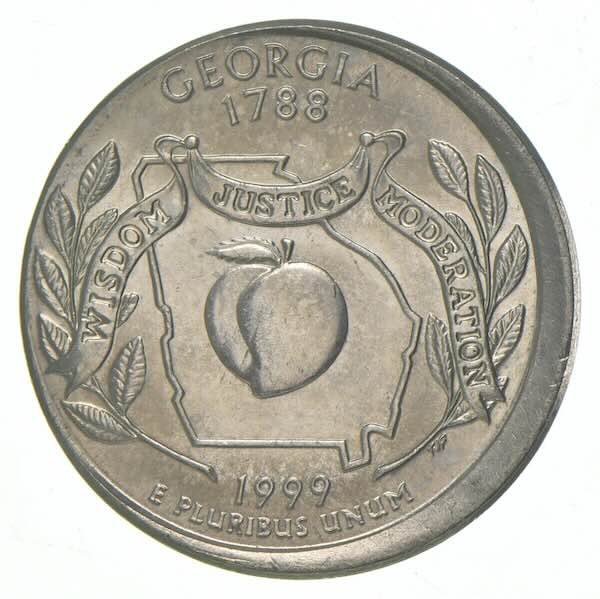
The Georgia State Quarter was released on July 19, 1999, as the fourth coin in the 50 State Quarters Program. The reverse design features a peach at the center, flanked by live oak branches, with a state outline and banner bearing the Georgia motto “Wisdom, Justice, Moderation.” The obverse retains the standard John Flanagan George Washington portrait used on all state quarters.
| Variety | Mintage |
|---|---|
| 1999-P Georgia Quarter (Philadelphia) | 451,188,000 |
| 1999-D Georgia Quarter (Denver) | 488,744,000 |
| 1999-S Clad Proof | 3,713,359 |
| 1999-S Silver Proof | 804,565 |
With a combined business strike mintage of over 939 million coins, the 1999 Georgia quarter is readily available in circulated condition. However, error coins, high-grade uncirculated examples, and silver proof versions command premiums above face value.
1999 Georgia Quarter Value by Grade
Standard 1999 Georgia quarters without errors are copper-nickel clad coins worth face value in circulated grades. Uncirculated examples and proof coins carry modest premiums.
| Variety | Grade | Estimated Value |
|---|---|---|
| 1999-P or 1999-D (Circulated) | VF-35 to AU-58 | $0.25 (face value) |
| 1999-P or 1999-D (Uncirculated) | MS-63 | $3 – $5 |
| 1999-P or 1999-D (Gem) | MS-65 | $8 – $15 |
| 1999-P or 1999-D (Superb Gem) | MS-67+ | $50 – $300 |
| 1999-S Clad Proof | PR-69 DCAM | $5 – $12 |
| 1999-S Silver Proof | PR-69 DCAM | $20 – $40 |
1999 Georgia Quarter Silver Proof
The 1999-S Silver Proof Georgia Quarter was struck in 90% silver at the San Francisco Mint with a mintage of 804,565 coins. Each silver proof contains 0.18084 troy ounces of pure silver, giving it a base melt value of approximately 10.29. Silver proofs are identified by the “S” mint mark and their mirror-like proof finish. In PR-69 Deep Cameo (DCAM) condition, these coins typically sell for $20 to $40, while perfect PR-70 DCAM examples can reach $75 to $150.
1999 Georgia Quarter Error Coins Worth Money
The enormous mintage of 1999 Georgia quarters across two mints resulted in several documented error varieties. These are the error types most likely to carry significant value.
Experimental Planchet Errors (Most Valuable)
The most valuable 1999 Georgia quarter errors are coins struck on experimental planchet stock intended for testing the Sacagawea dollar composition. These coins appear in a golden or olive tone rather than the standard silver color, weigh 5.9 to 6.3 grams (versus the normal 5.67 grams for a clad quarter), and may appear slightly thicker than a standard quarter. Authenticated examples have sold for up to $10,000 at auction. If you find a 1999 Georgia quarter with an unusual golden color, weigh it immediately — if it falls outside the standard 5.67 gram weight, it may warrant professional authentication.
Missing Clad Layer Errors
Missing clad layer errors occur when one of the outer copper-nickel cladding layers fails to bond to the copper core during the planchet manufacturing process. The result is a coin with exposed copper visible on one side, giving it a distinctly reddish or brownish appearance. Missing clad layer errors on 1999 Georgia quarters are valued at $170 to $800, depending on whether the obverse or reverse clad is missing and the coin’s overall condition.
Off-Center Strike Errors
Off-center strikes result from misalignment between the planchet and dies during the striking process. Value depends heavily on the percentage of off-center strike and whether the date and mint mark remain visible. A 5% to 15% off-center 1999 Georgia quarter is worth $20 to $50. Dramatically off-center examples in the 40% to 60% range with a readable date can bring $150 to $300 or more at auction.
Die Cracks and Die Chips
Die cracks appear as raised lines on the coin’s surface caused by stress fractures in the die. On the 1999 Georgia quarter, notable die cracks have been documented above the ribbon area, within the motto letters, and along the peach outline. While minor die cracks add only a few dollars in value, dramatic die breaks or “cuds” (raised blobs at the rim where a piece of the die broke away) can be worth $50 to $100.
Broadstrike Errors
A broadstrike occurs when the coin is struck without the retaining collar that gives quarters their reeded edge. The result is a coin that appears slightly wider than normal with a smooth or distorted edge. Broadstrike errors on 1999 Georgia quarters are valued at $25 to $75 depending on condition.
1999 Georgia Quarter Error Value Summary
| Error Type | Estimated Value |
|---|---|
| Experimental Planchet (golden color) | $5,000 – $10,000+ |
| Missing Clad Layer | $170 – $800 |
| Off-Center Strike (5-15%) | $20 – $50 |
| Off-Center Strike (40-60%) | $150 – $300 |
| Die Crack / Chip | $5 – $100 |
| Broadstrike | $25 – $75 |
Other Valuable State Quarter Errors Worth Looking For
The 1999 Georgia quarter is not the only state quarter with valuable error varieties. Collectors should also watch for these well-known state quarter errors:
- 1999-P Delaware “Spitting Horse” — A die crack creates the appearance of liquid coming from the horse’s mouth. Values range from $20 to $500 depending on the stage of the die crack.
- 2004-D Wisconsin “Extra Leaf” — The most famous state quarter error. High Leaf and Low Leaf varieties sell for $400 to $1,500 or more.
- 2005 Minnesota “Extra Tree” DDR — A doubled die reverse creating an extra tree line. Values range from $100 to $600.
- 2015 Nebraska “Snow on the Roof” — A die chip on Chimney Rock creates a snow-like blob. Worth $100 to $600 in higher grades.
- 2020-W Quarters — Low-mintage West Point quarters from the America the Beautiful series. Worth $20 to $100+ in uncirculated condition.
How to Check Your 1999 Georgia Quarters for Errors
To evaluate whether your 1999 Georgia quarter has any valuable characteristics, follow these steps. First, weigh the coin using a precision scale — standard weight is 5.67 grams, and any significant deviation may indicate a planchet error. Second, examine the coin’s color: a golden or olive tone rather than the standard silver appearance could signal an experimental planchet. Third, use a magnifying glass or loupe to inspect both sides for doubling in the lettering, die cracks, or missing design elements. Fourth, check the edge for proper reeding (a smooth edge may indicate a broadstrike). If you identify any potential errors, consider submitting the coin to PCGS or NGC for professional authentication and grading, as certified error coins command higher prices than ungraded examples.
Related Coin Value Guides
- 1964 Quarter Value Guide
- 1965 Quarter Value Guide
- Bicentennial Quarters Worth Money
- 2022 American Women Quarter Errors
- Top 7 State Quarters Worth Money
- Which Quarters are Silver?
- What Dimes Contain Silver
- 1922 Silver Dollar Value Guide
- Silver Bullion Coins
Disclaimer: This article is for informational and educational purposes only and should not be considered financial or investment advice. Coin values are estimates based on recent auction results and market data and may vary depending on condition, buyer demand, and market conditions. Always consult a qualified numismatic professional before making significant purchasing or selling decisions. FindBullionPrices.com is a price comparison platform and does not buy or sell coins directly.